COMOROS COMPLETE TRAVEL GUIDE
The Union of the Comoros is one of Africa’s most intriguing yet least-known island nations, a volcanic archipelago floating in the Indian Ocean between northern Madagascar and the East African coast. It is a place where dramatic landscapes meet warm tropical seas, where centuries-old Swahili trade traditions blend with Arab, African, French, and Malagasy influences, and where the pace of life remains slow, authentic, and deeply connected to community and culture. Though the Comoros is relatively small in size and population, the richness of its natural environment, the complexity of its history, and the warmth of its people make it a uniquely rewarding destination for travelers seeking quiet beauty and cultural depth.
The Comoros consists of three main islands under its jurisdiction—Grande Comore (Ngazidja), Mohéli (Mwali), and Anjouan (Ndzuwani)—while a fourth island, Mayotte, remains under French administration. Each island has its own personality, landscapes, cultural traditions, and atmosphere. Grande Comore is the youngest geologically, dominated by the imposing Mount Karthala volcano, one of the most active in the world. Mohéli is the most pristine and peaceful, a sanctuary of biodiversity that holds one of the Indian Ocean’s most important marine parks. Anjouan is the most historic and traditional, filled with terraced hillsides, fragrant spice plantations, waterfalls, and villages that reflect centuries of Indian Ocean culture.
Despite its beauty, Comoros remains one of Africa’s least visited countries, meaning travelers who venture here often find themselves surrounded by untouched nature, secluded beaches, and a culture that has not been shaped by mass tourism. Instead, the islands offer a sense of discovery, intimacy, and authenticity that is increasingly rare in popular island destinations. The Comorians themselves are warm, hospitable, and community-oriented, proud of their heritage and eager to share it with respectful visitors.
This 6000-word guide explores Comoros in depth—its history, geography, culture, top attractions, biodiversity, marine life, cities, villages, and practical travel insights—creating a complete country page that fits perfectly within your Africa Destinations section on amazingbucketlist.com.
History of the Comoros
The history of the Comoros is long, layered, and influenced by centuries of migration, trade, colonization, and cultural exchange. Because the islands lie along ancient maritime routes linking East Africa, the Middle East, Madagascar, and the wider Indian Ocean world, they became a natural meeting place for people from different continents.
The earliest settlers of Comoros likely included Austronesian-speaking seafarers from Southeast Asia and Madagascar, as well as Bantu-speaking migrants from the African mainland. Over centuries, Arab traders and sailors also arrived, bringing Islam and establishing Comoros as an important stop in the Swahili trading network that stretched from Somalia to Mozambique. The islands became known for producing spices, coconuts, tortoise shells, and perfumes, especially ylang-ylang flowers, which would later play a key role in the islands’ economy.
By the 11th century, Islam had taken root, and the islands developed into a chain of Islamic Sultanates, each ruled by a sultan or local leader. These sultanates traded with Zanzibar, Kilwa, Oman, Persia, and India. Wealthy merchant families brought Islamic scholarship, architecture, and literacy, while local Bantu traditions blended with Arab customs to form a unique Comorian culture.
European interest in the Comoros began in the 16th century, with Portuguese, Dutch, and French ships stopping for provisions. By the 19th century, France had become the dominant European power in the region. The islands were drawn into the French colonial sphere as protectorates, eventually forming part of French overseas territories. Mayotte was the first to come under French control; over time, France annexed the remaining islands.
In 1975, Comoros declared independence from France, although Mayotte voted to remain French. Since then, the country has experienced political struggles, including coups and governance issues, but also periods of stability and cultural revival. Today, the Comoros maintains close ties with the Arab world, the African Union, and the Indian Ocean region, while working to preserve its heritage and natural environment.
Geography and Natural Beauty
Comoros is blessed with striking geography shaped entirely by volcanic activity. Each island reflects a different stage of volcanic evolution, giving the archipelago extraordinary diversity within a compact area.
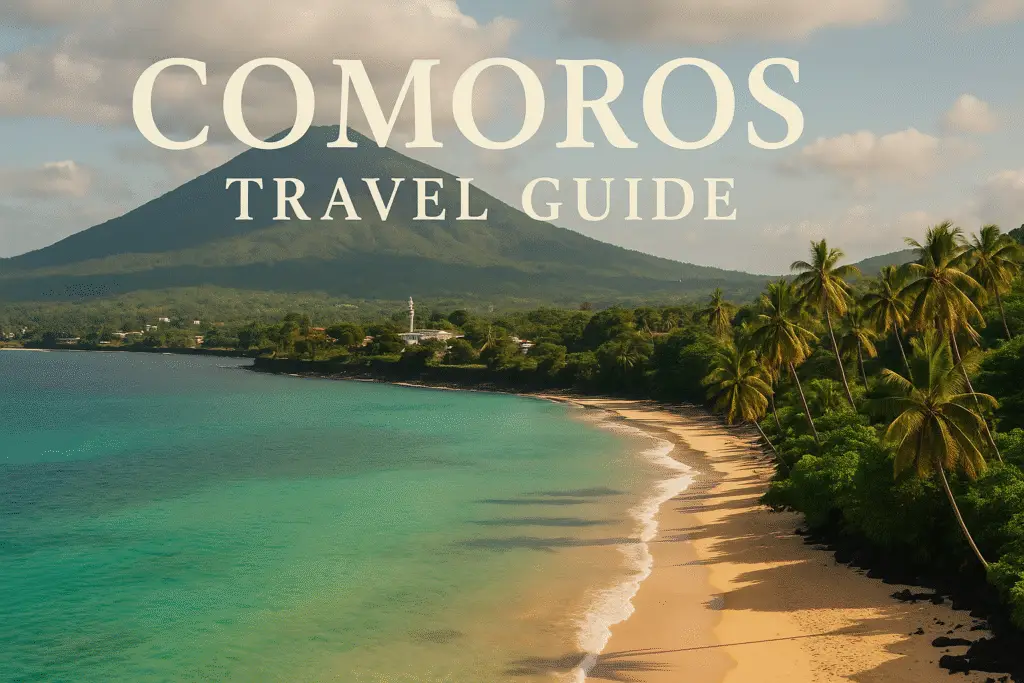
Grande Comore (Ngazidja) is the largest and youngest island, formed by Mount Karthala, a shield volcano that remains active. The landscape is rough and dramatic, dominated by hardened lava flows, volcanic rock fields, craters, and fertile slopes supporting villages, banana plantations, and ylang-ylang fields. The coastline mixes black volcanic beaches with luminous turquoise lagoons and coral reefs.
Mohéli (Mwali), the smallest island, is a tranquil paradise of rolling hills, untouched beaches, dense tropical forests, and bays where sea turtles and whales gather. The island is sparsely populated, giving it a peaceful, secluded atmosphere. Much of Mohéli is protected as the Mohéli Marine Park, one of the most biodiverse marine regions in the Indian Ocean.
Anjouan (Ndzuwani) is mountainous, green, and deeply atmospheric. Known historically as “The Perfume Island,” its slopes are terraced with clove trees, cinnamon, vanilla vines, and ylang-ylang plantations. Waterfalls tumble down its interior valleys, and coastal villages sit between lush hills and winding shorelines. The island’s volcanic peak, Mount Ntroungui, rises dramatically above the landscape.
Offshore, the Comoros are surrounded by coral reefs teeming with fish, turtles, rays, and seasonal humpback whales. The islands sit within the Mozambique Channel, a hotspot of marine biodiversity with warm, nutrient-rich waters. Mangrove forests cover parts of the coast, and seagrass beds provide habitat for dugongs, though they are rare.
Culture and People of the Comoros
Comorian culture is shaped by centuries of migration and blending. African, Arab, Malagasy, and French influences converge to form a society that is both traditional and cosmopolitan. The Comorian people are predominantly Muslim, and Islam plays a central role in daily life, from family gatherings to architecture to the rhythm of village life.
The societal structure is deeply communal. Families share responsibilities, neighbors help one another, and celebrations are public events that involve entire communities. Traditional music and dance remain vibrant. Wedding celebrations can last several days and include drumming, chanting, feasting, and the famous “grand marriage” traditions—elaborate ceremonies that highlight social status and community cohesion.
The Comorian language, Shikomori, is related to Swahili but has distinct influences from Arabic and Malagasy. French is widely spoken due to colonial history, and Arabic is used in religious contexts. This multilingual environment reflects the islands’ multicultural identity.
Craft traditions include wood carving, henna art, traditional embroidered clothing, and artisanal perfume production. Ylang-ylang, a fragrant flower used in luxury perfumes, grows in abundance and is processed in small distillation huts, producing essential oils exported worldwide.
Fishing is central to the culture. At dawn and sunset, fishermen take their wooden ngalawas into the lagoon, standing or paddling as their ancestors did. Markets sell freshly caught fish, coconuts, tropical fruits, yams, spices, and handmade goods.
Cities, Towns, and Villages
Moroni, the capital on Grande Comore, is a charming coastal city with whitewashed mosques, narrow alleys, and lively markets. The Old Friday Mosque, with its arched facade and stone minaret, is one of the most iconic buildings in the country and an example of early Islamic architecture in the Indian Ocean region. The Medina buzzes with trade, street food, and everyday life, offering visitors a close-up look at Comorian traditions.
Mitsamiouli, another town on Grande Comore, is known for its beaches, calm waters, and historic landmarks. Its nearby villages reflect rural Comorian life, with simple houses, fishing boats, and views of Mount Karthala.
On Mohéli, the village of Nioumachoua overlooks a stunning archipelago of small islands where turtles nest and dolphins swim. Fomboni, the island’s small capital, has a relaxed atmosphere and is surrounded by beautiful coastline.
Mutsamudu, the main town of Anjouan, features old fortifications, winding alleys, and vibrant markets. The old citadel and Arab-influenced architecture give the town a unique historic charm. Surrounding villages such as Bambao and Domoni offer insights into the island’s agricultural and cultural traditions.
Top Natural Highlights
The natural attractions of Comoros are numerous and diverse. Mount Karthala is one of the most impressive features—a massive shield volcano whose summit crater is accessible through challenging but rewarding hikes. The view from the top reveals ancient lava fields, calderas, and endless ocean horizons.
The beaches of Mohéli are extraordinary, with fine white sand, leaning palm trees, and warm, clear water ideal for snorkeling. In the Mohéli Marine Park, visitors can observe dolphins, sea turtles, and schools of fish in crystal lagoons. Humpback whales migrate through the waters around Mohéli and Grande Comore between July and October, offering dramatic breaching displays.
Anjouan’s waterfalls, such as those near Bambao or Tatinga, cascade through lush valleys surrounded by spice forests. The terraced hillsides are a testament to centuries of agriculture, blending natural beauty with human heritage.
Coral reefs encircle much of the archipelago, providing diving and snorkeling opportunities with minimal crowds. Reef fish, octopuses, rays, reef sharks, and colorful corals are common sightings. Seagrass beds host turtles and occasionally dugongs.
Mangrove forests along the coasts support birdlife and protect the shoreline from erosion. Inland forests contain endemic species found only in Comoros, including the Livingstone’s fruit bat—one of the world’s largest bats—which roosts in the highlands of Anjouan.
Wildlife, Marine Life, and Conservation
The Comoros are a biodiversity hotspot. While the land mammals are limited due to the islands’ isolation, the marine life is incredibly rich. The Mohéli Marine Park is the centerpiece of conservation efforts, established to protect coral reefs, fish populations, and nesting turtle sites. Green turtles and hawksbill turtles nest on Comorian beaches, often in large numbers.
The islands serve as a crucial passage for humpback whales, which migrate from Antarctica to warmer waters to give birth. Whale-watching tours offer respectful opportunities to observe these gentle giants.
Inland, the forests of Anjouan host rare species, including the massive Livingstone’s fruit bat, which has a wingspan of up to 1.4 meters. These bats roost on forested cliffs and play a crucial role in seed dispersal.
The birdlife of Comoros includes several endemic species such as the Comoro blue pigeon, Comoro fody, and various sunbirds. Wetlands, mangroves, and coastal ecosystems support herons, kingfishers, and migratory species.
Conservation challenges include deforestation, overfishing, and climate pressures. However, many local communities participate in marine protection efforts, especially on Mohéli, where community-led conservation has shown great success.
Comorian Cuisine
Comorian cuisine is flavorful, aromatic, and influenced by Swahili, Arab, French, and Malagasy traditions. The use of coconut milk, cloves, ginger, vanilla, bananas, breadfruit, cassava, and fresh seafood gives the cuisine a tropical character.
Rice is the staple of most meals, often accompanied by fish stews or spicy pilau rice flavored with cardamom and cinnamon. Langouste (local lobster) is a delicacy in coastal villages. Grilled fish, octopus dishes, and coconut curries are common. Snacks include fried bananas, cassava fritters, and pastries filled with spices.
Tea is widely consumed, especially sweet cardamom-infused chai. Fresh fruit juices made from mangoes, guavas, lychees, and papayas are popular.
Meals are often communal, reinforcing the importance of family and social unity.
Travel Practicalities
Traveling in the Comoros is rewarding but requires some preparation. Infrastructure is modest, and domestic flights or ferries connect the islands. Roads vary in condition, especially on Anjouan and Mohéli, but transportation is manageable with patience.
French is commonly spoken, making communication easier for Francophone travelers. English is limited but improving.
The climate is warm year-round, with a rainy season typically from November to April. The best time to visit for diving and whale-watching is between June and October.
Because the Comoros is not developed for mass tourism, travelers should expect simplicity—and in return, genuine culture, peaceful nature, and quiet beaches.
Conclusion: Why the Comoros Belong on Your Bucket List
The Comoros are one of Africa’s most magical yet least-explored destinations. From the volcanic majesty of Mount Karthala to the tropical beauty of Mohéli’s marine sanctuaries, from Anjouan’s terraced spice hills to Moroni’s historic mosques and markets, the islands offer a rare combination of authenticity, tranquility, and natural splendor.
Here, travelers find a place untouched by mass tourism, shaped by ancient trade routes, and blessed with some of the richest marine biodiversity in the Indian Ocean. The Comorian people welcome visitors with warmth, simplicity, and pride, sharing a culture that feels both timeless and deeply alive.
Comoros is a paradise for nature lovers, cultural explorers, divers, hikers, and anyone seeking a peaceful escape far from crowded beaches and commercial resorts. It is a place where every sunrise, waterfall, coral reef, and village carries a sense of discovery.
A journey to Comoros is not just a trip—it is an immersion into one of the world’s last quiet, beautiful island cultures.
Related Amazing Bucketlist Articles
- 5 Once-in-a-Lifetime Floating Stays
- Hurawalhi Island Resort
- Top 10 Most Romantic Countries in the World for Couples