
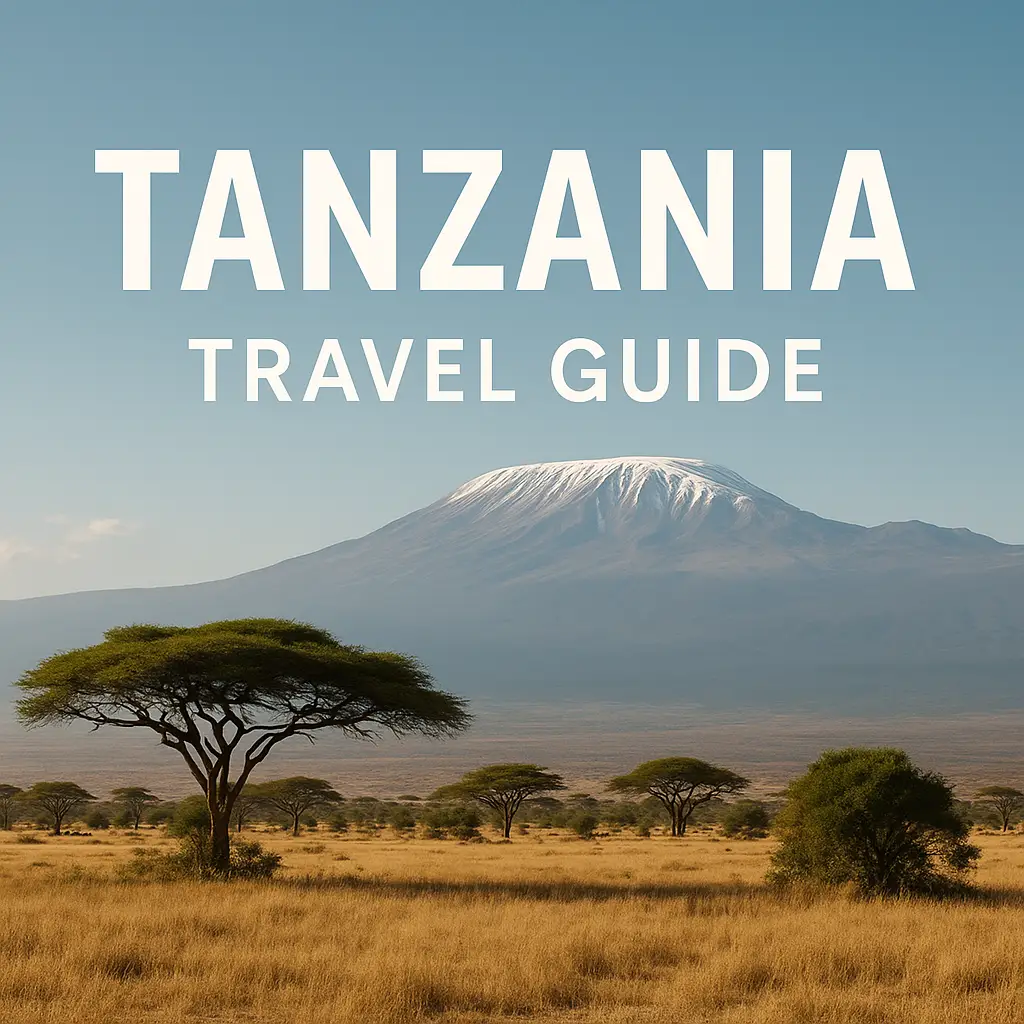
Tanzania Travel Guide
Tanzania is one of the most captivating destinations on Earth — a place where ancient landscapes, extraordinary wildlife, tropical islands, and vibrant cultures blend into a travel experience that feels raw, emotional, breathtaking, and timeless. From the perfect volcanic cone of Mount Kilimanjaro to the endless golden plains of the Serengeti, from the turquoise waters of Zanzibar to the deep crater floor of Ngorongoro, Tanzania offers some of the most dramatic and unforgettable scenery in the world. This is a country where elephants wander through acacia-dotted savannas, where lions rest beneath kopjes that rise from the earth like natural monuments, where millions of wildebeest migrate in an ancient circular rhythm, and where coral reefs shimmer beneath crystal-clear waves along palm-fringed shores. Few destinations can rival the sheer variety and emotional impact of Tanzania.
The country is home to some of the most famous national parks and natural wonders on the planet. The Serengeti National Park, perhaps the most iconic wildlife sanctuary in Africa, is a vast expanse of plains, woodlands, and rivers that stretch endlessly toward the horizon. Every year, the Great Migration — the largest movement of animals on Earth — sweeps through the Serengeti in a spectacular cycle of survival, drama, and raw power. Millions of wildebeest, zebras, and gazelles move across the plains in search of grass, followed closely by predators such as lions, hyenas, leopards, cheetahs, and crocodiles. The scale of this phenomenon is overwhelming, and witnessing it up close is one of the greatest wildlife experiences a traveler can ever have.
Just beyond the Serengeti lies one of the world’s most extraordinary natural features — the Ngorongoro Crater. Formed by a massive volcanic eruption millions of years ago, the crater is now a lush, self-contained ecosystem bursting with wildlife. Its steep walls rise dramatically around a fertile valley where elephants, rare black rhinos, lions, zebras, flamingos, and countless other species move across grasslands, swamps, forests, and lakes. The Ngorongoro Conservation Area feels like a prehistoric world preserved in time, and its beauty is so intense that many travelers describe it as the most magical place they have ever seen.
But Tanzania is far more than safaris. It is a country of mountains, coasts, cultures, islands, lakes, and cities that each offer their own distinctive atmosphere. Mount Kilimanjaro, the tallest mountain in Africa, rises dramatically from the Earth as a snow-capped peak towering above flat plains and farmlands. Standing over 5,800 meters high, Kilimanjaro is a bucket-list challenge for trekkers around the world — a mountain that requires endurance but does not demand technical climbing skills. Reaching the summit, Uhuru Peak, is a life-changing moment for many who attempt it. The mountain’s ecological zones — from rainforest to moorland to alpine desert to ice caps — make the journey as fascinating as the destination.
To the west sits Lake Tanganyika, one of the oldest and deepest lakes in the world, surrounded by mountains and thick tropical forests where chimpanzees roam in national parks like Gombe Stream and Mahale Mountains. These parks offer some of the most intimate primate encounters anywhere on the continent. In the south, the enormous Selous Game Reserve and Ruaha National Park provide vast, wild, and remote safari experiences far from the crowds, with lions, elephants, hippos, and rare wild dogs thriving in massive, untouched ecosystems. Tanzania’s southern circuit is perfect for travelers seeking solitude and authenticity.
And then, of course, there is Zanzibar — a jewel of the Indian Ocean whose beaches and culture have captured the imagination of travelers for centuries. The islands of the Zanzibar Archipelago are known for their turquoise lagoons, swaying palm trees, coral reefs teeming with life, and white-sand beaches that stretch for miles. Stone Town, a UNESCO World Heritage site, is the historical and cultural heart of Zanzibar — a labyrinth of narrow streets, carved wooden doors, mosques, markets, and the lingering influence of Arab, Persian, Indian, and African heritage. Zanzibar is a place of spice farms, dhow boats sailing at sunset, and warm tropical nights scented with cloves and sea breeze. It is one of the most romantic and atmospheric island destinations in the world.
Throughout the country, Tanzanian culture is warm, welcoming, and deeply rooted in tradition. More than 120 ethnic groups live within Tanzania’s borders, each with its own languages, customs, clothing, music, and social practices. The Maasai, one of the most recognizable cultural groups, inhabit regions around northern Tanzania and Kenya. Their distinctive dress, beadwork, dance, and pastoral lifestyle offer an iconic image of East African heritage. But Tanzania’s cultural richness goes far beyond the Maasai: the Chaga people cultivate the fertile slopes of Kilimanjaro, the Swahili culture dominates the coastline and islands, the Sukuma thrive near Lake Victoria, the Iraqw live around the Great Rift Valley, and many smaller groups contribute to the country’s rich cultural mosaic.
The Swahili language, spoken widely across East Africa, originates in Tanzania and is an essential part of the country’s identity. Its rhythm, grace, and poetry reflect the region’s history as a crossroads of African, Indian, Arab, and Persian civilizations. Words like karibu (welcome), rafiki (friend), and pole pole (slowly, slowly) are not just phrases — they express the Tanzanian mindset of hospitality, patience, and warmth.
Arusha, located in the north, is the safari capital of Tanzania. It is the gateway to the Serengeti, Ngorongoro, Lake Manyara, Mount Meru, and Tarangire National Park. Despite being busy and often chaotic, Arusha sits beneath the watchful peak of Mount Meru and offers markets, cultural centres, coffee farms, and vibrant street life. Many visitors arrive here before departing on multi-day safaris or treks. Nearby, Tarangire National Park is one of Tanzania’s most underrated wildlife destinations — a park known for enormous herds of elephants, ancient baobab trees, seasonal swamps, and peaceful river valleys. During the dry season, the Tarangire River becomes a magnet for wildlife, creating scenes that rival even the Serengeti.
To the west of Arusha, Lake Manyara National Park provides a completely different landscape — a mix of groundwater forests, open plains, acacia woodlands, and a shallow soda lake that attracts flamingos and hippos. Manyara is famous for its tree-climbing lions, although sightings are unpredictable. What makes the park especially beautiful is the contrast between its lush vegetation and the steep cliffs of the Great Rift Valley that rise dramatically along its edge. The park feels intimate, quiet, and biologically rich.
Moving north, the Serengeti dominates the landscape — millions of hectares of open plains, dotted with granite formations called kopjes that serve as lookout points for predators. The Serengeti is divided into several distinct regions, each with different wildlife concentrations depending on the time of year. The northern Serengeti is home to dramatic river crossings during the Great Migration, where thousands of animals plunge through crocodile-infested waters in an instinctive race for survival. The central Serengeti remains one of the best year-round areas for viewing lions, leopards, and cheetahs. The southern Serengeti is the birthplace of the migration’s newborn calves each year, as hundreds of thousands of wildebeest give birth almost simultaneously in a breathtaking natural spectacle. The western corridor, along the Grumeti River, offers green landscapes and seasonal gatherings of animals. No matter when you visit, the Serengeti delivers raw, emotional wildlife encounters that stay with you forever.
South of the Serengeti, the Ngorongoro Crater offers one of the most concentrated wildlife experiences in Africa. The crater floor is a fertile, circular valley surrounded by steep volcanic walls that trap thousands of animals within its ecosystem. In just a few hours of driving, travelers can encounter lions lounging in tall grass, elephants walking along forest edges, zebras grazing near lakes, flamingos wading through shallow waters, and the rare black rhino wandering across open plains. The crater’s natural beauty is overwhelming — mist hangs above the rim in the morning, sunlight filters through the clouds, and the scenery feels ancient, vast, and awe-inspiring.
Further east, Mount Kilimanjaro dominates the sky. This iconic volcano is a symbol of Africa and one of the most famous mountains in the world. Climbing Kilimanjaro is not technically difficult, which makes it accessible to hikers of many experience levels, but the altitude and long days require endurance, determination, and mental strength. The climb begins in rainforest alive with monkeys and birds, transitions through moorland and alpine desert, and ends in a world of ice and snow. Reaching the summit at sunrise, as golden light breaks over the East African horizon, is a moment that many travelers describe as the highlight of their lives.
But Tanzania’s beauty extends south and west far beyond the popular northern circuit. The southern parks — Ruaha, Selous (now part of Nyerere National Park), and Mikumi — offer wilder, less crowded experiences. Ruaha is known for its dramatic baobab forests, riverbeds filled with elephants, and large prides of lions. Selous, one of the largest protected areas in Africa, contains waterways, woodlands, wetlands, and savannas that feel untouched and ancient. Boat safaris along the Rufiji River offer a unique perspective: crocodiles bask on muddy banks, hippos grunt from the water, and fish eagles glide overhead.
To the west, remote parks like Mahale Mountains and Gombe Stream offer rare opportunities to trek with wild chimpanzees. These are intimate, emotional wildlife encounters in jungles that descend toward the deep blue waters of Lake Tanganyika. Mahale, especially, feels like a paradise — mountains plunging into clear water, dense forests full of chimp families, and peaceful beaches accessible only by boat.
Dar es Salaam, the commercial capital of Tanzania, is a bustling coastal city filled with markets, restaurants, traffic, and tropical heat. It may not be as visually dramatic as other regions, but it is an essential gateway to Zanzibar and the southern safari circuit. The city’s mix of cultures — African, Indian, Arab — reflects centuries of trade along the Swahili coast.
And then comes Zanzibar — a world of its own. The island’s beaches are the definition of tropical beauty: soft white sand, shallow turquoise water, coral reefs filled with vibrant fish, and palms that sway in warm ocean winds. Nungwi and Kendwa in the north are famous for their long beaches and lively atmosphere, while the east coast (Paje, Jambiani, Bwejuu) offers a more relaxed, windswept, kite-surfing paradise. The south of the island is quiet, romantic, and surrounded by marine reserves where dolphins swim freely.
Stone Town is the cultural heart of Zanzibar. Its narrow alleys reveal centuries of Swahili, Arab, Persian, Portuguese, and Indian influence. Ornate carved doors line old streets, mosques call the faithful to prayer, spice markets fill the air with fragrance, and the waterfront glows at sunset with dhow boats sailing into the horizon. Stone Town feels ancient, mysterious, and alive — a place where history seems to breathe through the walls.
Tanzanian cuisine reflects its multicultural roots. On the coast, seafood dominates: grilled fish, prawns, octopus curry, coconut-infused dishes, and Zanzibari spices like cloves, cinnamon, cardamom, and ginger. Inland, meals include ugali (a maize staple), nyama choma (grilled meat), beans, spinach, stews, and fresh tropical fruits such as mango, pineapple, and passionfruit. Street food is a delight — Zanzibar’s famous “Zanzibar pizza,” mishkaki skewers, kachori, and fresh sugarcane juice bring bold flavors to every corner.
Tanzanian culture is defined by warmth and openness. Hospitality is deep and genuine, and visitors often find themselves welcomed with smiles, conversations, and curiosity. The pace of life is slower than in many parts of the world — the beloved phrase hakuna matata, meaning “no worries,” captures this laid-back mindset perfectly.
Tanzania is also remarkably safe for travelers, especially those who follow basic precautions and respect local advice. Safari lodges are secure, national parks are professionally managed, and popular tourist areas like Zanzibar are accustomed to welcoming visitors from around the world. It is a destination that feels adventurous yet reassuring, offering both excitement and comfort.
What makes Tanzania truly special is the way it touches the emotions. The scale of its landscapes, the ancient rhythms of wildlife, the warmth of its people, the spice-scented island breezes, the golden savannas, and the towering mountains all combine into a travel experience that is impossible to forget. Whether you dream of seeing lions at sunrise, relaxing on a white-sand beach, climbing the highest mountain in Africa, or drifting through a tropical paradise with nothing but wind and waves, Tanzania offers everything — and more.
This is a country that stays with you long after you leave, a place where adventure, culture, and beauty fuse into something unforgettable. Tanzania is not simply a destination — it is a feeling, a journey, and a story that continues to unfold in your memory for years to come.