
🇰🇵 North Korea Travel Guide
An in-depth exploration of one of the world’s most secretive, isolated, and intriguing countries
North Korea, officially known as the Democratic People’s Republic of Korea (DPRK), is one of the most mysterious countries on Earth. It is a nation wrapped in secrecy, shaped by ideology, and defined by a unique blend of political isolation, military culture, and carefully controlled public life. Unlike any other travel destination, North Korea offers a glimpse into a society that has consciously chosen to remain separate from the rest of the world. For some travelers, visiting the DPRK is an opportunity to witness a completely different worldview; for others, it is a chance to understand modern history, Cold War legacies, and the human experience within a tightly controlled system.
Travel to North Korea is unlike travel anywhere else, and it raises questions, emotions, and sometimes ethical considerations. But for those who choose to visit, the experience is often unforgettable — a combination of monumental architecture, carefully choreographed cultural displays, peaceful countryside landscapes, and interactions with guides who shape the narrative of the country.
This guide provides a deep, long-form, objective travel overview of North Korea — its history, geography, cities, landscapes, culture, daily life, government structure, tourism rules, monuments, and the complex reality of a highly controlled state. It is not political commentary; it is an educational, descriptive guide intended for informational purposes.
1. Introduction: A Country Unlike Any Other
North Korea is a nation suspended in time. As soon as you arrive — whether by train from China or on one of the tightly regulated flights — it becomes clear that you are entering a place with its own rhythm, its own mythology, and its own way of presenting reality. The streets are wide and often quiet, with far fewer cars than in any modern country. Large billboards display ideological imagery rather than commercial advertisements. Public spaces feel ordered, choreographed, and intentionally symbolic.
The country’s public identity is deeply intertwined with its founding leaders, particularly Kim Il-sung and Kim Jong-il, and today’s leader Kim Jong-un. Their images, statues, and teachings are present throughout the country, shaping its visual landscape and cultural narrative. At the same time, behind the ideology lies an ordinary population that farms, studies, works, and lives within a system that dictates nearly every aspect of life.
Travelers usually describe North Korea as fascinating, surreal, peaceful on the surface, and emotionally complex. Visiting it requires openness, patience, and an understanding that what you see is only what the government allows.
2. Geography and Landscape
Despite its political isolation, the physical landscape of North Korea is breathtaking. Mountains cover about 80% of the country, giving it dramatic scenery filled with forested slopes, rocky ridges, and cascading waterfalls. The Paektu Mountain range dominates the northern region, with Mount Paektu — a sacred volcanic peak shared with China — rising as the tallest mountain on the Korean Peninsula.
The countryside is dotted with rice fields, fruit orchards, terraced hillsides, and small farming villages. Rural life appears simple and agricultural, with oxen pulling plows and workers tending fields by hand. In winter, snow transforms the landscape into a quiet, white world, while summer brings deep green hillsides and humid monsoon rains.
The country has several major rivers, including the Yalu River bordering China, the Tumen River near the Russian border, and the Taedong River flowing through Pyongyang. Along the coasts, especially in the east near Wonsan, travelers may see beaches and rugged cliffs that would be major tourist attractions if the country were open.
3. A Deep Historical Overview
North Korea’s past is crucial to understanding its present. The Korean Peninsula has thousands of years of history, from ancient kingdoms like Goguryeo and Silla to centuries of united rule. However, the modern era of North Korea begins in the 20th century.
Japanese Occupation (1910–1945)
Korea was annexed by Japan, and its culture, language, and political freedoms were suppressed. Many Koreans joined resistance movements, some of which found refuge in the northern mountains. Kim Il-sung emerged as one of the resistance figures. The memory of occupation still influences North Korean ideology today.
Division of Korea (1945)
After World War II, the peninsula was divided along the 38th parallel:
Soviet influence in the north, American influence in the south.
Two separate governments formed:
– Kim Il-sung’s DPRK in the north
– Syngman Rhee’s Republic of Korea in the south
The division, intended to be temporary, became permanent.
The Korean War (1950–1953)
North Korea invaded the south in hopes of reunifying the peninsula under northern rule. The war drew in major superpowers:
– The United States and UN forces supported South Korea
– China supported North Korea
– The Soviet Union provided assistance to the north
The war ended in an armistice, not a peace treaty, meaning the two Koreas are still technically at war today.
The war devastated the peninsula, killing millions and shaping decades of hostility.
Post-War Reconstruction and Ideology
After the war, Kim Il-sung solidified his rule and developed the ideology of Juche, meaning self-reliance. The government focused on rebuilding industry and infrastructure. Over time, the state became increasingly controlled, isolated, and militarized.
Leadership Transitions
Kim Jong-il took over in the 1990s after economic hardship and famine reduced the population. Kim Jong-un has led since 2011, continuing nuclear development, expanding Pyongyang, and slowly increasing controlled tourism.
4. Pyongyang — The Showcase Capital
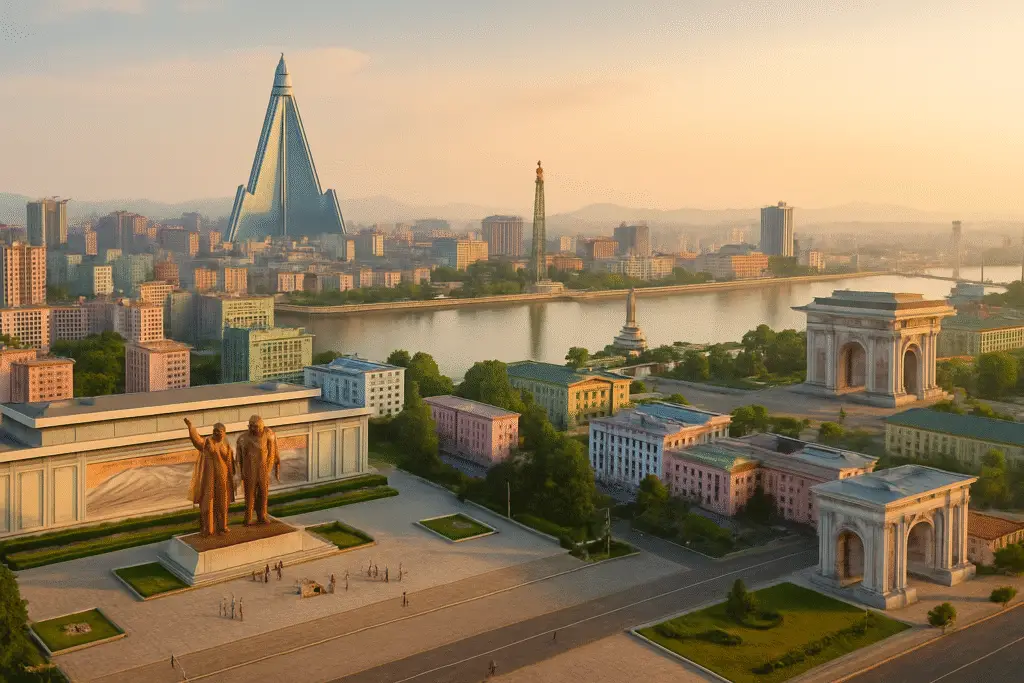
Pyongyang is unlike any other capital city in the world. It is carefully curated, symbolic, monumental, and designed as a showpiece of national pride. Wide avenues stretch across the city with very little traffic. Residential buildings are painted in pastel colors — mint green, sky blue, pink, yellow — giving the skyline a distinctive look.
Mansudae Grand Monuments
Two enormous bronze statues of Kim Il-sung and Kim Jong-il stand on Mansu Hill. The site is deeply important and always visited on tours. Visitors must bow as a sign of respect.
Kim Il-sung Square
The political heart of North Korea, used for military parades and mass gatherings. Surrounding buildings include government ministries and museums. Facing the square is the Taedong River, adding a scenic touch.
Juche Tower
A tall monument representing the country’s ideology. Visitors may take an elevator to the top for panoramic views of Pyongyang.
The Metro System
One of the world’s deepest metro systems, originally built as a bomb shelter. Stations are decorated with chandeliers, murals, and mosaic artwork. Trains feel like stepping into a retro time capsule.
The Arch of Triumph
Larger than Paris’s version, symbolizing liberation from Japanese occupation.
Kumsusan Palace of the Sun
A solemn mausoleum where the preserved bodies of Kim Il-sung and Kim Jong-il lie in state. It is one of the most strictly controlled tourist sites in the world.
Ryugyong Hotel
The massive, pyramid-shaped skyscraper dominates the skyline. It remains unopened, serving as both a symbol of ambition and complexity.
Daily Life in Pyongyang
Visitors often observe residents practicing synchronized morning exercises, walking to work, or participating in mass dance events. The city appears clean, orderly, and organized — but also highly controlled.
5. Beyond the Capital: Major Regions and Cities
Kaesong and the DMZ (Demilitarized Zone)
Near the border with South Korea, Kaesong is one of the oldest cities in the DPRK. It contains traditional Korean architecture, including tiled-roof houses reminiscent of historical Korea.
The DMZ visit is a highlight for many tourists, offering a glimpse into one of the tensest borders in the world. North Korean soldiers escort visitors through meeting rooms shared with the South before they exit back into the regulated path.
Wonsan and the East Coast
A port city that the government hopes to develop into a beach resort hub. Wonsan has quiet beaches, waterfront promenades, and natural beauty.
Mount Kumgang (Diamond Mountain)
One of the most scenic areas in the country, known for its sharp peaks, waterfalls, and lush forests. Hiking here offers breathtaking views, but tourists can only visit in organized groups.
Mount Paektu
Sacred in Korean mythology, with a crater lake called Heaven Lake. The area is deeply tied to the official national narrative and is considered a spiritual birthplace of the nation.
Hamhung
An industrial city not typically visited by tourists, but some tours include it. It is a window into everyday North Korean urban life outside the capital.
Rason Special Economic Zone
Near the borders of China and Russia, Rason is more economically open, allowing limited market activity and trade. It is a unique contrast to central North Korea.
6. Life in North Korea: Society, Culture & Daily Realities
North Korean life is shaped by a combination of cultural tradition, political ideology, and controlled state systems.
Social Structure
Every resident belongs to a classification system known as songbun, which determines opportunities like housing, education, and employment. While tourists never see this directly, understanding this helps explain why Pyongyang appears very different from rural regions.
Collective Culture
Community participation is central. Citizens practice group exercises, mass dances, agricultural work, and national celebrations with synchronized unity.
Education and Work
Most children attend school shaped by ideological teachings. Work units often participate in group activities, political study sessions, and state-directed tasks.
Arts and Performances
North Korea produces highly choreographed artistic displays — large mass games, synchronized dances, music concerts, and patriotic theatre.
Technology
The country has its own closed intranet, domestic smartphones, and controlled broadcasting. Internet access is reserved for officials.
Rural Life
Farmland is collectivized, and manual labor remains widespread. Tractors often share space with oxen and carts. Villages appear modest and quiet, with limited electricity in some areas.
7. Tourism in North Korea — How It Works
Travel to North Korea is not independent. All trips must be organized through approved agencies, and visitors are always accompanied by two government guides plus a driver.
Tour Rules
Visitors may not wander alone, interact freely with locals, or photograph anything considered sensitive. Guides explain what can and cannot be photographed.
Hotels
Tourists stay in designated hotels such as the Yanggakdo International Hotel or Koryo Hotel. These hotels often contain restaurants, karaoke rooms, bars, and gift shops.
Meals
Food served to tourists is generally plentiful and varied, ranging from Korean dishes to Chinese-style meals. The famous Pyongyang cold noodles (naengmyeon) are a must-try.
Performances
Tour groups often attend musical shows, circus performances, acrobatic displays, and ideological exhibitions such as the Mass Games when available.
Shopping
Souvenir shops offer postcards, propaganda posters, books, artwork, and stamps.
8. Ethics of Visiting North Korea
Traveling to North Korea sparks debate. Some argue that tourism supports the regime; others believe engagement brings understanding. It is important for visitors to educate themselves and approach the trip respectfully, ethically, and thoughtfully.
9. Safety and Practical Information
Safety for Tourists
North Korea is generally safe for visitors as long as they follow all rules. The government protects tourists closely.
Currency
The North Korean won is not typically used by foreigners. Euros, USD, and Chinese yuan are accepted in tourist shops and hotels.
Weather
– Winters: cold, snowy, quiet
– Summers: hot, humid, rainy
– Spring/Autumn: the best times to visit
Packing Tips
Warm layers for winter, respectful clothing for monuments, gifts for guides (optional), and printed copies of travel documents.
10. Why North Korea Fascinates Travelers
North Korea leaves a deep impression because it is unlike any other place:
- It feels frozen in time
- It offers a controlled yet captivating narrative
- The architecture is monumental
- The landscapes are beautiful and untouched
- The culture is unique, proud, and ritualized
- The experience raises profound questions about freedom, ideology, and humanity
For many, a visit to North Korea becomes a story they never forget.
 Related Articles
- Kakslauttanen Arctic Resort
- Top 10 Most Unique Places to Stay in Europe
- 10 Incredible Castles Around the World