
🇵🇰 Pakistan Travel Guide — A Journey Through Himalayan Peaks, Mughal Heritage, Desert Forts, Sufi Shrines & Timeless Hospitality
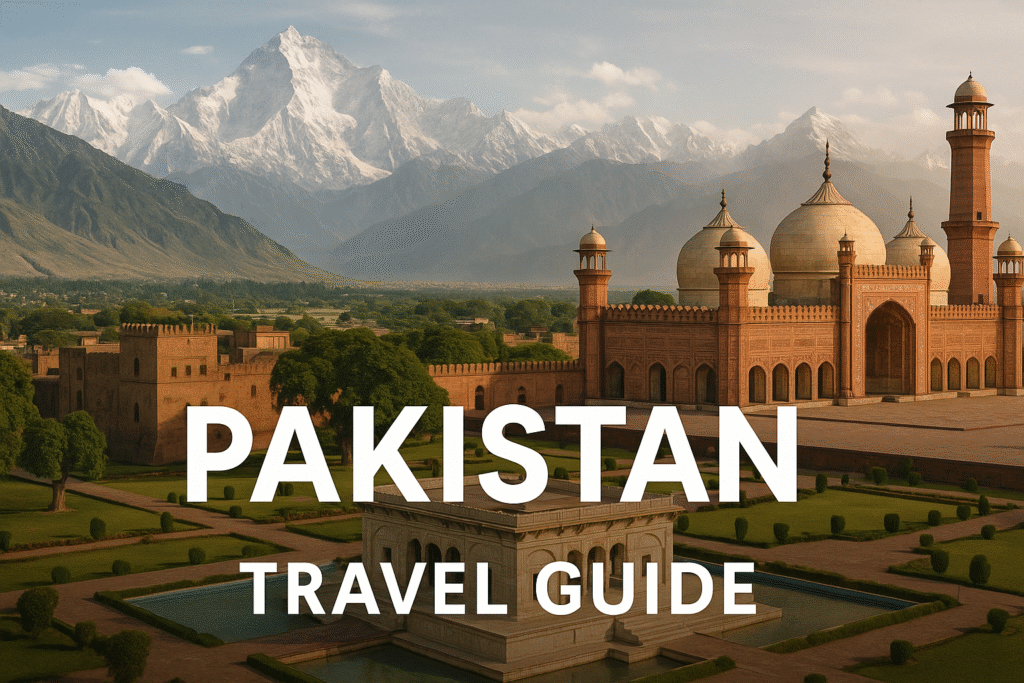
Pakistan is one of the most astonishing and misunderstood countries on Earth — a land of mighty mountains, ancient civilizations, lush valleys, vibrant cities, golden deserts, glittering mosques, remote villages, and warm hospitality that leaves a mark on every traveler. It is a nation shaped by the world’s highest mountain ranges, by rivers that gave birth to ancient societies, by empires that left grand architectural marvels, by mystical traditions, and by a resilience and cultural richness unmatched across Asia.
Traveling through Pakistan feels like moving through an encyclopedia of human history and natural wonder. In the north rise the Karakoram, the Himalayas, and the Hindu Kush — three of the world’s greatest mountain ranges, home to towering peaks such as K2 and Nanga Parbat. Valleys like Hunza and Skardu offer snow-covered summits, turquoise rivers, orchards filled with apricots and cherries, and villages with centuries-old traditions. To the west lie deserts and rugged plateaus dotted with ancient forts and caravan routes. To the east stretch the fertile plains of Punjab, where Mughal emperors built magnificent mosques, gardens, and palaces. In the south, the Indus River meets the Arabian Sea, bringing life to the port city of Karachi and to deserts where Sufi shrines glow at night with music and devotion.
The cultural depth of Pakistan is profound. Nearly every region has its own identity, language, food, music, dress, and traditions. Punjab is expressive, agricultural, and rich with Sufi spirituality. Sindh is poetic, artistic, and home to ancient Indus Valley cities. Balochistan is vast, tribal, rugged, and full of silent beauty. Khyber Pakhtunkhwa is mountainous, conservative, brave, and shaped by warrior traditions. Gilgit-Baltistan is mystical, serene, and home to some of the most dramatic landscapes on Earth. The culture blends Persian, Central Asian, South Asian, and Islamic influences, but at its heart lies something uniquely Pakistani — warmth, resilience, tradition, and pride.
This guide explores Pakistan in rich detail: its landscapes, cities, history, spirit, cuisine, identity, and the unforgettable experiences that define it.
A Geography of Mountains, Rivers, Deserts & Valleys
Pakistan’s geography is one of the most extraordinary in the world. Nowhere else on Earth converge three massive mountain ranges: the Himalayas, the Hindu Kush, and the Karakoram. The meeting point of these ranges creates landscapes of unimaginable scale — jagged peaks, enormous glaciers, turquoise lakes, and river valleys that seem carved by time itself.
Northern Pakistan is dominated by these high-altitude realms. Peaks reach heights of over 8,000 meters. The Karakoram Highway — one of the world’s highest and most spectacular roads — winds through valleys where cliffs tower above glittering rivers. The Hunza Valley, with villages like Karimabad and Gulmit, feels peaceful and ethereal. The region’s glaciers feed orchards, forests, and fields, creating pockets of green surrounded by rock and ice. Baltistan, with Skardu as its heart, leads travelers toward remote wildernesses such as Deosai National Park, the “Land of Giants,” where plateaus roll beneath open skies at 4,000 meters. Further up lie the mighty Concordia and the valleys from which climbers attempt K2, Broad Peak, and Gasherbrum.
To the west, Pakistan transitions into rugged highlands and plateaus. Balochistan’s deserts and rocky landscapes hold deep silence and solitude. Its coast stretches along the Arabian Sea, with untouched beaches, dramatic cliffs, and fishing villages where life moves slowly.
In the east, the plains of Punjab hold the Indus and its tributaries. This region is fertile, culturally rich, and full of cities shaped by Mughal heritage and modern energy. Rivers cut through agricultural fields, canals run across the countryside, and old caravan routes once connected Lahore to Delhi and beyond.
Sindh, in the southeast, is marked by desert, sea, and ancient civilization. The Thar Desert shifts in color as sand dunes roll toward the Indian border. The Indus River forms a lifeline through the province. Its delta is a world of mangroves and fishing villages. Karachi, the country’s biggest city, rises on the coast — a chaotic, energetic metropolis.
Pakistan’s geography is not just visually impressive — it defines identity, culture, and lifestyle.
A History Stretching Back to the Dawn of Civilization
Pakistan’s history spans thousands of years, from the earliest civilizations to major empires.
The Indus Valley Civilization flourished here over 4,000 years ago, with cities such as Mohenjo-Daro and Harappa displaying advanced urban planning, art, craftsmanship, and trade. These ancient cities remain some of the world’s most significant archaeological sites, offering insights into early human organization.
Later, the region became a crossroads for many empires: Achaemenids, Greeks, Mauryans, Kushans, Guptas, and Persians. Gandhara, centered around modern-day Peshawar and Taxila, became a center of Buddhist culture, producing beautiful sculptures and monasteries that influenced Asia.
Islam arrived through traders and rulers, leading to the rise of powerful sultanates and empires. The Mughal Empire, one of the greatest in history, left a profound mark on Pakistan, especially in Lahore — a city of Mughal gardens, mosques, and palaces.
In the 19th and 20th centuries, the region became part of British India until Pakistan emerged as an independent nation in 1947. The country’s modern history is complex, shaped by conflicts, migrations, resilience, and identity.
Through all changes, Pakistan has preserved its cultural soul — spiritual, artistic, diverse, and deeply rooted in its landscapes.
Lahore — The Cultural & Historical Heart of Pakistan
Lahore is the beating heart of Pakistan — a city of poets, emperors, artists, storytellers, scholars, and dreamers. It is one of the most historically rich cities in South Asia and remains the cultural capital of the country.
The Lahore Fort rises from the edge of the old city, overlooking the Badshahi Mosque — one of the world’s largest and most magnificent mosques, built by Emperor Aurangzeb. Its vast courtyard, marble domes, and red sandstone walls create an atmosphere of timeless grandeur.
Nearby lies the Walled City, a labyrinth of alleys filled with spice markets, traditional eateries, Sufi shrines, and historic mansions. The Shalimar Gardens, built by the Mughals, remain an oasis of fountains, trees, and terraces. Colonial architecture from the British era appears throughout the city, blending with modern districts, universities, and cafés.
Lahore is known for its passion — for food, art, literature, music, and debate. Its energy is intense and creative.
Islamabad — Calm, Green & Serene
Islamabad, Pakistan’s capital, offers a completely different atmosphere. Planned, green, and peaceful, it sits beneath the Margalla Hills, which offer hiking trails, viewpoints, and nature. Faisal Mosque, one of the most iconic mosques in Asia, stands proudly at the foot of the hills with its unique tent-like design.
Islamabad is modern, clean, and quiet — a place to relax, enjoy parks, museums, and the blend of nature and city life.
Karachi — A City of Sea, Energy & Contrasts
Karachi is Pakistan’s largest city and economic engine — chaotic, vibrant, diverse, and intense. It is a cultural melting pot where people from every region of Pakistan come together. The Arabian Sea gives Karachi a coastal identity, with beaches, seafood, and sea breezes. Victorian-era buildings reflect the city’s colonial past. Markets buzz with life, from fish auctions to textile bazaars.
Karachi is a world within a world — complicated, artistic, alive, and always moving.
Northern Pakistan — The Kingdom of Mountains
Northern Pakistan is one of the most beautiful regions on Earth. Valleys like Hunza, Skardu, Naran, Gilgit, and Ghizer reveal landscapes that feel dreamlike.
Hunza is known for snow-capped peaks, ancient forts, orchards, and some of the most hospitable people in Pakistan. Baltit and Altit Forts reveal centuries of history. The Karakoram Highway winds through the valley in a dramatic display of engineering and nature.
Skardu is the gateway to the high Karakoram — a world of glaciers, alpine lakes, wildflower meadows, and sacred mountains. Lakes like Shangrila, Upper Kachura, and Sheosar shimmer beneath open skies. Deosai Plateau feels infinite, with rolling hills and wildlife.
Naran and Kaghan valleys are lush, green, and full of waterfalls, rivers, and alpine lakes such as Saif-ul-Malook — a lake shrouded in myth and storytelling.
Northern Pakistan feels both peaceful and majestic.
Sindh — Ancient Civilization, Sufi Mysticism & Desert Worlds
Sindh is a province of deep history. Mohenjo-Daro, one of the world’s oldest urban centers, lies here — a city that predates ancient Egypt and Mesopotamia.
Sufi culture flourishes in Sindh. Shrines like Lal Shahbaz Qalandar’s in Sehwan beat with drums, dance, and devotion every Thursday night. The Sindhi culture is poetic, artistic, and colorful.
Karachi, the economic center, lies in Sindh, but the province also contains deserts, forts, and fishing villages.
Punjab — Farms, Festivals & Mughal Glory
Punjab is Pakistan’s agricultural heart and home to major historical sites. The Wagah border ceremony near Lahore attracts crowds every evening. The shrines of Sufi saints, such as Data Darbar, create a spiritual atmosphere. Multan, the “City of Saints,” glows with blue-tiled shrines.
Punjab is emotional, festive, expressive, and full of life.
Khyber Pakhtunkhwa — Mountains, Rivers & Warrior Traditions
Khyber Pakhtunkhwa (KP) is full of rugged mountains, pine forests, rivers, and valleys such as Swat, Dir, and Chitral. The people here are known for bravery, hospitality, and strong traditions. Swat Valley, once called the “Switzerland of the East,” offers alpine beauty and Buddhist heritage.
Chitral is home to the Kalash people, whose culture, dress, festivals, and rituals differ dramatically from surrounding regions.
Balochistan — Silence, Desert & Ancient Mystery
Balochistan is Pakistan’s least populated but largest province — full of open landscapes, deserts, mountains, and the dramatic coastline of Gwadar. Life here is shaped by tribal identity, tradition, and survival in harsh environments.
Balochistan feels ancient, vast, and mysterious.
Pakistani Cuisine — Rich, Aromatic & Full of Soul
Pakistani cuisine is incredibly diverse, varying by region. Punjab is home to buttery curries, tandoori breads, kebabs, and hearty dishes. Karachi blends South Asian, Iranian, and coastal flavors. Sindh offers spicy biryanis and seafood. KP emphasizes grilled meats, dumplings, and mountain flavors. Northern Pakistan offers soups, apricot dishes, and organic ingredients.
Food is central to hospitality. Sharing meals is a sign of love, friendship, and honor.
Why Pakistan Stays With You
Pakistan is a place that touches the heart — with its mountains, its history, its spirituality, its cultural richness, and above all, its people. It is a country of warmth, complexity, poetry, resilience, and natural beauty.
Travelers leave Pakistan with memories shaped by landscapes but carried by human connection: the kindness of strangers, the flavor of home-cooked food, the silence of mountains, the glow of golden mosques at sunset, the stories told over tea, the colors of festivals, and the feeling of discovering a place both ancient and alive.
 Related Articles
- Kakslauttanen Arctic Resort
- Top 10 Most Unique Places to Stay in Europe
- 10 Incredible Castles Around the World