
🇺🇿 Uzbekistan Travel Guide — Word Journey Through the Silk Road’s Golden Cities, Desert Kingdoms, Timeless Traditions & Central Asian Hospitality
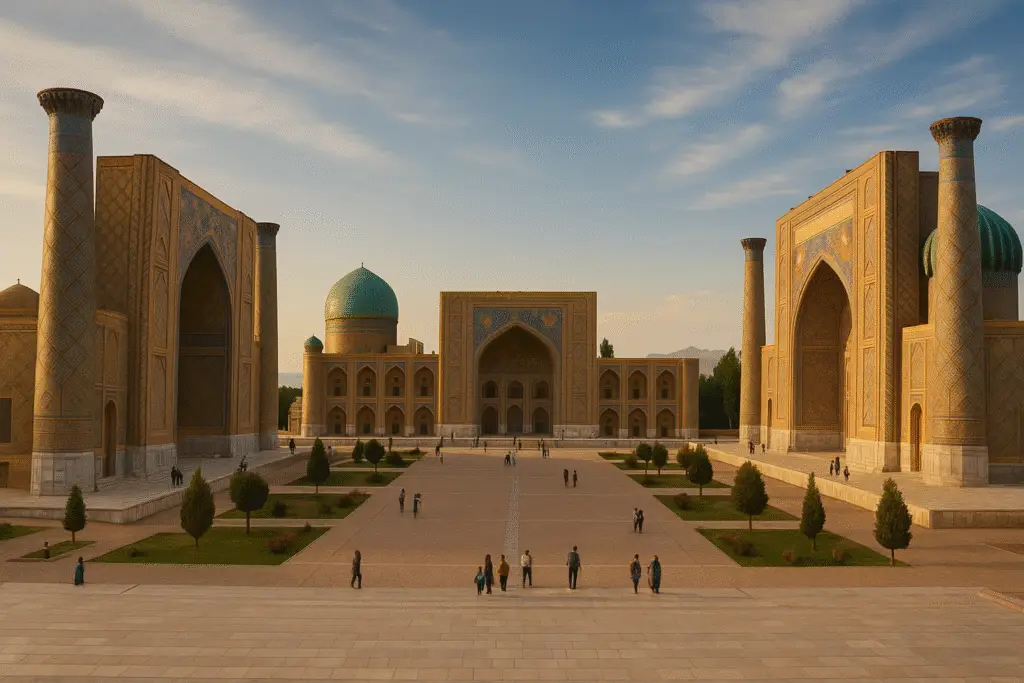
Uzbekistan is one of the most enchanting, historically important, and visually breathtaking countries in the world — a land where blue-tiled mosques shimmer beneath the desert sun, where ancient Silk Road caravans once carried silk and spices across continents, where medieval madrasas still echo with stories of scholars and poets, and where green valleys, golden dunes, snow-covered mountains, and dynamic modern cities create a landscape full of contrasts and wonder.
Travelers who arrive in Uzbekistan immediately feel the weight and beauty of time. Samarkand’s Registan Square glows with turquoise domes and golden mosaics. Bukhara’s old city feels like a living museum where centuries-old caravanserais, bazaars, palaces, and minarets still stand proudly. Khiva’s walled Itchan Kala transports you to another era entirely — a perfectly preserved desert citadel surrounded by earthen walls. Beyond the cities lie vast deserts where the sky seems endless, mountain villages where time moves slowly, and fertile oases that sustained trade routes for thousands of years.
Uzbekistan is more than its monuments. It is the heart of Central Asian culture — shaped by nomadic traditions, Persian influences, Islamic architecture, Timurid empires, Soviet-era development, and modern innovation. It is a land of storytellers, musicians, artisans, and warm hospitality. Its people welcome visitors with sincerity, offering tea, bread, fresh fruit, and conversation. The Uzbek identity blends urban sophistication with rural simplicity, ancient heritage with modern pride, and tradition with openness.
This guide explores Uzbekistan in immense depth — its geography, its Silk Road cities, its architecture, its history, its cuisine, its people, and the emotional experience of traveling through a land where every street, every dome, every courtyard feels like a chapter from a living epic.
A Geography of Deserts, Oases, Mountains & River Valleys
Uzbekistan lies in the heart of Central Asia, bordered by Kazakhstan, Turkmenistan, Tajikistan, Afghanistan, and Kyrgyzstan. It is a country of dramatic contrasts, defined by golden deserts, fertile river valleys, snowy peaks, and ancient oases that sustained entire civilizations.
Much of Uzbekistan is covered by the Kyzylkum Desert — a landscape of rolling dunes, sandstone plateaus, and wide-open plains where camels roam and the sky meets the horizon in a vast, uninterrupted line. This desert once challenged Silk Road caravans but also created the geographic isolation that helped preserve cities like Khiva and Bukhara.
To the east, the landscape changes dramatically. Mountains rise along the borders with Tajikistan and Kyrgyzstan. The Tien Shan and Pamir foothills bring fresh air, alpine valleys, lakes, and green pastures. The Fergana Valley, one of Central Asia’s most fertile regions, stretches wide with orchards, farms, rivers, and lively markets. This region has long been a cultural crossroads — a place of music, crafts, and agriculture.
In central Uzbekistan, the Zeravshan and Amu Darya river valleys create fertile belts where ancient cities flourished. These rivers once fed vast irrigation systems, supporting farming communities and growing the crops that supplied Silk Road markets.
To the south, the landscape becomes more rugged and dramatic near the Afghan border. Mountain passes, fortress ruins, and desert villages reveal a region shaped by centuries of trade, conflict, and cultural blending.
Uzbekistan’s geography is not just visually impressive — it shaped the nation’s identity, heritage, and economy for thousands of years.
A History Woven From Empires, Scholars & Silk Road Kingdoms
Uzbekistan’s history is one of the richest in Central Asia. This land witnessed the rise of powerful civilizations, the spread of religions, the exchange of ideas, and the flourishing of trade that connected Europe and Asia.
The earliest settlements emerged in fertile oases where agriculture first took root. Over time, these communities grew into fortified towns that thrived on trade. Persian influence shaped language, architecture, and culture. Zoroastrianism, Buddhism, and early forms of Islam all left their mark.
But it was the Silk Road that transformed Uzbekistan into one of the world’s most important crossroads. Caravans filled with silk, spices, jade, metalwork, carpets, and precious stones passed through Samarkand, Bukhara, Khiva, and Tashkent. Caravanserais offered shelter to merchants, scholars, musicians, and travelers from China, India, Persia, Arabia, and Europe. Ideas moved as freely as goods — astronomy, mathematics, poetry, medicine, and philosophy all flourished along these trade routes.
The greatest transformation came with the rise of Amir Timur, also known as Tamerlane. In the 14th century, he built a vast empire stretching from India to the Mediterranean. Samarkand became his capital — a city filled with splendid mosques, madrasas, gardens, and palaces. Timur’s descendants, the Timurid dynasty, turned the region into a golden center of art and science.
After the Timurids, Uzbek khanates ruled Bukhara, Khiva, and Kokand. Each built their own palaces, mosques, minarets, and fortified walls — many of which survive today.
Russian influence arrived in the 19th century, followed by Soviet control in the 20th century. This era brought railways, industry, and urban development, but also political shifts and cultural change.
Uzbekistan gained independence in 1991 and has since embraced tourism, preservation, and modernization, while proudly maintaining its cultural heritage.
Samarkand — The Pearl of the Silk Road
Samarkand is one of the world’s most legendary cities — a place where history feels alive and architecture feels eternal. The city’s heart is the Registan, one of the most beautiful squares on Earth. Three grand madrasas rise on its sides, covered in blue mosaics, geometric patterns, calligraphy, and shining domes. At sunrise and sunset, the colors shift dramatically, creating a sense of awe that overwhelms visitors.
Beyond the Registan lies Gur-e-Amir, the mausoleum of Amir Timur. Its blue dome glows under the sky, and its interior holds some of the most ornate tilework in Central Asia. Nearby, the Bibi-Khanym Mosque, once one of the largest in the Islamic world, still impresses with its scale and design.
The Shah-i-Zinda necropolis is perhaps Samarkand’s most magical site — a corridor of mausoleums decorated with brilliant blue tiles, each telling the story of a spiritual figure, scholar, or noble. The atmosphere here is deeply spiritual and emotional.
Samarkand is more than monuments. Its bazaars sell dried fruit, nuts, spices, ceramics, and textiles. Its people take pride in their city’s heritage. Its neighborhoods reveal daily life that continues as it has for centuries.
Bukhara — A Living Museum of Sandstone, Minarets & Timeless Streets
Bukhara feels like an open-air museum — a perfectly preserved Silk Road city where over a hundred historical monuments stand within walking distance. The old city’s sandy colors blend into the desert, while turquoise domes rise above labyrinthine alleys.
The Kalyan Minaret dominates the skyline, a towering structure that once guided caravans. The Poi-Kalyan complex surrounding it is a masterpiece of Islamic architecture, featuring grand madrasas and mosques that reflect centuries of scholarship.
Lyabi-Hauz, the central square built around a pool shaded by ancient mulberry trees, remains the social heart of Bukhara. Tea houses, restaurants, and artisan stalls create a lively yet peaceful atmosphere.
Caravanserais, hammams, domed bazaars, and fortress walls reveal a city that once hosted merchants from across Asia. The Ark Fortress, Bukhara’s citadel, contains museums, courtyards, and centuries of history.
Bukhara feels authentic, peaceful, and full of soul — a place where time stands still.
Khiva — A Desert Citadel Frozen in Time
Khiva’s old city, Itchan Kala, is one of the world’s best-preserved walled towns. Enclosed by thick earthen walls, the city feels like a film set — except everything is real and centuries old.
Narrow streets lead to palaces, madrasas, mosques, minarets, wooden balconies, and beautifully carved doors. The Kalta-Minor Minaret, unfinished yet striking with its turquoise tiles, stands at the entrance. The Juma Mosque, with its 200 wooden columns, creates an atmosphere of spiritual calm.
At sunset, the city glows orange and gold. At night, lanterns illuminate the walls, creating a magical desert dreamscape.
Khiva is quieter than Samarkand and Bukhara, offering a sense of intimacy, stillness, and wonder.
Tashkent — A Modern Capital with Deep Roots
Tashkent blends Soviet-era architecture, modern development, wide boulevards, museums, parks, and lively markets. It is a city of contrasts — metro stations decorated with mosaics and chandeliers, modern shopping districts, classical opera houses, and traditional teahouses.
The Chorsu Bazaar is one of its most colorful attractions, filled with spices, fruit, bread, crafts, and textiles. The Khast-Imam complex houses ancient manuscripts and beautifully restored religious buildings.
Tashkent feels energetic, youthful, and forward-looking — the perfect balance to Uzbekistan’s historic cities.
The Fergana Valley — Green Fields, Crafts & Cultural Depth
The Fergana Valley is lush and fertile — a region known for agriculture, crafts, and warm hospitality. Cities like Fergana, Kokand, Margilan, and Andijan reveal traditional weaving, ceramics, and silk production.
Margilan is famous for its handmade silk — a tradition unchanged for centuries. Kokand holds the grand Khudayar Khan Palace, a colorful and ornate structure.
The valley is peaceful, green, and culturally rich.
The Desert & Aral Sea — Silence, Sand & Memory
The Kyzylkum Desert offers camel camps, yurt stays, and silent landscapes under starry skies. Ancient fortresses like Ayaz Kala and Toprak Kala rise from the desert like forgotten kingdoms.
Further north, the Aral Sea region tells a story of environmental tragedy and human resilience. The dried-up seabed, ship graveyards, and dunes reveal one of the world’s greatest ecological changes. Yet nature is slowly returning, and local communities continue to preserve their culture.
Cuisine — Hearty, Flavorful & Central Asian at Heart
Uzbek cuisine is rich, satisfying, and deeply rooted in hospitality. Pilaf (plov) is the national dish — a fragrant mix of rice, carrots, herbs, and meat cooked in massive cauldrons. Fresh bread (non) is sacred and baked in clay ovens. Samsa pastries, kebabs, soups, and fresh vegetables fill markets and homes.
Tea is served everywhere — a symbol of warmth and respect. Fruit from the Fergana Valley is incredibly sweet and flavorful.
Meals are a celebration of life, friendship, and family.
Why Uzbekistan Stays With You
Uzbekistan is more than architecture, more than history, more than landscapes. It is a place of emotion — the feeling of walking through a blue-tiled archway, hearing the call to prayer echo across ancient squares, tasting fresh bread at sunrise, speaking with artisans who inherited centuries-old skills, and watching the desert sky turn pink and gold at sunset.
The warmth of the people, the beauty of the cities, the depth of the history, and the power of the landscapes stay with you forever.
 Related Articles
- Kakslauttanen Arctic Resort
- Top 10 Most Unique Places to Stay in Europe
- 10 Incredible Castles Around the World