
Germany – The Rhine Valley: A Journey Through History, Nature, and Wine
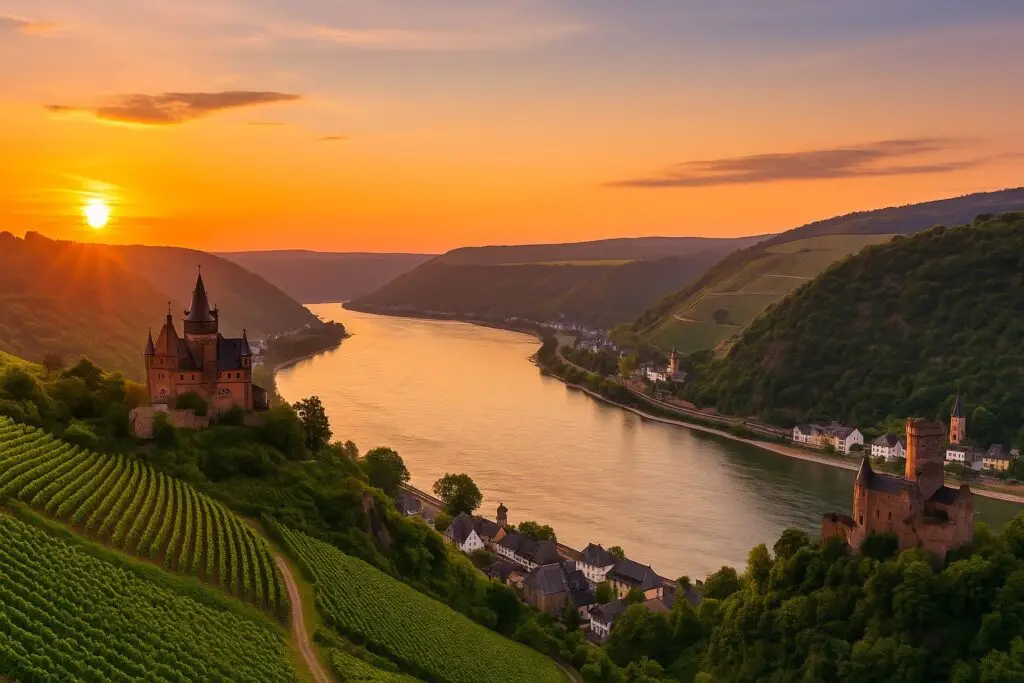
The Legendary River That Shaped a Nation Germany Rhine Valley
The Germany Rhine Valley Rhine River is more than just water flowing through Germany; it is a living symbol of the country’s soul.
Winding for over 1,200 kilometers from the Swiss Alps to the North Sea, it passes castles and vineyards, Roman ruins and medieval towns, legends and love songs. Germany Rhine Valley
In the Rhine Valley, especially between Bingen and Koblenz, the river becomes a stage — a sweeping landscape of cliffs, forests, villages, and fortresses that has inspired poets, painters, and travelers for centuries.
For Germans, the Rhine is a source of pride. For visitors, it’s a journey through time — from ancient trade routes to romantic ruins perched high above the water. Germany Rhine Valley
Few places in Europe combine natural beauty, cultural heritage, and human creativity as seamlessly as this valley. Whether you arrive by train, car, or riverboat, the Rhine promises one of Europe’s most unforgettable travel experiences.
Geography and Overview – The Heart of Western Germany
The Rhine enters Germany from Switzerland near Basel, flows north through the Upper Rhine Plain, forms the border between France and Germany for a while, and then cuts deeply into the slate hills of western Germany — creating the spectacular Upper Middle Rhine Valley, a UNESCO World Heritage Site.
This 65-kilometer stretch between Bingen/Rüdesheim and Koblenz is the region’s crown jewel, lined with more than 40 castles, countless vineyards, and picture-perfect villages.
North of Koblenz, the Rhine widens and flows past Bonn, Cologne, and eventually into the lowlands of the Netherlands.
South of Bingen, it passes through the Rheingau, one of Germany’s finest wine regions.
Each section of the Rhine has its own character — from medieval romance to industrial might — but the valley remains united by its connection to the river and its traditions.
The Upper Middle Germany Rhine Valley – A UNESCO Treasure
Designated a World Heritage Site in 2002, this central stretch is often called the “Romantic Rhine.”
Here, the river twists dramatically between steep hills covered in vineyards, dotted with stone towers and crumbling castles.
Each bend reveals another fairy-tale scene — a church spire, a ruined fortress, or a barge gliding beneath ancient cliffs.
The Loreley Rock
No landmark captures the spirit of the Rhine quite like the Loreley Rock, a 132-meter cliff near St. Goarshausen.
According to legend, a beautiful maiden named Loreley sat upon the rock, singing so sweetly that sailors lost control of their ships and crashed on the reefs below.
The tale, immortalized by Heinrich Heine’s 19th-century poem, gave the Rhine its mythical aura — a place where nature and imagination intertwine.
From the Loreley viewpoint, visitors enjoy one of the most dramatic panoramas in Germany: the river narrowing between steep cliffs, with castles guarding both shores. Germany Rhine Valley
Top Towns and Cities Along the Germany Rhine Valley
Koblenz – Where the Rivers Meet
At the northern end of the UNESCO section, Koblenz stands proudly where the Rhine meets the Moselle River.
Its name comes from the Latin Confluentes — “confluence.”
The city blends Roman foundations, medieval churches, and elegant 19th-century boulevards.
Highlights include:
- Deutsches Eck (German Corner): The monumental confluence point crowned by an equestrian statue of Emperor William I.
- Ehrenbreitstein Fortress: One of Europe’s largest fortresses, towering above the Rhine and reachable by cable car.
- Old Town: Cobbled streets, lively squares, and half-timbered houses full of cafés and wine taverns.
Koblenz is both gateway and guardian to the Rhine Valley — sophisticated, welcoming, and surrounded by beauty on all sides.
Boppard – The Rhine’s Serene Heart
Further south lies Boppard, once a Roman settlement and now a charming resort town known for its relaxed pace and scenic location within one of the Rhine’s grandest bends.
You can ride the chairlift to Vierseenblick, a viewpoint whose name (“Four Lakes View”) refers to the illusion created by the winding river — it looks like four separate lakes glistening in the sun.
Boppard is also famous for its wine, particularly the light and fruity Bopparder Hamm Riesling, grown on the steep slopes above town.
Stroll the riverside promenade, take a ferry across, or simply enjoy the view from a terrace with the sound of church bells echoing through the valley. Germany Rhine Valley
St. Goar and St. Goarshausen – Castles and Legends
Facing each other across the river, these twin towns are home to two of the Rhine’s most iconic castles.
- Rheinfels Castle in St. Goar is a vast ruin — once the most powerful fortress on the Rhine. Its tunnels, walls, and museum bring the Middle Ages vividly to life.
- Katz and Maus Castles in St. Goarshausen perch on opposite hills, watching each other across the water like rivals frozen in time.
Between them lies the Loreley Rock, the river’s narrowest and most treacherous point.
It’s a place of breathtaking scenery and timeless mystery.
Bacharach – The Essence of Germany Rhine ValleyRomance
Few towns capture the spirit of the Romantic Rhine like Bacharach.
Enclosed by vineyards and medieval walls, it looks like something from a fairy tale.
Half-timbered houses line cobbled streets; ivy climbs ancient towers; church spires rise over wine taverns glowing with lanterns.
Above town, Stahleck Castle has guarded the valley for nearly 900 years — today it operates as a youth hostel, offering travelers one of the most spectacular budget views in Europe.
Bacharach is also a center of wine culture. Its Rieslings, grown on steep terraces, are among the most celebrated in the Middle Rhine.
Whether you wander the alleys, climb the city walls, or watch the sunset over the river, you’ll understand why poets and painters once called this valley “the landscape of longing.” Germany Rhine Valley
Rüdesheim am Rhein – Music, Wine, and Cheer
At the southern gateway to the valley, Rüdesheim is the liveliest of all Rhine towns.
The famous Drosselgasse is a narrow street packed with wine taverns, brass bands, and laughter — a celebration of Rhineland joy.
But beyond the tourist bustle lies real charm: quiet lanes, river views, and family-run wineries with centuries of history.
Take the cable car to the Niederwald Monument, which overlooks the Rhine and vineyards from a forested hilltop.
From there, walking paths lead through woods and meadows — the same landscapes that inspired the Romantic painters of the 19th century.
Mainz – The Cultural Capital of the Germany Rhine Valley
South of Rüdesheim, Mainz stands where the Rhine meets the Main River.
It’s a university town, a media center, and one of Germany’s oldest cities.
The Mainz Cathedral, begun in 975, dominates the skyline, while the Gutenberg Museum honors the man who revolutionized communication with his printing press.
Mainz combines ancient heritage with a lively spirit — markets, festivals, and wine tastings fill the calendar.
It’s also known for Fastnacht, one of Germany’s most exuberant carnival celebrations. Germany Rhine Valley
Bonn and Cologne – The Northern Rhine Giants
As the Rhine flows north beyond the romantic section, it passes Bonn, birthplace of Ludwig van Beethoven, and Cologne, home to the mighty Cologne Cathedral.
Both cities mark the transition from mythic landscapes to urban grandeur.
Yet even here, the river remains the central thread — lined with parks, promenades, and riverboats carrying echoes of the past.
Castles of the Rhine – Guardians of Time
More than forty castles and fortresses crown the cliffs between Koblenz and Bingen. Germany Rhine Valley
Each tells a story — of feudal power, merchant rivalry, or romantic dreams reborn in ruin.
Notable examples include:
- Marksburg Castle (Braubach): The only fortress on the Middle Rhine never destroyed, with medieval kitchens, armories, and breathtaking views.
- Pfalzgrafenstein Castle (Kaub): A white-walled toll fortress built on a tiny island mid-river — one of the most photographed spots in Germany.
- Burg Sooneck and Burg Rheinstein: Restored 19th-century castles representing the Rhine Romantic movement.
- Burg Reichenstein: A collection of towers and battlements rising above Trechtingshausen.
Each fortress adds to the Rhine’s mythic atmosphere — stone guardians watching the endless procession of ships and time.
Vineyards and Wine Culture
The Rhine Valley is the cradle of German wine culture, especially Riesling, a grape perfectly suited to the steep slate slopes and cool climate.
The Rheingau, Mittelrhein, and Nahe regions each produce wines with unique character — crisp, mineral, and aromatic.
Wine is woven into daily life: festivals fill the calendar, vineyards climb almost every hill, and locals celebrate each harvest with music and open cellars.
Towns like Oberwesel, Assmannshausen, and Lorch are smaller gems where you can walk from the river straight into the vineyards.
River Cruises, Cycling, and Scenic Drives Germany Rhine Valley
Few experiences rival a journey along or on the Rhine.
- River cruises (short or multi-day) reveal castles and vineyards from the best vantage point — the water itself.
- The Rhine Cycle Route (EuroVelo 15) follows the river from its Alpine source to the North Sea — a 1,200-kilometer adventure through six countries, with the Middle Rhine as its most scenic stretch.
- The B9 road and the Deutsche Weinstraße offer spectacular drives for motorists, winding through hills and wine towns.
Ferries connect both banks frequently, allowing travelers to combine hiking, cycling, and sightseeing in endless combinations. Germany Rhine Valley
Nature and Hiking Germany Rhine Valley
Beyond the river, the Rhine Valley hides a wealth of natural beauty — forests, cliffs, and wildflower meadows.
Rheinsteig and RheinBurgenWeg
Two long-distance trails run parallel to the river:
- Rheinsteig (east bank): 320 km from Bonn to Wiesbaden — steep climbs, castles, and panoramic views.
- RheinBurgenWeg (west bank): 200 km from Remagen to Bingen — slightly gentler, passing directly through picturesque towns.
Both routes offer unforgettable perspectives of the valley’s drama and peace.
Siebengebirge and Rheingau Hills
Near Bonn, the Siebengebirge (“Seven Mountains”) form one of Germany’s oldest nature reserves — volcanic peaks, chestnut forests, and lookout points like the Drachenfels, crowned by romantic ruins.
In the south, the Rheingau Hills merge vineyards with forested ridges, offering serene hikes and sweeping vistas.
Festivals and Traditions
Life along the Rhine flows with the seasons.
Every village has its own celebrations — from wine festivals to fireworks shows illuminating the cliffs.
- Rhein in Flammen (Rhine in Flames): A summer spectacle where fireworks explode over the river and illuminated ships sail beneath.
- Wine Festivals: Held from spring to autumn in almost every town.
- Carnival (Fastnacht): Especially vibrant in Mainz and Cologne, with parades, costumes, and humor.
- Christmas Markets: Medieval squares glowing with lights and mulled wine in winter.
These events embody what locals call Rheinische Lebensfreude — the joy of life on the Germany Rhine Valley
Art, Literature, and the Romantic Movement
In the 19th century, the Rhine became a muse for poets and painters of the Romantic era.
Writers like Goethe, Heine, and Lord Byron celebrated its landscapes in verse; painters like Turner captured its golden light and misty ruins.
Tourists followed — the first generation of travelers seeking inspiration and emotion in nature’s grandeur.
This “Rhine Romanticism” shaped how the world saw Germany — as a land of castles, legends, and sublime beauty.
Even today, that spirit lingers in every mist-covered hill and echoing church bell. Germany Rhine Valley
Practical Travel Information
- Best Time to Visit: May to October for warm weather and river traffic; September for grape harvests and festivals.
- Getting There: Major entry points are Frankfurt, Cologne, and Düsseldorf. High-speed trains reach Koblenz, Mainz, and Bingen easily.
- Getting Around: Regional trains, ferries, and bike paths connect all major towns.
- Accommodation: From historic inns and family-run guesthouses to castles turned into hotels.
- Language: German (English widely understood).
- Currency: Euro (€).
Why the Rhine Valley Captivates Travelers Germany Rhine Valley
Because here, history and landscape flow together like the river itself.
The Rhine is not just scenery — it’s a living story.
You feel it in the echo of church bells across the water, in the scent of grapes warming on the hillside, in the reflection of castles at sunset. Germany Rhine Valley
It’s a region that invites you to slow down, breathe deeply, and rediscover the romance of travel — not as a checklist of sights, but as a connection between people, place, and time.
The Rhine Valley is Germany distilled: timeless, graceful, and ever-moving. Germany Rhine Valley
 Related Articles
- Staying Overnight at Tropical Islands Resort Berlin
- Top 10 Most Unique Places to Stay in Europe
- 10 Incredible Castles Around the World