
🇽🇰 Kosovo — Mountain Valleys, Living History & Quiet Discovery
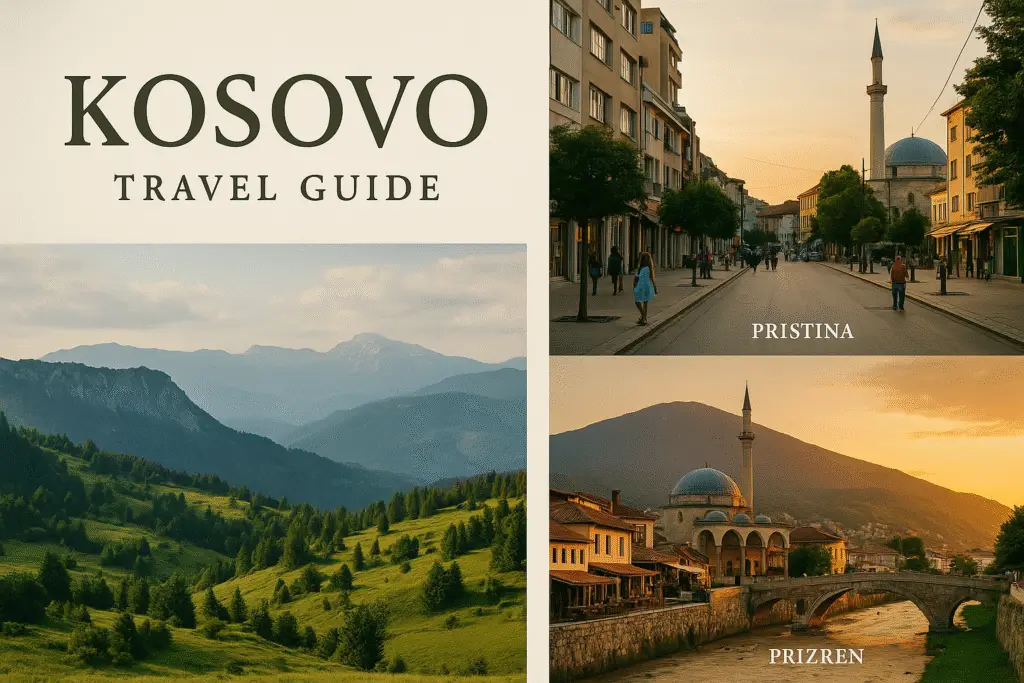
Hidden in the heart of the Balkans, Kosovo is a land of mountains and stories — a place where villages cling to stone ridges, where medieval monasteries rise from forested slopes, and where skylines are traced with minarets and quiet domes.
It is Europe’s youngest nation and one of its least explored.
But behind the headlines and history lies a country of immense natural beauty, warm character, and layered cultural memory.
Kosovo is still forming its identity — shaping itself from ancient roots, Ottoman chronicles, Yugoslav shadows, and new hope.
Modern cafés sit beside centuries-old mosques; fortresses overlook colourful bazaars; alpine valleys stretch toward peaks that catch sunrise in silver and rose.
This is not a polished destination — it is a real one.
Authentic, honest, soulful.
Kosovo is not just a place to see — it is a place to feel.
🌄 A Land Written in Stone
Kosovo’s geography forms a rough diamond:
high mountains ring its borders in jagged arcs, while fertile valleys open in the centre.
To the west lie the Accursed Mountains — the Prokletije range — vast and wild, with deep gorges and alpine villages where shepherds still follow ancient seasonal rhythms.
To the southeast spreads the broad Kosovo Plain — fields, vineyards, orchards, and rivers flowing down from slopes anchored in myth.
Everywhere you go, mountains are near.
Their presence shapes the wind, the weather, and the daily lives of the people.
They form a backdrop to towns, a boundary to journeys, and an invitation to wander.
Kosovo is not large — but it feels deep.
🇽🇰 Kosovo — A Deep Dive Travel Guide


🕌 Layers of Civilisation
Civilisations have crossed this land for thousands of years:
Illyrian tribes settled its valleys; Romans built the road networks; Byzantines raised fortresses; Ottomans shaped cities with mosques and baths; Serbs constructed monasteries that still glow with medieval frescoes.
These layers remain visible:
- in a bridge’s curve over a river,
- in the frescoes of a monastery chapel,
- in a caravanserai hidden behind new apartments,
- in a bazaar still humming with trade.
Kosovo carries its history openly — sometimes proudly, sometimes quietly, sometimes with scars.
But the past is never static here.
It blends with modern life — cafés inside Ottoman houses, new murals on old walls, hip hostels beside stone mosques.
This cultural tapestry gives Kosovo a unique flavour:
neither Western nor Eastern, but entirely its own.
🏙 Pristina — A City of Youth & Contrast
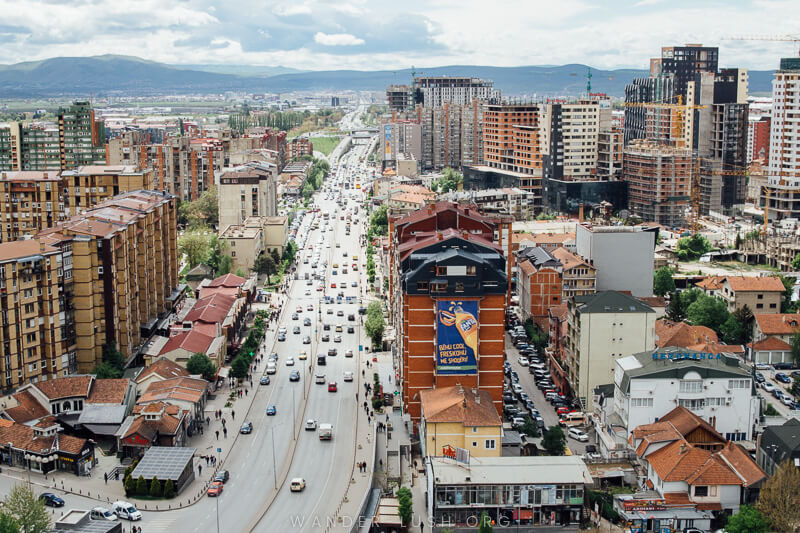
Pristina (Prishtinë) is raw energy.
It is one of Europe’s youngest capitals — not only in age but in spirit. Young people fill its cafés and avenues; new buildings rise beside old warehouses; street art splashes colour across concrete walls.
The city is not beautiful in a traditional sense —
its charm lies in its contrasts.
It is messy, lively, hopeful.
You wander through:
- narrow lanes where small shops sell traditional bread,
- boulevards lined with coffee bars,
- quiet courtyards lit by strings of bulbs at night,
- university neighbourhoods where laughter echoes from cafés until late.
Pristina’s skyline is marked by the National Library — a bold, strange modernist structure wrapped in metal lattices and bubble roofs.
Nearby, Mother Teresa Square gathers families, kids on scooters, and evening strollers.
Markets spill onto sidewalks; baklava shops glow warmly; mosques call at dawn; buses honk; students hurry with books under their arms.
Pristina is movement.
It is a city still inventing itself.
🕌 Prizren — Stone Lanes, Old Mosques & Sunset Over a River
Prizren is Kosovo’s most atmospheric city —
a river town tucked beneath green hills, its heart threaded with Ottoman bridges and medieval walls.
Here, stone lanes wind between traditional houses; vine-draped patios overlook the river; minarets rise against mountain silhouettes; church bells ring softly from distant slopes.
In the centre, tea houses and bakeries open to cobbled streets; old men chat beneath walnut trees; little shops sell silverwork and handwoven carpets.
Above everything, the fortress watches.
Climb at sunset, when Prizren glows gold — minarets, roofs, and river all drifting into shadow. The wind is soft up there, and the city feels timeless.
Prizren is the emotional heart of Kosovo —
a place of memory, beauty, and festival.
🏞 Rugova Valley — A Cathedral of Stone & Air
Just outside Peja begins the Rugova Valley —
a dramatic canyon of limestone walls rising like cliffs of silver and ash.
The road follows the river into the mountains; waterfalls trickle from rock; tunnels pierce sheer walls; pine forests cling to slopes.
Higher up, the valley widens —
alpine meadows appear; shepherd huts stand alone; wildflowers paint hillsides in spring.
The silence here is powerful.
You hear your steps, the river, the wind.
Rugova is not just scenery —
it is a presence.
It offers:
- glacial lakes hidden in folds of rock
- mountain trails crossing ridges
- via ferrata routes pinned to cliffs
- winter ski slopes
- endless forest paths
The valley feels ancient — older than borders, older than nations.
It is the wild heart of Kosovo.
🌄 The Accursed Mountains — Wild & Untamed
In the far west rise the Accursed Mountains — a name earned from their savage beauty.
Known locally as Prokletije, these mountains form one of Europe’s most rugged ranges.
Their ridges feel primordial:
sharp summits, deep basins, streams rushing down wild slopes.
Villages here look carved into the land — stone houses, wooden fences, fields held on terraces.
Trails cross into Montenegro and Albania along the famous Peaks of the Balkans route — a path of high passes, shepherd camps, and star-filled nights.
The mountains here are not manicured — they’re raw.
Perfectly imperfect.
🕍 Monasteries — Stones Holding the Past
Kosovo is home to some of the most important medieval Orthodox monasteries in the Balkans.
These sanctuaries hold frescoes that glow like gentle fire — saints, kings, angels, painted centuries ago.
The crown jewel is Visoki Dečani —
a 14th-century masterpiece set in a quiet forest near Peja.
Its stone walls rise gracefully; inside, murals shimmer in blues, reds, and golds.
Further south near Prizren stands Our Lady of Ljeviš, another treasure — calm, fragrant with candle smoke, marked with time and devotion.
These monasteries are not museums —
they are living memories.
🕌 Ottoman Echoes — Mosques, Hamams & Bazaars
Alongside the monasteries stand elegant Ottoman mosques —
thin minarets, domed roofs, quiet courtyards.
In Prizren, the Sinan Pasha Mosque dominates the skyline —
its stone glowing warm at dusk, its call blending with the river.
Old bazaars still beat with life:
gold vendors, tea sellers, bakers rolling dough, stallholders calling greetings.
These are not reconstructed tourist centres —
they are real places, where daily life continues.
🏘 Village Kosovo — Quiet Roads & Warm Welcome
Beyond cities lie villages where pace slows.
Stone walls guard gardens; chickens scratch along lanes; children ride bicycles; elders gather beneath trees to talk and watch the world.
Hospitality is strong here.
Guests are welcomed generously, with coffee, sweets, sometimes a whole meal.
Stories flow easily — about family, history, land.
Village Kosovo is the country’s true soul.
🍞 Food — Simple, Honest, From the Land
Kosovar food is rustic and heartfelt.
Meals are usually built from grains, cheese, grilled meat, vegetables, yogurt, bread.
Expect:
- Flaky pies filled with cheese or spinach
- Slow-cooked lamb and stews
- Peppers stuffed with rice and herbs
- Fresh bread warm from the oven
Desserts reflect Ottoman roots —
sweet syrups, nuts, and delicate pastries.
Meals are meant to be shared —
neighbours, family, friends.
🚗 Travel Rhythm — Slow & Free
Kosovo is small enough to cross in a few hours,
but big in feeling.
It is a land for slow travel:
drive two hours and you are in a new world —
from bustling Pristina to river-lit Prizren,
from mountain gorges to quiet monasteries.
The joy is in wandering.
🌄 Sample Routes
🔹 5 Days
- Day 1: Pristina — cafés & modern culture
- Day 2: Prizren — river, fortress sunset
- Day 3: Peja — bazaar & monastery
- Day 4: Rugova Valley — hiking & alpine views
- Day 5: Villages & return
🔹 7 Days
Add Gjakova, plus another day hiking in Rugova or crossing into Albania.
🧭 Practical Notes
- English spoken more in cities; Albanian widely spoken
- Euro currency
- Roads decent; mountain roads narrow
- Culture conservative outside cities
- Best seasons: spring & early autumn
💛 Why Kosovo Stays With You
Kosovo is not perfect, polished, or crowded.
It is real —
alive with memory and emotion.
A place where mountains guard valleys;
where rivers split ancient towns;
where monasteries glow beneath cedar shadows;
where the past sits close beside a hopeful future.
You arrive curious —
and leave moved.
Kosovo offers what many destinations have lost:
authenticity, sincerity, and soul.
Once you’ve walked its stone lanes,
breathed its mountain air,
shared tea with its people —
you will carry it with you.
Forever.
 Related Articles
- Kakslauttanen Arctic Resort
- Top 10 Most Unique Places to Stay in Europe
- 10 Incredible Castles Around the World