
🇱🇹 Lithuania — Forest Spirit, Baltic Shores & Echoes of an Ancient Kingdom
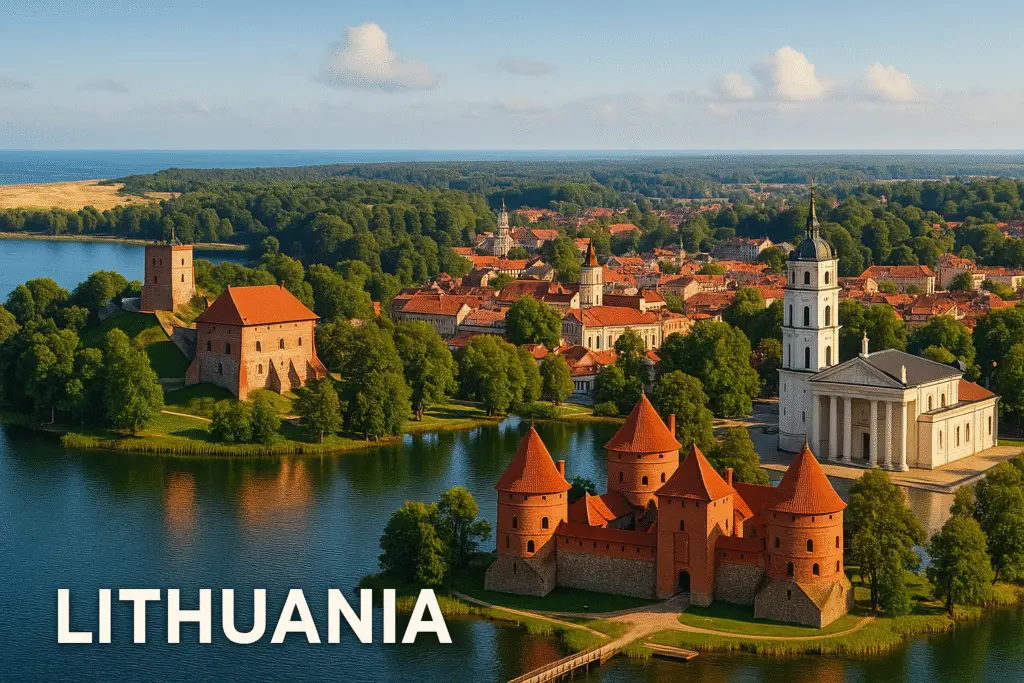
Lithuania is a quiet force of the north — a Baltic land where dense forests breathe history, where rivers move like silver through green meadows, where hilltop fortresses watch over lakes, and where the past whispers beneath wooden shingles and grand baroque domes.
It is a place layered with myth, faith, poetry, and the resilience of a people who have endured conquest, partition, and occupation, yet emerged with their language, songs, identity, and soul intact.
Lithuania is not defined by grand mountains or chaotic capitals.
Its beauty is softer, more contemplative, rooted in nature, memory, and story.
Woodlands stretch across the land, dotted with villages and farms; sandy dunes roll along the Baltic coast; lakes mirror the sky; ancient forests hum with birdsong.
It is a country that feels older than time, yet youthful in spirit — open, creative, curious.
In its cities, medieval streets wind beneath baroque churches; cafés spill onto cobbled squares; art fills courtyards; students carry books beneath leafy boulevards.
Outside the cities, lakes lie silent beneath the light; wooden farms rest beside birch groves; the wind carries the scent of pine, hay, and the distant sea.
Lithuania is a land of quiet wonder —
its stories rise not from spectacle, but from depth.
🌆 Vilnius — A City of Baroque Light & Forested Hills
Vilnius, the capital, sits in a cradle of green.
Forests approach its edges; river valleys carve through its heart; hills rise like gentle guardians around an old town of warm colours and church spires.
The Old Town is one of Europe’s largest — a labyrinth of cobblestone alleys, pastel facades, hidden courtyards, ivy-draped walls, and domes that catch the sun.
Its skyline is a forest of towers: Catholic, Orthodox, Baroque, Gothic — each speaking of an age, a culture, a faith layered into the country’s centuries of story.
Vilnius feels intellectual, artistic, and relaxed.
Students and writers sit outside cafés; musicians play in quiet plazas; painters sell their canvases along the streets leading to the Cathedral and the white bell tower that opens toward a broad square.
The atmosphere is light, open, sensitive — a city that welcomes thought and conversation.
Up the slope, Gediminas Hill stands crowned by its red-brick tower. From the top, the city stretches outward in gentle folds: river bends, leafy neighbourhoods, distant hills. You see not only the old city roofs, but the expanse of green that surrounds and holds it.
Across the river stands Užupis, a bohemian district that once declared itself a separate republic — a playful micro-nation of artists, poets, and dreamers. Its constitution is posted on walls in many languages, proclaiming whimsical truths:
“Everyone has the right to be happy,”
“Everyone has the right to be unique.”
Vilnius is a capital, yes —
but it feels like a sanctuary.
🏰 Trakai — A Castle on Water
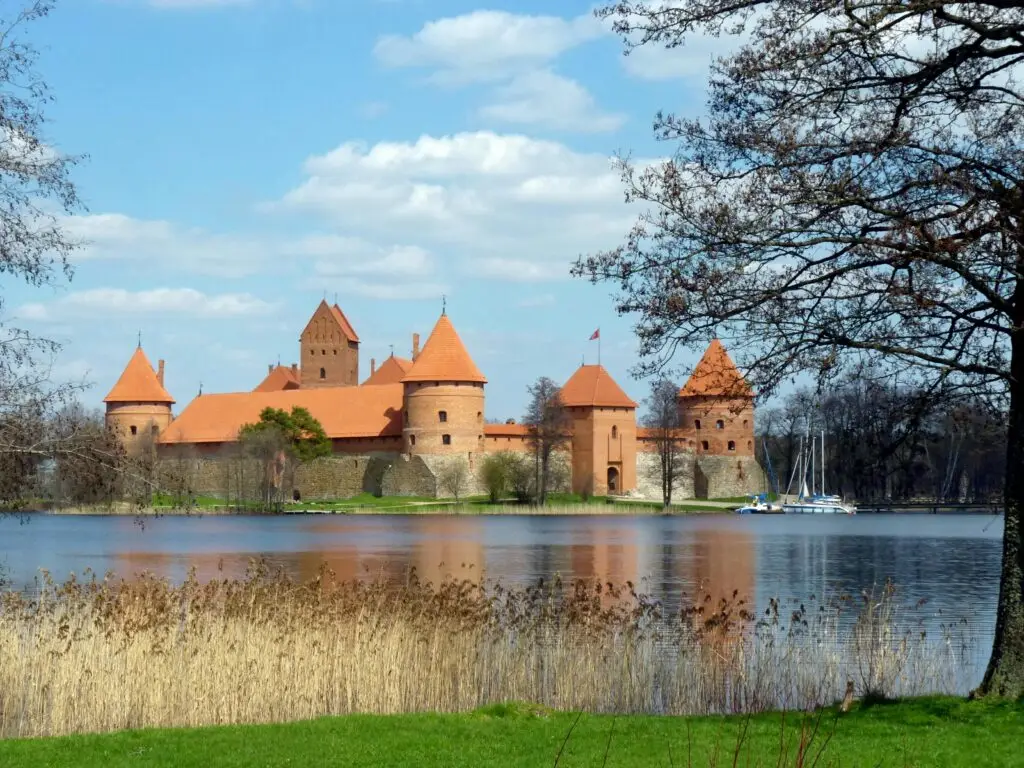
Not far west of Vilnius lies Trakai, a dream of towers and red walls floating on a lake.
The castle stands on an island surrounded by calm blue water, reached by wooden bridges that appear like pathways to another age.
The scene seems made for fairy tales:
pine forests encircle the lake; boats glide quietly; the castle’s walls reflect in stillness; reeds whisper in wind.
Walking the grounds, you feel the centuries beneath your feet — the memory of the Grand Duchy, once one of Europe’s most powerful realms, stretching from the Baltic to the Black Sea.
The village around Trakai is peaceful, and the lakes radiate outward into a network of blue that glows beneath summer sun.
It is a place that embodies the gentleness of Lithuania — old, serene, reflective.
🌲 Nature — Lakes, Fields, & Endless Forest
Lithuania’s landscape is an unfolding tapestry of green and blue.
It is a country of lakes — more than 6,000 scattered through forest and meadow.
Rivers wander through the land like threads of silver; pine woods stretch for kilometres; birches stand in bright white clusters; oaks spread their deep shade.
Nature here is calm, never overwhelming.
It does not shout; it sings.
The wind carries scents of resin, grass, and distant water; birds weave melodies through branches; the earth feels soft and welcoming.
In summer, the countryside is alive with light — fields shining gold with rye and barley, villages tucked into valleys, dragonflies skimming lakes at sunset.
In autumn, forests become flame — amber, crimson, bronze — and paths disappear into seas of leaves.
Winter turns the land pure and white; wood smoke rises from chimneys; the world becomes still.
Spring arrives quietly — slow green budding under lingering chill.
Nature is not separate from daily life; it is part of identity.
Lithuanians walk, gather mushrooms, pick berries, swim in lakes, ski through woods.
The forest is home.
🏖 Curonian Spit — Dunes, Wind, & Baltic Quiet
Along the Baltic coast lies one of Lithuania’s most extraordinary landscapes: the Curonian Spit, a long, thin stretch of sand separating lagoon from sea.
It is a world of dunes — immense, golden, shaped constantly by wind.
Some are gentle, rolling like waves; others rise steep as hills, catching sunlight and shadow in soft curves.
Pine forests cover much of the spit, roots gripping the sand, needles whispering beneath ocean wind. Wooden villages appear between trees, with houses painted in reds, blues, and whites — colours echoing the sea and sky.
Near Nida, the dunes rise highest.
From the crest, the world seems endless — lagoon on one side, Baltic Sea on the other; forests stretching down the spine; the horizon dissolving into light.
The Curonian Spit is not loud or wild —
it is meditative, timeless, spacious.
Every step feels like a conversation with wind.
🛶 Hill of Crosses — A Testament of Faith & Memory
In northern Lithuania, near Šiauliai, stands a hill unlike any other.
At first it looks small — a rise in the landscape. But as you approach, you see that it is covered in crosses:
tall crosses, tiny crosses, wooden, metal, carved, simple — hundreds of thousands of them, placed over decades as symbols of hope, grief, persistence, and devotion.
The air feels reverent.
Wind moves through rosaries; sunlight glints on metal; shadows lie quiet beneath arms and beams.
It is not a cemetery — it is a living act of memory.
Even during occupation, when authorities removed crosses, people returned and planted new ones in the night.
The hill stood, and still stands, as a testament to spirit.
Walking through the narrow paths, you hear the soft music of thousands of pendants and prayer beads clinking in the wind.
It is one of the Baltic’s most moving places — simple, powerful, human.
🏙 Kaunas — Interwar Grace & Rivers Meeting
Kaunas rests at the confluence of two rivers — the Nemunas and the Neris — a wide green city of interwar elegance, university life, and long walking boulevards.
Its Old Town is quiet and atmospheric:
brick churches, pastel facades, slow streets, courtyards hidden behind arches.
The main pedestrian avenue stretches for what feels like forever, shaded by trees, lined with cafés, bookstores, and small galleries.
Kaunas was once Lithuania’s temporary capital during the interwar years, and much of its architecture comes from this period — clean, modernist, thoughtful.
It feels different from Vilnius — less baroque, more balanced, more spacious.
It is a city that invites walking, reading, daydreaming.
Nothing rushes here; everything moves slowly with the rivers.
🌄 Aukštaitija — Lakes & Traditional Wooden Villages
In northeastern Lithuania, forests and lakes merge into a landscape of deep calm.
Aukštaitija National Park holds some of the country’s most tranquil scenery — small wooden villages, quiet docks, fishermen gliding across dawn-lit water, pine covering hills like dark velvet.
Paths wind through birch groves and along lake shores; wooden churches stand beneath old oaks; villages feel preserved in time — but never artificial.
They live simply, naturally, with forest and water.
It is a place where mornings begin with mist rising from lakes; where silence feels full, not empty.
🌳 Samogitia — Hills, Memory & Grassland Wind
Samogitia in the northwest is a land of soft hills, farms, and memory.
Villages sit among fields and forests; churches rise above meadows; old traditions linger in song and story.
Nothing is dramatic —
yet everything feels meaningful.
The wind carries stories; the land keeps secrets; the paths feel ancient.
Near the town of Telšiai, lake and hill meet in quiet beauty.
Samogitia feels deeply Lithuanian — rural, spiritual, steady.
🧭 Daily Rhythm & Village Life
Outside cities, Lithuania keeps a gentle pace.
Villages have wooden houses, barns, orchards, gardens full of currants, dill, potatoes, and flowers.
Chickens wander; cats stretch in the sun; storks nest on tall poles, watching fields.
People work with seasons:
planting, harvesting, mushrooming, fishing.
Families gather for long dinners, conversation, song.
Life is simple in the best way —
rooted in land and community.
✨ Soul, Language & Song
Lithuanian is one of Europe’s oldest languages — closer to ancient Indo-European roots than almost any other.
The sound of it is gentle and musical:
breaths, soft consonants, flowing vowels.
Songs are woven into identity.
Folk traditions trace back centuries; melodies speak of forests, love, rivers, memory.
Festivals celebrate midsummer with wreaths, fire, dance, and night that never fully darkens.
Lithuanians carry history quietly, deeply — in words, in songs, in silence.
🔥 Seasons of Light & Shadow
Lithuania changes with the seasons in ways that transform both land and spirit.
Summer is long-lighted and joyful.
Days seem endless; forests glow green; berries and mushrooms fill baskets; lakes welcome swimmers until late evening.
Autumn is fire —
forests blazing gold and copper; fields fading into mist; nights cooling; stories gathering indoors.
Winter is quiet —
snow falling softly, lakes freezing beneath stars, villages glowing with warmth and candlelight.
Spring is subtle —
slow colors returning, rivers rising, birdsong returning.
The seasons teach patience, reflection, renewal.
🚗 Traveling Lithuania
Distances are small; the country easy to cross.
Roads pass through forest and farm; buses link towns; trains follow river valleys.
To travel here is to breathe slowly, to watch the land unfold with grace.
You do not rush in Lithuania —
you wander.
💛 Why Lithuania Stays With You
Lithuania is not loud.
It does not impress with mountains or spectacle.
Its power is quieter —
in the hush of birch groves,
in churches glowing at sunset,
in lakes that hold the sky
as though it were a secret.
You remember the softness of its forests,
the calm of Vilnius streets at dawn,
the cross-covered hill whispering faith and defiance,
the dunes where sea and wind converse,
the lakes that mirror everything.
Lithuania teaches you to notice —
the small, the subtle, the sacred.
It invites you to slow down, breathe, feel.
And when you leave,
its quiet remains inside you
like light caught in pine needles
or wind remembered in a dream.
 Related Articles
- Kakslauttanen Arctic Resort
- Top 10 Most Unique Places to Stay in Europe
- 10 Incredible Castles Around the World