
🇲🇩 Moldova — Wine Hills, Monasteries & Gentle Land Between Rivers
Moldova is one of Europe’s quietest countries — overlooked, unpolished, pure.
A land of rolling vineyards, deep river valleys, monasteries hidden in stone, and villages where time moves slowly, carried not by hurry but by ritual.
In Moldova, beauty does not announce itself with spectacle.
It reveals itself softly:
in the trembling of poplar leaves along a dirt road,
in the smell of soil after rain,
in the freshness of grapes on the tongue,
in the echo of a church bell across fields.
This is a country between worlds —
between Romania and Ukraine,
between past and future,
between forest shade and sunlit orchard.
It is a place shaped by river, field, and vine; by Orthodox faith; by the endurance of a people who have lived through empire, war, and quiet independence.
Moldova remains deeply rural, deeply human — a country of homes, gardens, cellars, and stories told over long tables beneath walnut trees.
🌆 Chișinău — A Capital of Trees & Light
Chișinău is a capital that breathes.
Its streets are broad, leafy, and calm; its rhythm slow; its architecture a mix of tsarist elegance, Soviet futurism, and modern fragments.
It is not a city of dramatic monuments —
instead, it offers green parks, soft evening walks, cafés tucked among trees, small markets, quiet conversation.
The centre is airy:
boulevards with linden and chestnut trees; public gardens where elderly men play chess; fountains that sparkle beneath summer sun.
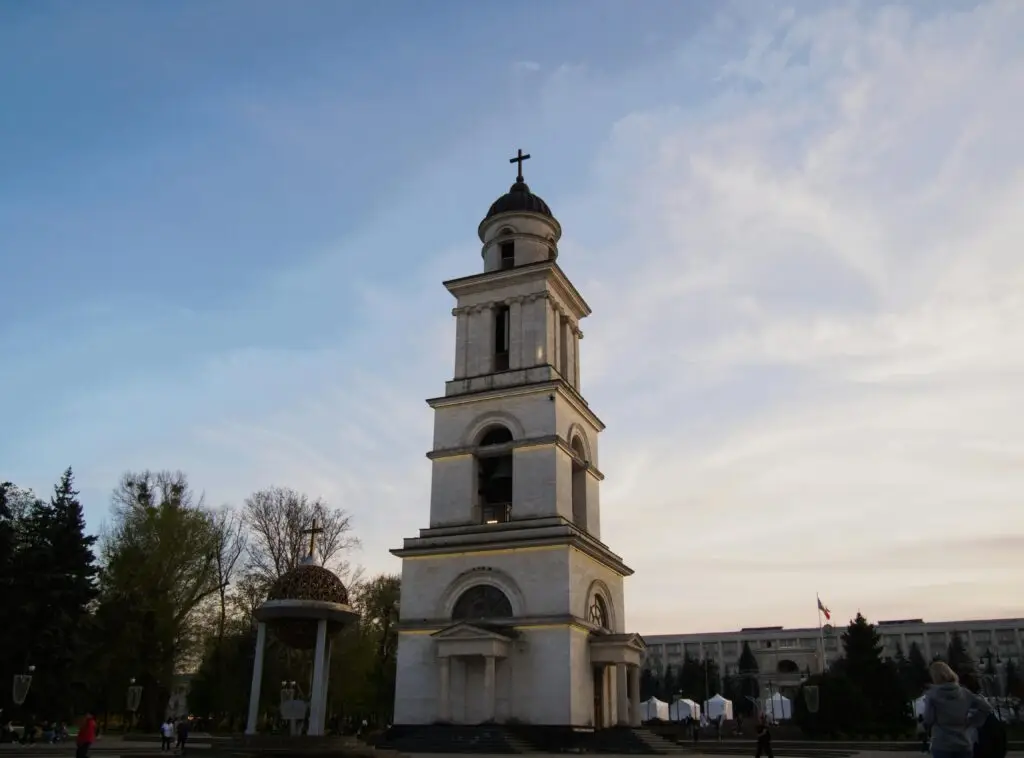
The buildings around the Cathedral Park stand with gentle dignity — white colonnades, yellow facades, modest domes.
In Chișinău, life is close to the ground:
markets filled with fruit and honey, trams rattling past apartment blocks, students studying outside, families strolling at night.
Even in winter the city feels gentle —
light snow on branches, warmth spilling from bakeries, the slow glow of street lamps.
Chișinău embodies the Moldovan soul:
quiet, resilient, warm, subtle.
🍇 A Land of Vine & Cellar
Moldova is vineyard country.
More than almost anywhere in Europe, the landscape is defined by wine — valleys of vines spilling over gentle hills, villages with stone cellars, families tending rows beneath open sky.
Wine here is not only culture; it is memory —
passed down through seasons, kept in barrels beneath homes, shared at weddings, births, and long summer meals.
The Black Sea climate shapes the hills:
hot summers, long autumns, rich soil.
Grapes ripen slowly, their sweetness deepened by time.
The fields stretch in soft green folds.
Morning mist hangs over slopes; sunlight glints on leaves; workers move quietly along rows, speaking low, laughing softly.
The land feels generous —
yielding fruit, warmth, peace.
Even for those who know nothing of wine, the vineyards offer something deeper —
a sense of continuity, rootedness, patience.
🏞 Orheiul Vechi — Stone, River & Ancient Silence
One of Moldova’s most extraordinary landscapes lies northeast of Chișinău —
Orheiul Vechi, an open-air museum of cliffs, river bends, archaeological ruins, and cave monasteries carved from limestone.
The Răut River loops around the site, curling beneath white bluffs that rise above fields.
Atop the cliffs stands a small church, its tower catching the light.
Below, tunnels cut into rock lead to candlelit chambers where monks once prayed.
The wind here carries ancient voices:
Dacian settlements, medieval fortresses, centuries of farmers living close to land.
From the hilltop, the view is immense —
the valley folding like a green ribbon, the river shining as it bends, silence broken only by birds and distant bells.
Evenings are especially powerful —
the sun setting across the steppe,
the cliffs glowing gold,
the church silhouetted against sky.
Orheiul Vechi is not a monument to look at —
it is a place to feel.
⛪ Monasteries — Faith in Stone & Hill
Orthodox Christianity has shaped Moldovan life for centuries.
Monasteries lie across the countryside — in forests, hills, river valleys — quiet sanctuaries of stillness, prayer, and light.
At Căpriana, the white walls stand beneath tall trees, sunlight flickering through leaves.
The air smells of pine and incense; footsteps echo on stone; bells call softly across fields.
Nearby, Hâncu Monastery sits in a wooded valley — a place where nature and spirit intertwine.
Even in silence, the walls seem to sing.
In Transnistrian lands to the east, the Noul Neamț monastery rises beside the Dniester River —
a powerful reminder of faith holding steady through political fracture.
These monasteries are threads connecting village life with eternity.
Their gardens bloom, their icons glow, their halls whisper stories older than memory.
🌾 Villages — Walnut Trees, Clay Walls & Warm Hands
Most of Moldova is rural —
small villages arranged along quiet roads, fields stretching behind houses, orchards of cherry, apple, plum and walnut.
Homes are simple:
whitewashed walls with blue or green trim, gates opening onto gardens full of tomatoes, peppers, sunflowers, grapes.
Chickens scratch in dust; cats nap beneath vines; children play beneath walnut trees.
People live close to land —
sowing, harvesting, making preserves, kneading dough, tending animals.
Autumn is the season of abundance:
grapes gathered, wine pressed, plums dried, corn stored, jars filled with fruit and honey.
Life here feels slow —
not stagnant, but peaceful.
Days defined not by hurry but by need:
bake, gather, fix, share.
Hospitality is instinct.
A visitor is offered bread, wine, soup, conversation —
not as obligation, but as joy.
Village life is Moldova’s heart.
🌳 Codri Forests — Deep Green & Old Quiet
In central Moldova lies Codri, the last remnant of an ancient forest that once covered much of the land.
It is a world of oak, linden, beech, maple — tall trees forming deep shade where birdsong moves like water.
Paths wind through hills; sunlight filters in green; mushrooms appear after rain; deer slip quietly between trunks.
Codri feels untouched —
a sanctuary of stillness.
Its air is cool, earthy, clean.
You walk and hear only leaves, wind, wings —
the forest speaking in old language.
This is Moldova’s memory of wilderness.
🌊 Dniester River — A Quiet Thread of Story
The Dniester River flows along Moldova’s eastern edge, a wide silver path winding through forest and field, village and cliff.
Its banks are peaceful —
fishermen standing beneath poplars, cows grazing, small boats drifting slowly.
The river is history’s witness:
kingdoms rose and fell along it; trade passed; battles came and went; borders shifted like water.
Today, it remains calm —
a place to sit on warm rock and watch birds cross the sky.
🧭 Transnistria — A Parallel World
Along the east lies Transnistria, a breakaway region with its own identity —
Soviet symbols, streets named for history long past, statues of Lenin, wide squares, a different rhythm.
Tiraspol, the de facto capital, feels like time paused —
long boulevards, big monuments, river parks, quiet afternoons.
Though politically complex, the region remains peaceful, lived-in, human —
families picnicking, children laughing, elders playing cards in shade.
It is another layer of Moldova’s story —
a parallel thread, woven into the whole.
🏙 Bălți — Northern Calm
In the north lies Bălți, Moldova’s second city —
a place of broad streets, markets, parks, and everyday life.
Here, the pace is unhurried;
the sky feels wide;
the land around it opens into fields that glow gold in summer.
Bălți feels like the Moldova of work and routine —
shops filled with bread and berries, people coming and going on foot, fields stretching forever.
🌅 Gagauzia — Steppe, Identity & Warmth
In the south lies Gagauzia, a region of Turkic-speaking Orthodox people, farmers and herders living on open steppe.
The land is wide:
low hills, sunflower fields, long roads beneath huge sky.
Villages are simple and warm;
markets lively;
traditions strong.
Gagauzia shows another thread of Moldova —
woven from different language, history, and song, yet bound by land and faith.
🍞 Daily Life — Orchard, Cellar, Table
Moldova’s life unfolds through seasons, home, and table.
Spring brings blossoms to orchards; summer brings cherries, tomatoes, long evenings outside; autumn brings wine, preserves, quiet work; winter brings warmth, soup, stories.
Every home feels like a world:
wells in courtyards; grapevines shading doors; cellars holding barrels, jars, history.
Meals are shared:
hearty soups, fresh bread, vegetables from the garden, fruit from trees, wine from cellar.
Life is modest but rich.
Time is measured in seasons and gatherings.
✨ Language, Culture & Memory
Moldova speaks Romanian, with Russian widely used;
Ukrainian, Gagauz, and others weave into daily sound.
The language is musical —
soft consonants, flowing vowels, warm cadence.
Culture is humble:
songs of field and village,
stories of land and family,
faith woven into daily rhythm.
The people have endured —
empires, boundaries, shifting fates —
yet remain gentle, rooted, hopeful.
🌦 Seasons in Moldova
Spring arrives with blossoms and rain;
fields turn green;
birds return.
Summer is hot, fragrant —
vines heavy, markets colourful, rivers warm.
Autumn is the great season —
harvest, wine, golden hills, smoke from gardens.
Winter is quiet —
snow on fields, wood burning, night deep.
Each season brings its own truth.
🚗 Travelling & Moving Through the Land
Distances are small.
A day can take you from Chișinău to Orheiul Vechi, then to a forest or vineyard, then to a riverside village beneath evening sky.
Roads wander.
Buses link towns;
cars follow hills;
paths lead to quiet.
You travel not to see, but to understand —
to move slowly,
to breathe the land.
💛 Why Moldova Stays With You
Moldova is subtle.
It does not demand your attention —
it earns it.
You remember:
gold hills in late summer,
the silence of Orheiul Vechi,
grapevines whispering over wooden gates,
Orthodox bells across evening fields,
a glass raised beneath walnut trees,
the warmth of strangers becoming friends.
You remember roads lined with poplars,
the peace of monasteries in forests,
the Dniester flowing through dusk.
You remember time slowing,
the earth breathing,
yourself becoming still.
Moldova is not a country you check off —
it is a country you absorb.
It teaches you to look beyond surface,
to hear quiet,
to value small things.
To leave Moldova is to carry a piece of its silence —
a memory of vineyard wind,
wood smoke,
soft voices,
warm stone beneath sun.
Its gentleness endures.
 Related Articles
- Kakslauttanen Arctic Resort
- Top 10 Most Unique Places to Stay in Europe
- 10 Incredible Castles Around the World