
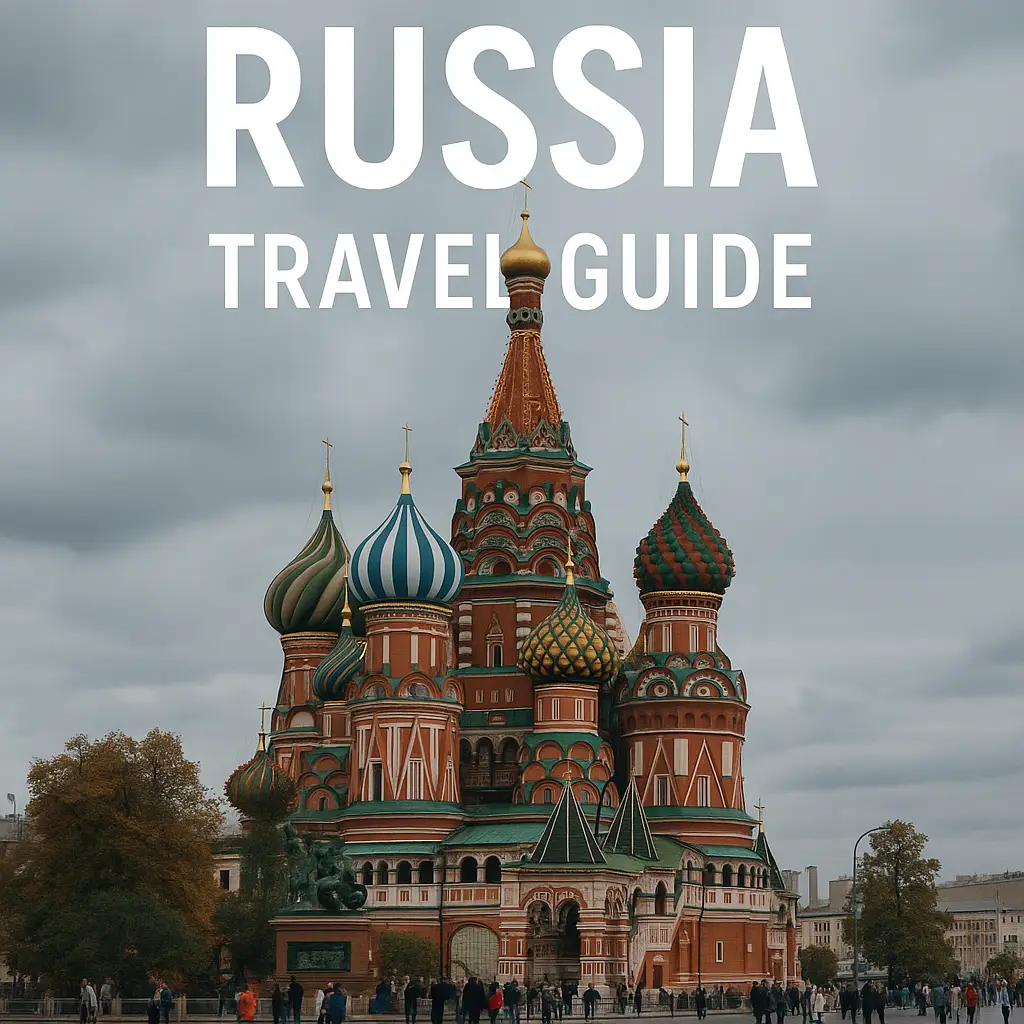
RUSSIA TRAVEL GUIDE
A deep and comprehensive guide covering Moscow, Saint Petersburg, Siberia, Lake Baikal, the Caucasus, the Far East, culture, history, food, nature, transport, and regional insights.
INTRODUCTION: RUSSIA’S IMMENSE SCALE & DIVERSITY
Russia is the largest country in the world, stretching across eleven time zones, from European capitals to Arctic tundra, and from dense forests to volcanic landscapes on the Pacific Rim. Its geography is so vast that traveling through Russia feels like experiencing several different countries in one. It offers cosmopolitan cities filled with imperial palaces, ancient fortresses, Orthodox cathedrals, world-class museums, snowy mountains, remote wilderness, Arctic coastlines, wide rivers, and unique indigenous cultures.
Though known for its historical influence and political complexity, Russia as a travel destination is rich, layered, and unexpectedly diverse. The architecture ranges from baroque palaces and onion-domed churches to futuristic skyscrapers. Nature spans frozen lakes, black-sand beaches, smoking volcanoes, and endless taiga forests. Travelers who explore beyond the major cities discover ancient traditions, rugged landscapes, warm hospitality, and centuries of cultural heritage.
This long travel guide provides a detailed overview of Russia as a destination—its cities, regions, landscapes, history, food, transport, and experiences—perfect for use as a full country page on your website.
1. MOSCOW — A GRAND CAPITAL OF MODERN & HISTORIC CONTRASTS
Moscow is one of the world’s most fascinating capitals—a city where imperial splendor sits beside modern skyscrapers. It has a vibrant cultural life, broad boulevards, artistic metro stations, and a rhythm that mixes old Russia with a fast-paced modern atmosphere.
Red Square & the Heart of Moscow
Red Square is the spiritual and symbolic center of Russia. The most iconic landmark is St. Basil’s Cathedral, its colorful domes resembling a fantasy world. Inside, narrow corridors lead to ornate chapels decorated with frescoes.
The Kremlin, Moscow’s historic fortress, sits along the south side of the square. It contains palaces, cathedrals, museums, and the Russian government’s seat. Visiting the Kremlin offers a deep look at centuries of Russian art and power.
Nearby, Lenin’s Mausoleum, GUM Department Store, and the State Historical Museum add layers of history to the square.
Moscow’s Metro — An Underground Palace System
Moscow’s metro stations are famous for their design—chandeliers, bronze statues, mosaics, marble pillars, and grand halls. Some of the most impressive include Komsomolskaya, Mayakovskaya, Belorusskaya, and Ploshchad Revolyutsii.
The Arbat & Central Neighborhoods
Old Arbat Street has shops, cafés, performers, and historic buildings. New Arbat contrasts with modern glass towers and nightlife. The area around Patriarch Ponds is trendy, with fashionable restaurants and bars.
Culture & Museums
Moscow offers world-class museums such as:
The Tretyakov Gallery, showcasing Russian art
The Pushkin Museum of Fine Arts, with European masterpieces
Museum of Cosmonautics, exploring Russia’s space achievements
Moscow mixes imperial beauty, cultural richness, and modern energy, making it essential for any Russia itinerary.
2. SAINT PETERSBURG — RUSSIA’S CULTURAL CAPITAL
Saint Petersburg is often described as Russia’s most beautiful city. Built by Peter the Great as a “window to Europe,” it features canals, palaces, and bridges reminiscent of Paris, Vienna, and Venice. It is the country’s artistic heart, combining history, grandeur, and romantic scenery.
The Hermitage Museum & Winter Palace
The State Hermitage Museum, one of the largest and most prestigious museums in the world, houses millions of artworks. Its main building, the Winter Palace, is an imperial masterpiece with lavish rooms and gilded halls.
Nevsky Prospekt & City Center
Nevsky Prospekt is the main avenue lined with churches, cafés, shops, and historic landmarks. Along the way, visitors find:
Kazan Cathedral
Anichkov Bridge
Gostiny Dvor shopping arcade
The area around the Church of the Savior on Spilled Blood is one of the most photographed spots in Russia, with its vibrant domes and mosaics.
Peterhof Palace
Often called the “Russian Versailles,” Peterhof is a coastal palace complex famous for its golden fountains, landscaped gardens, and ornate architecture. The Grand Cascade is one of the most impressive water features in Europe.
Tsarskoye Selo & Catherine Palace
The Catherine Palace in Pushkin features the legendary Amber Room and a series of beautifully restored halls. Its blue-and-white façade and expansive gardens make it a must-visit.
White Nights & Bridges
In summer, Saint Petersburg experiences the White Nights, when the sun barely sets and the city celebrates with festivals and late-night river strolls. Watching the bridges rise over the Neva River is a beloved experience.
3. THE GOLDEN RING — ANCIENT TOWNS OF OLD RUSSIA
The Golden Ring is a loop of ancient towns northeast of Moscow, known for wooden houses, onion-domed churches, old monasteries, and traditional craftsmanship.
Suzdal
Suzdal is one of Russia’s most picturesque towns, filled with:
Wooden churches
Pastoral landscapes
Quiet monasteries
Charming countryside
The entire town feels like an open-air museum.
Vladimir
Vladimir features the Golden Gate, Assumption Cathedral, and medieval architecture that offers a glimpse into Russia’s early history.
Yaroslavl, Kostroma & Rostov Veliky
Each town has a unique charm, from riverside views to kremlins and fresco-filled cathedrals.
The Golden Ring is perfect for travelers seeking rural beauty, history, and traditional culture.
4. SIBERIA — ENDLESS WILDERNESS & CULTURAL DIVERSITY
Siberia covers an enormous area stretching from the Ural Mountains to the Pacific. It is known for its forests, lakes, indigenous cultures, and extreme weather. Despite its reputation for remoteness, it offers some of Russia’s most stunning natural landscapes.
Lake Baikal — The Deepest, Oldest Lake on Earth
Lake Baikal in southern Siberia is a natural wonder containing 20% of the world’s fresh surface water. It is the deepest, clearest, and oldest lake globally, surrounded by mountains and forests.
Summer at Baikal
In summer, Baikal is a paradise for:
Hiking
Boat tours
Visiting villages
Exploring the Circum-Baikal Railway
Swimming in icy crystal-clear water
Olkhon Island is the lake’s spiritual heart, known for shamanic traditions, cliffs, and dramatic rock formations.
Winter at Baikal
Winter transforms Baikal into a surreal landscape of thick turquoise ice, frozen bubbles, ice caves, and snow-covered mountains. It is ideal for photographers and adventurers, with opportunities to:
Walk or skate on the frozen lake
Drive across ice roads
Explore frosty cliffs and transparent ice sheets
Baikal is one of Russia’s most extraordinary natural destinations.
Irkutsk — Gateway to Baikal
Irkutsk is a charming Siberian city with historic wooden houses, churches, museums, and a lively cultural scene. Many travelers use it as a base for Baikal excursions.
Novosibirsk & Siberian Cities
Novosibirsk is Siberia’s largest city, with an opera house, museums, and a modern atmosphere. Further east, cities like Krasnoyarsk and Barnaul offer access to mountains, rivers, and nature reserves.
Altai Mountains — Siberia’s Hidden Gem
The Altai Mountains, near Mongolia and Kazakhstan, are one of Russia’s most beautiful natural regions. With alpine lakes, traditional villages, glacier valleys, and petroglyphs, the Altai is known for outdoor adventure, hiking, horseback riding, and spiritual traditions.
5. THE RUSSIAN FAR EAST — VOLCANOES, BEARS & WILD LANDSCAPES
Most travelers don’t realize how wild and spectacular the Russian Far East is. This region offers incredible scenery—volcanoes, geysers, hot springs, tundra, and Pacific coastlines.
Kamchatka Peninsula — Russia’s Land of Fire & Ice
Kamchatka is a volcanic wonderland with steaming craters, lava fields, snow-covered mountains, and bears. It features some of the world’s most active volcanoes.
Top Attractions
Valley of Geysers
Mutnovsky Volcano
Gorely Volcano
Avachinsky Volcano
Black sand beaches near Petropavlovsk-Kamchatsky
Kamchatka feels like an untouched frontier, with helicopter tours and rugged excursions.
Sakhalin Island & Kuril Islands
These islands feature fog-filled coastlines, geysers, volcanos, and unique wildlife. Their remote beauty appeals to adventurous travelers.
Vladivostok — Russia’s Pacific Port
Vladivostok is a coastal city with hills, bridges, seafood markets, and architecture reminiscent of San Francisco. It’s the eastern endpoint of the Trans-Siberian Railway.
6. THE CAUCASUS — MOUNTAINS, CULTURE & RESORTS
Southern Russia meets the Caucasus Mountains, a region known for its dramatic peaks, healing spas, and diverse cultures.
Sochi — Russia’s Black Sea Resort
Sochi combines subtropical beaches, mountains, ski resorts, and palm trees.
Attractions
Olympic Park
Krasnaya Polyana ski area
Botanical gardens
Riviera beaches
Sochi is both a summer and winter destination.
Mount Elbrus — Europe’s Highest Peak
Located in the Caucasus, Mount Elbrus stands at 5,642 meters. It attracts climbers and winter sports enthusiasts from around the world.
Northern Caucasus Villages & Nature
Regions like Dagestan and Kabardino-Balkaria offer ancient fortresses, mountains, canyons, and traditional hospitality.
7. VOLGA REGION — RUSSIA’S HISTORICAL RIVER HEARTLAND
The Volga River flows through central Russia, shaping the culture of cities and villages along its banks.
Kazan — The Tatar Capital
Kazan is one of Russia’s most unique cities, blending Islamic and Orthodox cultures. The Kazan Kremlin, with its mosque and cathedral, symbolizes peaceful coexistence.
The city offers vibrant food markets, lakeside promenades, and a modern stadium.
Nizhny Novgorod
Perched above the Volga and Oka rivers, Nizhny Novgorod features a historic kremlin, picturesque viewpoints, craft markets, and a lively arts scene.
Samara, Saratov & Volgograd
These Volga cities offer river embankments, Soviet history, and cultural attractions. Volgograd, formerly Stalingrad, is home to the towering Motherland Calls statue.
8. THE TRANS-SIBERIAN RAILWAY — THE WORLD’S LONGEST TRAIN JOURNEY
The Trans-Siberian Railway covers nearly 9,300 km from Moscow to Vladivostok. It’s one of the world’s greatest travel adventures, passing through cities, forests, mountains, and steppes.
Travelers experience:
Constantly changing landscapes
Historic towns
Cultural diversity
Endless horizons
The route can continue into Mongolia and China, making it a bucket-list journey.
9. RUSSIAN CULTURE, HISTORY & TRADITIONS
Russian culture is deep and complex, shaped by centuries of empire, religion, art, literature, and political change.
Orthodox Heritage
Russia’s cathedrals and monasteries—like those in Moscow, Saint Petersburg, and the Golden Ring—feature onion domes, icons, and frescoes central to Russian identity.
Literature & Arts
Russia produced some of the world’s most influential authors: Tolstoy, Dostoevsky, Pushkin, Chekhov, and Turgenev. Museums, theaters, and opera houses continue this legacy.
Folk Traditions
Across Russia, folk music, embroidery, dances, and wooden crafts remain important, especially in villages.
Banya (Russian Sauna)
The banya is a cultural staple, combining steam, birch branches, and relaxation.
10. RUSSIAN CUISINE — HEARTY, COMFORTING & REGIONAL
Russian cuisine varies by region.
Staple Dishes
Borscht
Pelmeni (dumplings)
Blini
Beef Stroganoff
Shchi cabbage soup
Kasha porridge
Regional Variations
Siberia features fish, reindeer, and herbal teas. The Caucasus offers grilled meats and spices. Tatar cuisine includes manti, chak-chak, and rich pastries.
11. WEATHER & BEST TIME TO VISIT
Russia’s climate varies dramatically.
Summer
Warm, ideal for outdoor travel, city trips, and Siberian adventures.
Winter
Cold but magical, especially in Moscow, Saint Petersburg, and Siberian regions. Winter brings snow festivals, ice sculptures, and northern landscapes.
Shoulder Seasons
Autumn colors and spring blossoms add beauty, though temperatures fluctuate.
12. TRANSPORTATION IN RUSSIA
Russia’s distances are huge, so transport varies widely.
Trains connect all major cities.
Flights are essential for Siberia and the Far East.
Buses link smaller towns.
River cruises operate on the Volga and other waterways.
13. SUGGESTED ITINERARIES
7-Day Russia Classic
Moscow → Saint Petersburg
10-Day Golden Russia
Moscow → Golden Ring → Saint Petersburg
14-Day European Russia + Siberia
Moscow → Saint Petersburg → Irkutsk → Lake Baikal
21-Day Trans-Siberian Experience
Moscow → Yekaterinburg → Novosibirsk → Irkutsk → Vladivostok
14. TOP 25 PLACES TO VISIT IN RUSSIA
Moscow
Red Square
Kremlin
Saint Petersburg
Hermitage
Peterhof
Catherine Palace
Lake Baikal
Olkhon Island
Kamchatka
Altai Mountains
Sochi
Mount Elbrus
Kazan
Golden Ring
Vladivostok
Yekaterinburg
Nizhny Novgorod
Volgograd
Novosibirsk
Ruskeala Marble Canyon
Karelia lakes
Trans-Siberian Railway
Sakhalin Island
Kuril Islands
Conclusion
Russia is a country of epic scale and endless variety, offering everything from imperial cities and historic landmarks to wilderness adventures and volcanic landscapes. Whether exploring Moscow’s grand avenues, admiring the art and palaces of Saint Petersburg, trekking through Siberian forests, hiking to the volcanoes of Kamchatka, or cruising along the Volga River, Russia reveals a side of itself that is deeper, richer, and more diverse than most travelers expect.