
🇸🇲 Travel Guide — Country Overview
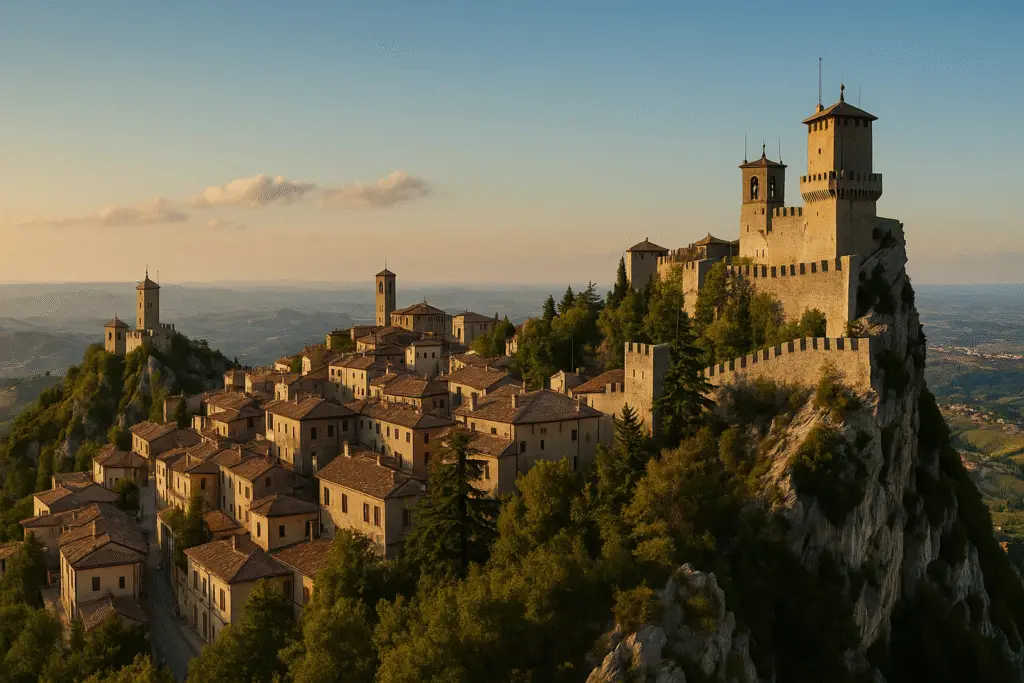
San Marino, officially known as the Most Serene Republic of San Marino, is one of the smallest and oldest countries in the world. Nestled entirely within the rolling landscapes of central Italy, it is a rare place where medieval charm, sweeping mountain panoramas, and deep historical continuity converge. Despite its small size, San Marino feels distinct—its own state, culture, and proud identity shaped by over 1,700 years of uninterrupted independence.
Travelers are often surprised by how much this tiny nation offers. The UNESCO-listed historic center of San Marino City sits dramatically atop Monte Titano, its three medieval towers dominating the skyline. Narrow cobblestone roads wind through fortified walls, opening into stone squares, artisan shops, museums, breathtaking viewpoints, and traditional restaurants. Beyond the capital, visitors discover quiet hilltop villages, small wineries, hiking trails, and peaceful countryside overlooking the fertile Romagna plains.
Unlike more popular Italian destinations that attract overwhelming crowds, San Marino feels more intimate and calm. Visitors can explore ancient fortresses without hurry, wander through charming alleys, sip espresso with locals, and admire spectacular sunsets from floating terraces. Its compact scale makes it easy to experience a great deal even during a single day—yet those who stay longer enjoy hidden corners, cultural traditions, and local rhythms often missed by short-term tourists.
This guide provides an extensive overview of San Marino—its culture, history, attractions, landscapes, towns, food, seasonal highlights, and practical travel advice—crafted to resemble a full country page for a travel website.
Geography & Setting
San Marino lies in central Italy, near the Adriatic Coast in the Emilia-Romagna region. Despite measuring only about 61 square kilometers, the terrain is strikingly varied. The country is dominated by Monte Titano, a rugged limestone mountain that rises 739 meters above sea level. The fortified capital city crowns its peak, allowing panoramic views across miles of countryside: rolling vineyards, golden wheat fields, olive groves, and small medieval villages stretching all the way to the distant sea.
San Marino is divided into nine municipalities, known as castelli (castles), each with its own local character. Most travelers focus first on the historic capital, but the outer castelli offer peaceful landscapes, scenic routes, and traditional living.
Although tiny, San Marino feels larger than its dimensions suggest because its hills rise dramatically above the surrounding Italian plains. Roads twist upward, offering scenic viewpoints at every turn. The atmosphere blends mountain freshness with Mediterranean warmth, making outdoor exploration incredibly pleasant most of the year.
Historical Overview
San Marino claims to be the world’s oldest surviving republic, founded in 301 CE by a Christian stonemason named Marinus, who fled persecution and settled on Monte Titano. His small community eventually grew into an autonomous republic based on collective government and republican ideals.
Despite rising and falling empires surrounding it, San Marino maintained independence through diplomacy, geographical position, and strong local identity. It survived medieval conflicts, Napoleonic expansion, Italian unification, and two World Wars without annexation. According to legend, Napoleon himself respected its sovereignty and even offered to expand its territory—an offer that was politely declined.
During World War II, San Marino remained neutral but offered refuge to thousands of civilians fleeing nearby conflict zones. The country continued peaceful development into the modern era while fiercely preserving historical structures and institutions.
Today, San Marino’s political system remains unique:
it is governed by two Captains Regent who jointly hold authority for six-month terms, reflecting a commitment to shared power and civic equality.
Its history—continuous, stable, and deeply rooted—is central to the national identity.
Cultural Character
San Marino’s culture shares similarities with its Italian neighbors, especially in language, cuisine, and lifestyle. However, the republic has distinct traditions and symbols that reinforce its sovereignty.
Locals emphasize community, respect for tradition, and national pride. The **flag—white and light blue with the state emblem—**is displayed throughout the country. Historical celebrations, such as Medieval Days and the Investiture of the Captains Regent, highlight ritual continuity rarely seen elsewhere. Cultural institutions maintain pre-Renaissance legal codes, archives, and ceremonies.
Religion remains an important part of daily life, with most residents identifying as Christian. Many festivals are tied to religious heritage, while historical reenactments celebrate the founding of the republic.
Even with modern influences, San Marino feels strongly anchored in its medieval foundations. Shops sell traditional crafts—especially ceramics, stamps, and coins—symbols of national identity. Tourism is important, yet life retains a peaceful rhythm, especially outside the capital.
Monte Titano & The Three Towers
San Marino’s most iconic landmark is Monte Titano, rising high above the surrounding region. At its crest stand the Three Towers, the main symbols of the republic. Each played a defensive role during the Middle Ages and offers extraordinary views.
1) Guaita Tower
The oldest and most famous tower, dating to the 11th century, Guaita served as a defensive fortress and a prison. Today, visitors can explore its stone corridors, terraces, and ramparts. From the top, the panorama stretches across rolling farmland toward the Adriatic Sea. The design is stark and powerful, reflecting centuries of vigilance.
2) Cesta Tower
Built on Monte Titano’s highest peak, Cesta houses the Museum of Ancient Weapons. Its collection spans medieval swords, crossbows, and armor. The tower’s position provides one of the best views in the country, especially at sunset when golden light floods the San Marino walls and neighboring Italian hills.
3) Montale Tower
The third tower, smaller and more isolated, is not open to the public. Its tapered design atop a narrow rock peak creates a dramatic silhouette. Historically used as a lookout and prison, it remains an evocative symbol best admired from the walking path between the other towers.
Walking between these towers is the most memorable experience in San Marino. The stone trail hugs cliffs, lined with viewpoints, walls, pine forests, and hanging bridges. Every corner reveals postcard-worthy scenery.
San Marino City (Historic Center)
The capital, officially called Città di San Marino, is a UNESCO World Heritage Site. The city is a medieval labyrinth of stone alleys, steep stairways, elegant palaces, fortified walls, and romantic terraces suspended over valleys.
The historic center is compact and mostly pedestrian-only. Travelers wander without cars, discovering charming corners, artisan workshops, souvenir boutiques, and small cafés. Many buildings date back centuries, restored with care to preserve authenticity.
Top Highlights
Piazza della Libertà
The central square is the symbolic heart of the republic. Locals gather here to socialize, and visitors watch the ceremonial changing of the guard—a colorful event performed by the Guard of the Rock.
The square opens onto dramatic viewpoints, especially at night when lights glow across the valley.
Palazzo Pubblico
Overlooking Piazza della Libertà stands the Public Palace, seat of the government. Its elegant neo-Gothic façade displays the country’s emblem. Inside are decorative council halls, historical archives, and wall frescoes celebrating San Marino’s legacy. The building symbolizes continuity of political independence.
Basilica di San Marino
This neoclassical church, dedicated to Saint Marinus, houses reliquaries of the country’s founder. Its interior is elegant yet restrained: marble columns, vaulted ceilings, and quiet chapels. The basilica remains an active place of worship and a spiritual center.
Museums
San Marino hosts several interesting museums reflecting national identity and artistic heritage. These include historical, artistic, and specialized collections. Even small museums provide a sense of intimacy, allowing visitors to understand the republic beyond its postcard image.
The Nine Castelli (Municipalities)
San Marino is divided into nine historic castelli, each representing a municipality with its own local traditions, architecture, and landscapes. While the capital receives the most attention, exploring these quieter areas reveals rural life, historic villages, wineries, and rolling countryside.
1) San Marino City (Città di San Marino)
The cultural and political heart of the country, perched dramatically on Monte Titano. Known for its towers, medieval walls, museums, and breathtaking views.
2) Borgo Maggiore
Situated just below Monte Titano, Borgo Maggiore is an important commercial center and gateway to the capital. A cable car connects the village to San Marino City, offering a scenic ride over vineyards and terracotta rooftops. Its traditional market, held in the central square, preserves local customs and community spirit.
3) Serravalle
The largest castello by population and home to many modern facilities. Although less historic than the capital, Serravalle offers shopping streets, residential neighborhoods, sports complexes, and scenic hills. The Serravalle Stadium is located here, hosting national sports events. The area’s blend of contemporary living and rural surroundings gives it a balanced feel.
4) Domagnano
A quiet municipality known for its archaeological heritage, including the Domagnano Treasure, a spectacular collection of late-Roman gold jewelry found in the area. The town’s elevated position provides peaceful countryside views, orchards, and vineyards.
5) Fiorentino
Set among gentle hills, Fiorentino combines rural farmland with small stone hamlets. Traditional restaurants and family-run farms highlight local cuisine and agricultural history. Travelers will appreciate its calm environment.
6) Acquaviva
Located near the northwestern border, Acquaviva is known for small workshops, artisan products, and agricultural landscapes. Winding roads lead to scenic overlooks, and the area’s slower rhythm offers a pleasant contrast to the capital.
7) Chiesanuova
A tranquil castello with sweeping mountain views, Chiesanuova lies near the Italian border. Dense woodlands and hilltop vantage points make it appealing for day hikers and countryside drives.
8) Montegiardino
The smallest municipality by population, Montegiardino feels more like a preserved medieval village. Its narrow lanes and stone walls convey the timeless charm of rural San Marino. The surrounding hills are ideal for walking trails and photography.
9) Faetano
Bordered by gentle rivers and farmland, Faetano is one of the most peaceful castelli. The town center features simple architecture and a quiet charm. Tradition plays a strong role here, with seasonal festivals celebrating village customs.
Together, these nine castelli provide a complete picture of San Marino: a blend of medieval heritage, rural charm, and modern life. Exploring beyond the capital helps travelers understand daily rhythms far from the busy squares and scenic viewpoints.
Nature, Landscapes & Outdoor Activities
San Marino’s compact territory is characterized by rugged limestone peaks, gentle valleys, and fertile rolling farmland. Its location between the Apennine Mountains and the Adriatic Sea creates striking contrasts—alpine freshness mixed with Mediterranean warmth.
Although small, the country offers excellent opportunities for hiking, scenic drives, photography, and nature walks.
Monte Titano Trails
A network of paths surrounds Monte Titano, linking its three towers and extending into surrounding countryside. These routes wind through pine forests, along stone walls, and past rocky outcrops. Throughout the day, light changes dramatically, illuminating cliffs and valleys.
The most popular trail connects Guaita – Cesta – Montale, offering continuous scenic viewpoints. It is particularly magical at sunrise or sunset, when colors shift across distant plains and coastal silhouettes appear on the horizon.
Surrounding Hills
Beyond Monte Titano, rural San Marino unfolds in a patchwork of vineyards, olive groves, and wheat fields. Small villages dot the hills, their bell towers rising above terracotta roofs. Cycling and walking routes give visitors access to peaceful corners where birdsong replaces city noise.
Wildlife
The countryside supports foxes, porcupines, hares, and numerous bird species. While wildlife viewing is not a primary attraction, nature lovers enjoy quiet observation and photography.
Viewpoints
San Marino’s elevated terrain creates countless scenic lookouts. Some of the best viewpoints include:
- The path between the Three Towers
- Terraces near Palazzo Pubblico
- Road viewpoints along Via del Pianello
- Sunset spots facing the west toward the Apennines
Clear days offer views extending across the Romagna plains all the way to the Adriatic Sea.
Villages & Rural Life
Life outside the capital feels calm and inviting. Stone houses sit among rolling hills, orchards, and small fields. You’ll find:
- Family-owned trattorias
- Quiet piazzas
- Local markets
- Traditional workshops
- Small chapels
In these areas, heritage blends with routine living—neighbors chat in village squares, elderly residents gather outside cafés, and farmers tend to vineyards and olive trees.
The pace is slow and steady. Many visitors who stay more than one day choose to explore these villages to experience San Marino’s authenticity beyond its famous fortresses.
Culture & Identity
San Marino’s strongest cultural values reflect independence, community, and tradition. Despite being surrounded entirely by Italy, it maintains a unique national character that locals proudly protect.
Language
The official language is Italian, but the Sammarinese dialect preserves unique linguistic elements. English is understood in tourist areas.
Religion
Most residents are Christian, and many local celebrations follow the Catholic calendar. That said, the society is generally open and hospitable to diverse beliefs.
National Symbols
- The Three Towers — central emblem of the country
- The Crowned Shield — national coat of arms
- La Serenissima — nickname referencing San Marino’s ancient stability
Festivals & Celebrations
Traditional events fill the annual calendar. Key highlights include:
- The Investiture of the Captains Regent (every April 1 & October 1): a historic civic ceremony dating back centuries.
- Medieval Days: lively reenactments, markets, music, and parades.
- National Holiday, September 3: commemorating Saint Marinus and the republic’s founding.
These celebrations underscore San Marino’s continuity as one of the world’s oldest republics.
Cuisine & Gastronomy
San Marino’s cuisine resembles that of neighboring Emilia-Romagna and Marche but includes local specialties. The food emphasizes fresh, seasonal produce, mountain herbs, handmade pasta, and locally raised meats.
Key Influences
- Rustic mountain traditions
- Italian coastal ingredients
- Local farm products
Food Culture
Meals are social and leisurely. Family gatherings often revolve around homemade pasta, cured meats, and regional wines. Traditional piadina (flatbread) is common, served warm with cheese and cured ham.
Local pastries, often filled with nuts and honey, appear during festivals and holidays.
Wine
The surrounding hills produce small-scale red and white wines. Vineyards remain family-run, and wine has deep cultural importance, especially during celebrations.
Traditional Dishes of San Marino
Although strongly influenced by Italy, San Marino has its own traditional recipes passed down through families. When you explore the republic, these dishes help you understand its agricultural heritage and mountain culture.
✅ Famous Local Foods
Torta Tre Monti
Perhaps the most iconic dessert of San Marino, Torta Tre Monti represents the Three Towers. It is made of layered wafers filled with chocolate and hazelnut cream, then covered in rich chocolate. Dense and sweet, it pairs perfectly with espresso.
Strozzapreti
A hand-rolled pasta similar to twisted ribbons, often served with meat ragù, mushrooms, or herbs. Its name humorously translates to “priest stranglers.”
Passatelli
A comforting dish made from breadcrumbs, Parmesan cheese, and eggs, pressed into noodles and served in broth. It is popular in winter.
Piadina Sammarinese
A regional variation of the classic flatbread; it can be thicker than the nearby Romagnolo version. It is commonly filled with cured meats, soft cheeses, or grilled vegetables.
Cacciatello
A baked custard dessert, simple and rustic, often flavored with lemon or honey.
Rabbit Stew
A slow-cooked countryside dish prepared with herbs, white wine, and vegetables. It reflects San Marino’s rural traditions.
Local Ingredients
- Fresh cheeses (especially soft cow’s cheese)
- Prosciutto and salami
- Truffles from nearby forests
- Chestnuts and wild herbs
- Local honey and nuts
These ingredients appear throughout the country’s cuisine and highlight its connection to the surrounding hills.
Museums & Cultural Attractions
While San Marino is small, it offers a surprising number of museums. These institutions focus on history, craftsmanship, politics, curiosities, and the republic’s national identity.
✅ Top Museums
Museo di Stato (National Museum)
Located in the historic center, the National Museum houses archaeological artifacts, paintings, sculptures, coins, and documents illustrating San Marino’s long history. Exhibits range from Etruscan and Roman times to medieval and modern eras, giving an excellent overview of the country’s cultural evolution.
Museum of Ancient Arms
Inside the Cesta Tower, this museum displays weapons collected over centuries — swords, armor, crossbows, early firearms. The thematic layout helps visitors understand medieval warfare and the defensive role of Monte Titano.
Public Palace (Palazzo Pubblico)
While technically a government building, it functions like a museum. Visitors can enter and see ornate council rooms, historical documents, and symbolic decorations. It remains central to civic life, hosting ceremonies and official events.
Wax Museum
This museum features scenes from San Marino’s historical past alongside international figures. While modest, it offers a fun and educational experience.
Museum of Curiosities
Dedicated to unusual human achievements and rare objects — miniature creations, bizarre inventions, records — it offers light-hearted entertainment.
Modern & Contemporary Art Galleries
Small but significant, these galleries feature works by national and international artists. Rotating exhibitions highlight the republic’s efforts to support culture beyond its medieval identity.
Shopping & Local Crafts
San Marino is known for unique artisan goods and duty-free shopping. Visitors can explore everything from handcrafted items to luxury boutiques.
✅ Popular Purchases
Ceramics
Traditional ceramics feature earthy tones, floral motifs, and regional patterns. Workshops throughout the republic sell handmade pottery, tiles, and decorative pieces.
Stamps & Coins
San Marino issues its own stamps and euro coins, cherished by collectors worldwide. They often feature cultural themes, historic anniversaries, or artistic designs.
Leather Goods
Because of its proximity to Italian artisan centers, San Marino offers high-quality leather bags, belts, and accessories.
Food Products
- Olive oil
- Local honey
- Herbal liqueurs
- Truffle sauces
These make perfect souvenirs.
Duty-Free Shopping
San Marino is famous for tax-free shopping. Electronics, perfumes, fashion brands, and jewelry can be found at competitive prices. Most shops are located in San Marino City, Borgo Maggiore, and Serravalle.
Religion & Traditions
Religion plays an important cultural role in San Marino, shaping festivals, architecture, and community life.
Major Religious Sites
- Basilica di San Marino
- Numerous small chapels throughout the castelli
- Religious artworks preserved in museums and churches
Celebrations
Religious and civic traditions often merge during major festivals, reinforcing a sense of unity.
Festivals & Events
San Marino hosts several unique events that showcase its identity, history, and community spirit.
✅ Key Annual Events
Investiture of the Captains Regent
Held on April 1 and October 1, this ancient ritual installs the two new heads of state every six months. The ceremony includes formal processions, traditional dress, music, and public gatherings.
Medieval Days (Giornate Medievali)
A summer celebration in San Marino City featuring:
- Knight reenactments
- Parades
- Archery shows
- Artisan markets
- Street performances
The city becomes a living time capsule, immersing visitors in medieval culture.
Feast of Saint Marinus (September 3)
Honors the founder of San Marino. Celebrations include:
- Religious services
- Historical commemorations
- Fireworks
- Music in town squares
Music & Cultural Festivals
Throughout the year, open-air concerts, theater productions, and storytelling events bring people together in historic settings.
These festivals reflect both reverence for tradition and a living cultural spirit.
Architecture & Urban Character
San Marino’s architecture blends medieval fortifications with neoclassical buildings and rural stone homes. Because urban development has been carefully controlled, the country maintains an authentic historical appearance.
Notable Characteristics
- Defensive walls and gates
- Bastions and watchtowers
- Stone alleyways
- Terraced streets
- Aristocratic homes with carved façades
- Neoclassical religious buildings
The most striking visual icon remains the Three Towers, rising from Monte Titano’s rocky spine, framed by evergreen trees and stone pathways.
Even modern districts respect the surrounding environment, working within the rugged topography rather than against it.
Seasons & Best Time to Visit
San Marino experiences four distinct seasons influenced by its elevation and Mediterranean-inspired climate.
✅ Spring (March – May)
- Mild weather
- Flowers blooming across hillsides
- Ideal for walking & photography
Tourist numbers increase in late spring, but the atmosphere remains relaxed.
✅ Summer (June – August)
- Warm to hot
- Long sunny days
- Lively plazas
- Festivals & outdoor events
This is the busiest season, especially during Medieval Days, but mornings and evenings are peaceful.
✅ Autumn (September – November)
- Pleasant temperatures
- Clear skies
- Harvest season
- Beautiful foliage
A favorite time for food lovers and hikers.
✅ Winter (December – February)
- Coldest season
- Occasional snowfall
- Quiet atmosphere
- Romantic scenery
The historic center becomes especially atmospheric under snow, though some outdoor routes may be slippery.
Suggested Itineraries
San Marino is compact enough to explore in a single day, but spending more time allows deeper immersion into its medieval atmosphere, quiet villages, and countryside.
Below are sample itineraries suited for different trip lengths.
✅ One-Day Itinerary: Classic Highlights
Morning
- Arrive at Borgo Maggiore
- Take the cable car to San Marino City
- Stroll through historic alleys
- Visit Guaita Tower
- Continue along the ridge walkway to Cesta Tower
Lunch
- Enjoy traditional cuisine in the historic center
Afternoon
- Visit Basilica di San Marino
- Explore Piazza della Libertà
- Tour Palazzo Pubblico
- Wander shops & viewpoints
Evening
- Sunset from Monte Titano overlooking the Romagna plains
➡ Perfect for travelers short on time but eager to see the essentials.
✅ Two-Day Itinerary: Culture + Nature
Day 1 — City & Towers
- Same as one-day itinerary
Day 2 — Villages & Countryside
- Explore lesser-known castelli such as:
- Borgo Maggiore
- Montegiardino
- Domagnano
- Visit small museums
- Optional nature walk around Monte Titano
- Dinner outside the capital in a rural trattoria
➡ Ideal for visitors wanting a balanced cultural & rural experience.
✅ Three-Day Itinerary: Deep Dive
Day 1
- Historic center & towers
Day 2
- Museum visits
- Palazzo Pubblico interiors
- Special exhibitions
- Relaxed shopping
Day 3
- Drive or hike around countryside
- Explore Chiesanuova & Acquaviva
- Stop at scenic viewpoints
- Quiet evening taking in panoramic views
➡ Best for relaxed travelers who want to absorb San Marino without rush.
How to Get to San Marino
Because San Marino has no airport or train station, travelers arrive through Italy. The nearest Italian region is Emilia-Romagna, with convenient transport links to the republic.
✅ Closest Airports
- Rimini Airport (Italy) — nearest
- Bologna Airport (Italy) — major international connections
- Florence Airport (Italy) — farther, but possible
Most visitors fly to Bologna or Rimini, then continue by bus or car.
✅ By Train
There is no train service inside San Marino.
The nearest station is:
- Rimini Railway Station (Italy)
From Rimini, buses run to San Marino City.
✅ By Bus
Buses connect:
- Rimini → San Marino City
The journey takes about 45–60 minutes.
✅ By Car
Driving is an excellent way to explore both San Marino and surrounding Italy. Roads climb steadily into the hills, offering scenic views. Parking garages are available at the base and near city gates.
Transportation Within San Marino
San Marino is small, and the historic center is pedestrian-friendly.
✅ Walking
Most exploration is done on foot. The old town’s narrow streets, staircases, and cobblestone alleys make walking the best way to experience it.
✅ Cable Car
The cable car connects Borgo Maggiore ↔ San Marino City, offering a beautiful alternative to driving up Monte Titano.
✅ Public Buses
Local buses connect major castelli, but service may be limited compared to larger countries.
✅ Driving
Useful for visiting rural castelli. Roads are generally well maintained but can be narrow and steep.
Accommodation (General Guidance)
San Marino offers a modest selection of hotels, guesthouses, and rural lodges. While choices may be fewer than in large Italian cities, the atmosphere is peaceful and scenic.
✅ Best Areas to Stay
San Marino City
- Ideal for first-time visitors
- Close to major attractions
- Romantic atmosphere at night
Borgo Maggiore
- Good access to cable car
- Residential feel
Countryside Castelli
- Rural views
- Quiet, slow pace
- Great for hiking & photography
Some travelers choose to stay in Rimini or nearby Italian towns and make day trips to San Marino, but staying within the republic offers a more immersive experience.
Safety & Practical Information
San Marino is very safe, with low crime rates and a calm atmosphere.
✅ Language
- Italian is official
- English is widely understood in tourist areas
✅ Currency
- Euro (€)
Although not part of the EU, San Marino uses the euro and issues unique euro coins.
✅ Time Zone
- CET / CEST (same as Italy)
✅ Electricity
- 230V, Type C/F plugs (European standard)
✅ Tipping
Tipping is not required but appreciated for excellent service.
✅ Water
Tap water is safe to drink.
Money & Costs
San Marino’s prices are similar to those in neighboring Italy.
✅ Typical Price Ranges
- Meals: moderate to high depending on style
- Hotels: moderate range, a few upscale options
- Museums: reasonable entrance fees
Duty-free shopping can provide excellent value on perfumes, fashion, and electronics.
Language & Communication
Italian is the main language, but English is spoken by many in hospitality and tourism.
The Sammarinese dialect is unique and rarely heard outside the republic. Street signs are generally in Italian; however, tourist areas provide occasional English explanations.
Recommended Photography Spots
San Marino is incredibly photogenic. Highlights include:
- View from Guaita Tower
- Trail between Guaita & Cesta
- Piazza della Libertà
- Terraces near Palazzo Pubblico
- Rural hills around Montegiardino
- Sunset viewpoints facing the Adriatic
Early morning or late afternoon creates dramatic shadows over valleys and cliffs.
Atmosphere & Travel Style
San Marino is ideal for travelers who enjoy:
- Medieval architecture
- Slow exploration
- Nature viewpoints
- Culture & history
- Photography
- Calm environments
Unlike major Italian cities, it avoids overwhelming crowds. Even during peak season, quiet corners remain accessible.
The republic’s elevated setting creates a feeling of refuge: peaceful and airy, far from urban noise.
Who Will Love San Marino?
✅ Great For:
- History lovers
- Culture & architecture fans
- Couples seeking romantic scenery
- Photographers
- Road trippers
- Slow-travel explorers
- Families looking for easy sightseeing
🚫 Not Ideal For:
- Travelers seeking nightlife
- Visitors wanting a beach holiday (Rimini suits them better)
San Marino appeals most to those who enjoy atmosphere rather than fast-paced attractions.
Responsible Travel
San Marino preserves its ancient heritage carefully. Visitors can help protect:
- Historic structures
- Viewpoints & nature trails
- Cultural traditions
Travel respectfully — avoid climbing fortification walls, stay on marked paths, and support small local businesses.
Historical Deep-Dive
San Marino’s story begins in 301 CE, when a stonemason named Marinus fled Roman persecution and settled on Monte Titano. According to tradition, he built a small Christian community dedicated to faith, labor, and modest life. Over time, this settlement evolved into a self-governing community with strong civic principles.
During the Middle Ages, San Marino formed a communal republic, adopting elected bodies and councils. Its mountainous defense, strategic diplomacy, and cohesive population helped it survive while other small states disappeared. Monte Titano’s natural stronghold allowed San Marino to resist attacks and negotiate from relative security.
By the 13th century, San Marino had a stable political system guided by councils of citizens. In 1243, it introduced the unique role of two Captains Regent, serving jointly as heads of state for six-month terms. This system — still in place today — was built to prevent consolidation of power and ensure balance.
In subsequent centuries, San Marino preserved autonomy despite political turbulence in Italy. It survived conflicts between regional lords, popes, and imperial forces by maintaining neutrality and negotiating alliances.
In the late 18th century, Napoleon Bonaparte recognized San Marino’s sovereignty. He reportedly respected the republic’s independence and even offered to reward it with additional territory. San Marino declined — preferring to maintain modest borders and peaceful coexistence.
The 19th century brought the unification of Italy, and many small states were absorbed into the new kingdom. San Marino again preserved independence, partly because of its diplomatic ties and its assistance to Italian unification figures, including Giuseppe Garibaldi.
During World War II, San Marino remained neutral but provided refuge to thousands of civilians. Despite its small size, it sheltered those fleeing bombing campaigns and political persecution. This humanitarian legacy strengthened its international standing.
Post-war, San Marino modernized while keeping traditions intact. It established formal relations with global partners, developed responsible industries, and preserved its ancient political institutions. Joining the UNESCO World Heritage List helped promote conservation of Monte Titano and the historic city.
Today, San Marino stands as a rare example of an unbroken republic — one of the oldest continuous states in the world, surviving through diplomacy, community cohesion, and a careful balance of tradition and adaptation.
Government & Political System
San Marino’s political structure is unique, shaped by centuries of republican development.
✅ Captains Regent
At the head of state are two Captains Regent, elected every six months by the Grand and General Council. They rule jointly and equally, ensuring distributed power. Their short terms prevent domination by any single individual or political faction.
✅ Grand and General Council
A legislative body of 60 members, elected by citizens. It enacts laws, approves budgets, and oversees political institutions.
✅ Congress of State
Acts as the executive branch, appointed by the Grand and General Council. It manages day-to-day administration and national affairs.
✅ Judicial System
San Marino has its own courts, independent from Italy. Its legal system incorporates ancient statutes mixed with modern legal principles.
The political system reflects San Marino’s commitment to shared governance, consensus, and civic continuity.
Arts & Cultural Expression
San Marino supports both traditional and contemporary artistic expression. Medieval architecture, religious carvings, frescoes, and stonework are visible throughout the historic center.
Modern galleries and public exhibits encourage new artistic voices, bridging past and present.
Artistic Themes
- History and myth of Saint Marinus
- Mountain landscapes
- Civic symbols
- Medieval heritage
Music festivals, theater performances, and cultural exhibitions enliven public squares. Small ensembles play classical music inside historic churches, while open-air stages host modern styles during summer.
Education & Society
San Marino maintains a strong focus on education. Schools teach Italian language, local history, and civic identity. Many students pursue higher education abroad and sometimes return to contribute to the republic.
Society prioritizes community ties. Small population size encourages familiarity — families know each other through generations. Public events deepen social cohesion.
Economy
San Marino’s economy combines tradition and modernity.
Key Sectors
- Tourism
- Crafts
- Finance & services
- Light manufacturing
- Agriculture (olive oil, wine, grains)
Tourism remains central, with visitors drawn to historic heritage and dramatic scenery. The country’s stamp and coin production, designed for collectors, contributes niche income and cultural visibility.
Tax regulations attract certain international businesses, though the government balances economic opportunity with international transparency standards.
Fun Facts About San Marino
- One of the oldest republics in the world (founded in 301 CE).
- Entirely surrounded by Italy.
- Uses the euro, issues its own unique coin designs.
- Both heads of state change every six months.
- The national soccer team is famous for its passion despite limited success — scoring a goal in international competition is celebrated nationwide.
- Its UNESCO site covers the historic center + Monte Titano.
- San Marino once sheltered more than 100,000 refugees during WWII, despite having only a few thousand residents.
- The Three Towers appear on the national flag and coat of arms.
- It has no national railway.
- One of the smallest countries in the world by size and population.
Atmosphere & Travel Impressions
Visiting San Marino feels like stepping into a preserved medieval world balanced on mountaintops. The fortress skyline dominates every viewpoint, while narrow stone streets lead past traditional houses, elegant government buildings, and lookout terraces.
The energy is peaceful. Shops sell ceramics, stamps, and artisan crafts; cafés spill into small squares; medieval flags wave in the breeze. In quieter corners, pine trees and rocky cliffs overlook vast plains stretching to the Adriatic Sea.
Sunset paints the valleys gold, and lights from distant Italian towns sparkle below like constellations inverted on the earth. Evenings are calm, with gentle conversations in restaurants and soft footsteps echoing along stone walls.
Despite modernization, the country preserves dignity, simplicity, and a timeless rhythm.
Final Summary
San Marino is a remarkable destination — small, elevated, and deeply historic. It offers:
- One of Europe’s best-preserved medieval capitals
- The dramatic Three Towers of Monte Titano
- UNESCO-listed architecture and civic spaces
- A unique political system, unchanged for centuries
- Stunning viewpoints across Italy
- Rural villages rich in tradition
- Seasonal festivals and cultural events
- A peaceful, intimate travel experience
Whether you visit for a day or stay longer, San Marino rewards slow exploration. Wander along fortress walls. Sit in a quiet piazza. Watch the light change across the plains. Experience a republic that has survived nearly two thousand years while preserving its identity.
Small yet inspiring, ancient yet alive — San Marino is a destination unlike any other in Europe.
 Related Articles
- Kakslauttanen Arctic Resort
- Top 10 Most Unique Places to Stay in Europe
- 10 Incredible Castles Around the World