
🇸🇰 Slovakia Travel Guide — Complete Country Overview
Slovakia, a landlocked nation in the heart of Central Europe, is a country of mountains, forests, and deep-rooted traditions. While often overshadowed by its more famous neighbors — Austria, Hungary, Poland, and the Czech Republic — Slovakia offers a unique atmosphere that blends medieval history, dramatic landscapes, and village life that feels unchanged for generations. It is a place where castles crown river bluffs, wooden churches glow with centuries of spiritual presence, and the High Tatras rise like stone cathedrals above pine valleys and glacial lakes. Travelers who come here quickly notice that Slovakia is not a destination of grand cities and dazzling crowds, but one of intimacy — small towns, mist-wrapped trails, quiet monasteries, and folk culture that continues to shape daily life.
The strength of Slovakia lies in its balance of nature and heritage. This is a country where wilderness begins at the edge of towns, where locals escape for hikes before breakfast, and where mountains occupy a central place in the national identity. The High Tatras — the smallest alpine range in Europe — create a skyline of jagged peaks, while the Low Tatras, Malá Fatra, Slovak Paradise, and other ranges form a mosaic of forests, meadows, gorges, and caves. Castles once guarded trade routes through river valleys; their ruins still overlook villages and vineyards, their stones carrying stories of kings, nobles, and battles long past. Beneath the mountains lie karst landscapes containing some of Europe’s most spectacular caves, while hot springs bubble below the surface, forming spa towns that have soothed generations of travelers.
Slovakia is small enough to cross in a few hours, yet varied enough to fill weeks of exploration. In cities like Bratislava and Košice, baroque squares, pastel façades, Gothic cathedrals, and quiet courtyards offer an elegant urban experience. But beyond them stretch regions with strong cultural identity: mountainous northern villages where shepherding and woodworking endure; wine-growing valleys in the southwest; medieval mining towns in the center; and eastern plains flavored by diverse traditions. In many places, life moves slowly — wooden houses, church spires, and green hills framing scenes that feel timeless.
Slovaks are reserved at first, but warm and straightforward once conversation begins. Respect for nature, family, and tradition defines their worldview. Festivals throughout the year celebrate music, crafts, and folk costumes. Meals emphasize simplicity and heartiness — dumplings, potatoes, soups, and mountain cheeses. With its forests, quiet roads, and small towns, Slovakia invites thoughtful travel: slow hiking, long meals, village strolls, and moments of reflection on castle terraces or at the edge of alpine lakes.
This guide offers an in-depth journey through Slovakia’s history, landscapes, towns, culture, and spirit.
Geography & Landscape
Slovakia occupies a central position in Europe, acting as a transition zone between western plains and eastern mountains. The land is defined by elevated terrain: roughly two-thirds of the country is covered by hills and mountains belonging to the Carpathian arc. The most iconic of these are the High Tatras, which form a natural border with Poland. Their peaks, often snowcapped, soar above narrow valleys carved by glacial rivers. Sharp ridges, turquoise lakes, and meadows dotted with alpine flowers create a landscape that feels far larger than the country’s compact size.
To the south and west, the land softens into lowlands. The Danube River — central to European history — flows along Slovakia’s southern edge. Its wide banks hold wetlands, floodplains, and protected areas rich with birds and wildlife. Fertile soil supports vineyards, orchards, and grain fields, forming a contrast to the rugged north.
Central and northern Slovakia are dominated by forested mountains such as the Low Tatras, Veľká Fatra, Malá Fatra, and Slovak Paradise. These are landscapes filled with gorges, cliffs, waterfalls, and rugged trails. Slovakia’s terrain also includes karst plateaus riddled with caves; many have become UNESCO sites, famous for unique rock formations, underground rivers, and ice chambers preserved for millennia.
Rivers such as the Váh, Hron, Orava, and Hornád wind through valleys where towns grew over centuries. Wooden churches and medieval castles overlook their curves, while quiet farms and orchards line their banks. Winter blankets these regions with snow, and skiing becomes a seasonal ritual. In summer, the mountains fill with hikers, shepherds, and berry collectors; the scent of pine, wet stone, and wildflowers fills the air.
Because Slovakia’s landscape changes quickly, a short drive can take you from vineyards to alpine crags, from rolling meadows to primeval forest. The country feels larger than the map suggests because every region holds its own terrain, folklore, dialect, and rhythm.
Historical Overview
Slovakia’s history is layered and multilingual, reflecting centuries at the crossroads of Central Europe. Evidence of human life dates back to prehistoric times, with settlements in river valleys where hunting and farming developed early. One of the most famous prehistoric artifacts — the Venus of Moravany — was found here, symbolizing a long human presence.
In antiquity, Celtic tribes lived in what is now Slovakia, establishing fortified settlements and trade networks. They were followed by Germanic tribes and later by the Romans, who controlled nearby regions. While Rome did not fully integrate Slovakia into its empire, its influence radiated through trade and cultural exchange.
The arrival of the Slavs in the 5th and 6th centuries laid the foundation for future states. In the 9th century, parts of Slovakia belonged to Great Moravia, an early Slavic empire that played a crucial role in spreading Christianity and Slavic literacy. Saints Cyril and Methodius introduced the Glagolitic script here, shaping Slavic culture for centuries to come.
After Great Moravia’s fall, Hungary expanded northward. From the 10th century onward, Slovakia became part of the Kingdom of Hungary — a relationship that lasted nearly a thousand years. During this era, towns grew along trade routes, mines enriched the treasury, and German craftsmen and settlers helped shape architecture, language, and urban planning. Medieval mining towns such as Banská Štiavnica and Kremnica produced precious metals that supported European economies.
In the 16th and 17th centuries, the Ottoman Empire invaded Hungary; the Hungarian crown and nobility retreated to present-day Slovakia, making Bratislava (then Pressburg) the capital of the weakened kingdom. For over two centuries, Hungarian kings were crowned here — a legacy still visible in the city’s architecture and monuments.
In the 19th century, Slovak national consciousness expanded. Writers, clergy, and intellectuals worked to preserve the Slovak language and identity within the multiethnic Austro-Hungarian Empire. After World War I, the empire collapsed, and Slovakia joined the newly formed Czechoslovakia. This state brought industrial growth but also ethnic tensions.
World War II fractured Czechoslovakia; Slovakia became a nominally independent, German-aligned state. After the war, Czechoslovakia reformed under communist rule. The decades that followed brought modernization but also repression. The Prague Spring of 1968 and subsequent Soviet invasion marked a turning point, though everyday life continued to evolve quietly.
In 1993, after the Velvet Revolution and the peaceful split of Czechoslovakia, Slovakia became an independent republic. Free elections, economic restructuring, and integration into European institutions followed. Today, Slovakia is a member of the European Union and NATO, balancing modern development with preservation of tradition.
Slovakia’s history is not characterized by vast empires of its own but by endurance — culture preserved through changing powers, identity carried by language, faith, and memory.
Regions, Cities & Towns
Slovakia’s regions vary remarkably in terrain, history, and atmosphere. Though the country is small, moving from west to east or north to south feels like crossing distinct cultural landscapes.
Bratislava & the Western Lowlands
Bratislava, the capital, sits along the Danube, close to both Austria and Hungary. The city’s location has shaped its identity for centuries: it once served as the coronation seat of Hungarian kings, later becoming a crossroads of cultures and ideas. Today, Bratislava blends medieval streets, baroque palaces, modern riverside development, and forests that creep down from the Little Carpathians.
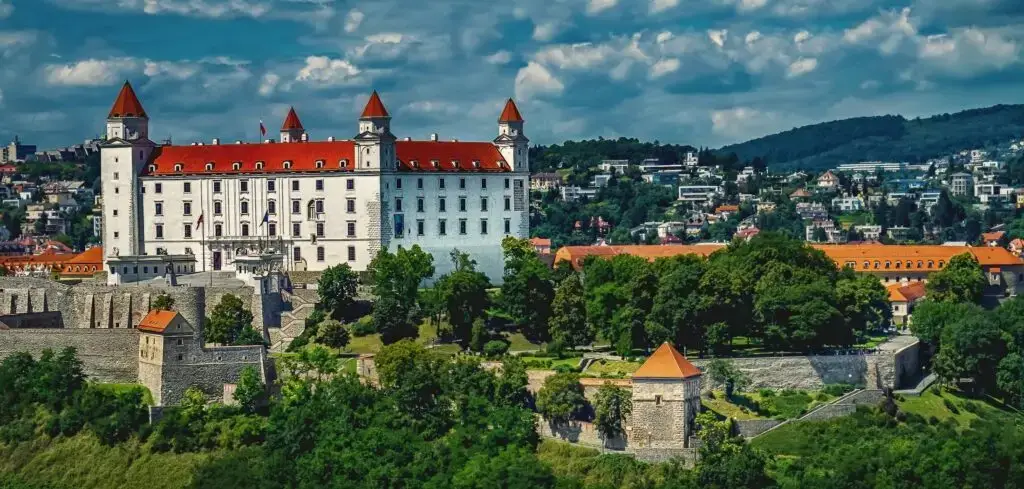
The old town is a quiet maze of pastel buildings, stone courtyards, Gothic fragments, and baroque churches. Cafés spill onto narrow streets; fountains gurgle in shaded squares; and vaulted wine cellars host long dinners. Above the Danube rises Bratislava Castle — a white rectangle with four towers — watching over the city. Its hilltop terraces give broad views toward Austria and the flatlands stretching to Hungary.
Bratislava is compact and calm compared to other capitals. Local life feels intertwined with nature; a short walk from the center leads into woodland trails, vineyards, and villages overshadowed by castle ruins. Summer sees the Danube become a social thread — cyclists, paddlers, and families gather near its wide banks.
To the north, Trnava preserves a religious heritage that earned it the nickname “Little Rome” for its concentration of churches. West of Bratislava, vineyards shape the foothills; small wine towns host autumn festivals celebrating harvest traditions.
The Central Highlands
Central Slovakia is dominated by old mining towns, hills, and dense forests. This region was one of Europe’s richest mining centers during the Middle Ages; silver, gold, and copper funded palaces, guilds, and exquisite churches. Today, towns like Banská Štiavnica, Kremnica, and Banská Bystrica still carry a quiet elegance.
Banská Štiavnica, a UNESCO site, is perhaps Slovakia’s most romantic small town — steep cobbled alleys, Renaissance houses, baroque churches, old mining buildings, and two castles that seem to perch protectively over the town. It sits in an ancient volcanic caldera, surrounded by forests and lakes known as tajchy — artificial reservoirs built by miners centuries ago. The town draws artists, writers, and hikers who value its dreamy atmosphere.
Nearby Kremnica has minted coins for over 700 years. Its town square is framed by pastel façades and the castle complex; narrow streets climb toward slopes where pine and beech forests begin.
Banská Bystrica, larger and livelier, retains a grand central square lined with Renaissance houses and small museums. Beyond the town rises the Low Tatras and the volcanic mountains of Štiavnica, making outdoor excursions easy.
Nature here feels intimate — forests begin at doorsteps, trails lead to meadows dotted with sheep, and the scent of resin and damp soil lingers after rain.
Northern Slovakia & the Tatras
The northern regions illustrate Slovakia at its most dramatic. The High Tatras lift like a stone wall above valleys filled with wooden chalets, grazing meadows, and forests. Their peaks — Gerlachovský štít, Lomnický štít, and others — give the country its alpine soul. Jagged ridges rise suddenly, creating a skyline more rugged than many larger mountain ranges. Small mountain lakes — tarns formed by glaciers — shimmer beneath steep cliffs. In summer, trails cross wildflower meadows and scree slopes; in winter, skiers glide down icy runs beneath sharp summits.
At the foot of these mountains lie towns such as Poprad, Starý Smokovec, and Tatranská Lomnica. They serve as gateways to ridges, waterfalls, and plateaus where bears, chamois, and eagles still roam. Wooden cabins in meadow clearings feel like outposts of calm; mornings bring mist, cold air, and slow sunshine creeping across peaks.
West of the Tatras lie the Orava and Liptov regions — pastoral lands dotted with traditional wooden houses and framed by foothill forests. Orava Castle, perched on a limestone bluff above the river, is one of Slovakia’s most arresting fortresses — towers stacked on a cliff, connected by narrow stairways and courtyards. Villages in this region still preserve folk craft: carved timber balconies, painted shutters, and steeply pitched roofs.
Eastern Slovakia
Eastern Slovakia feels older and more varied. The city of Košice centers around a long pedestrian boulevard framed by elegant townhouses, fountains, and small parks. At its heart rises St. Elisabeth Cathedral, a Gothic masterpiece. Košice is lively yet intimate, with a student population, cafés, theaters, and galleries lining its streets. Much of the city’s pleasure comes from wandering — discovering courtyards, quiet churches, and wine cellars beneath historic buildings.
South of Košice lie Tokaj vineyards; northward, the land rises into volcanic hills and forested valleys. Wooden churches, built without nails and decorated with angelic frescoes, glow with quiet reverence. Eastern castles appear suddenly on crags, guarding trade routes long faded.
The region blends influences from Slovak, Hungarian, Rusyn, and Roma communities. Market squares reflect this mix — bakeries sell sweet rolls next to shops offering paprika, honey, and regional spirits. Rural life remains strong; farmers’ carts still appear in autumn as families store potatoes, apples, and cabbage for winter.
Culture & Identity
Slovak identity is tied to land, language, and memory. For centuries, Slovak culture endured inside the Kingdom of Hungary, without its own state — preserved by folk songs, village churches, oral storytelling, woodcarving, and seasonal rituals. Even today, the heart of Slovak culture lies not in grand monuments but in humble traditions: embroidery on linen shirts, songs sung at harvest time, soups shared after work, and the quiet pride of mountain shepherds.
Village festivals celebrate harvest, spring, and religious holidays. Costumes differ by region — in some areas, wool vests and embroidered skirts; in others, colorful ribbons, beads, and hats with feathers. Music often features strings, flutes, accordions, and unique instruments like the fujara, a long shepherd’s flute that produces haunting, echoing tones.
Slovaks are subtle in manner — often reserved, patient, and careful with words. Friendship develops slowly but runs deep; trust is earned rather than assumed. Respect for nature is widespread; weekends are for hiking, berry picking, or skiing. Even city residents maintain strong ties to countryside roots, returning to grandparents’ villages for holidays.
Folk Traditions, Wooden Churches & Living Heritage
Folk culture is the quiet heartbeat of Slovakia. In many villages, especially in the northern and eastern mountains, traditions continue with remarkable strength. Seasonal festivals mark the rhythm of rural life — spring welcomes new growth with music and dancing; summer brings meadow work and weddings; autumn celebrates harvest; winter gathers families around the table with carols, rituals, and stories about ancestors.
Traditional clothing varies strikingly by region. In Orava and Liptov, garments are often earth-toned, with wool and linen embroidered in restrained patterns. In Myjava, Detva, and parts of Spiš, costumes explode with color: skirts painted with bright flowers, aprons embroidered with geometric designs, ribbons streaming from headdresses, and waistcoats decorated with beads. Men traditionally wore wool pants and caps, with wide leather belts carved with symbols of strength and protection.
Music flows through these celebrations. The fujara, a long shepherd’s flute, produces deep, echoing notes that seem to emerge from the mountains themselves; UNESCO recognizes it as a cultural treasure. Folk ensembles feature violins, basses, hammered dulcimers, pipes, and accordions. Songs tell stories about love, longing, nature, and village life. They are simple yet profound, often sung by multiple generations gathered together.
One of Slovakia’s greatest cultural achievements lies in its wooden churches, built entirely of timber and often without nails. These churches, found in regions like Orava, Šariš, and Zemplín, blend Gothic, Baroque, and Rusyn influences. Inside, altars and walls glow with rich icon screens and paintings, their quiet beauty preserved by faith and time. The smell of pine and incense lingers in the air; narrow windows let sunlight filter softly over painted saints and floral ornaments. In winter, snow blankets their steep roofs, creating scenes of pure serenity.
Cuisine & Gastronomy
Slovak cuisine is rooted in mountain life — simple ingredients, hearty flavors, and meals built to sustain long days outdoors. Potatoes, cabbage, garlic, onions, fresh herbs, mushrooms, and grains form the backbone of traditional dishes. Dairy plays a key role, especially cheeses produced by shepherds in high meadows.
Perhaps the most iconic Slovak dish is bryndzové halušky — small potato dumplings covered with tangy sheep cheese (bryndza) and sprinkled with bits of fried bacon or onions. The balance of soft dumplings and salty cheese creates the ultimate comfort food. Bryndza is itself a symbol of the nation: creamy, slightly sour, full of grassy notes from mountain pastures.
Soups are part of daily life. Sauerkraut soup warms homes in winter; garlic soup soothes tired hikers; bean soup with smoked meat fills valleys with fragrant steam. Mushroom soup, especially made with wild forest mushrooms, is a seasonal delight.
Meat is often roasted or stewed. Pork dominates, though beef, duck, goose, and game appear in rural areas. Sausages flavored with paprika and garlic hang in smokehouses, while schnitzels reflect Central European influence. On Sundays, roasts share the table with dumplings and thick gravies.
In the Tatras and other alpine regions, shepherds make fresh cheese shaped into decorative spheres or braids. Smoked varieties carry hints of campfire. Cheese is eaten with bread, pickles, or beer; it also appears in pastries and filled dumplings.
Bread is an essential presence — crusty loaves baked from wheat or rye, sometimes flavored with seeds or potatoes. In villages, families still bake bread weekly in outdoor ovens.
Desserts combine fruit, pastry, and nuts. Plum dumplings, sweet poppy-seed rolls, and honey cakes accompany coffee or tea. In summer, forests provide berries — blueberries, raspberries, and strawberries — which appear fresh in bowls or folded into pancakes.
Slovakia also possesses ancient wine traditions, especially in the southern lowlands and eastern Tokaj region. Cellars carved into volcanic rock preserve barrels of sweet and dry wines with golden hues and floral aromas. In the north and center, crisp beers refresh hikers and skiers after long days in the mountains.
Nature & National Parks
Slovakia is one of Europe’s great nature destinations, though it remains relatively quiet and uncommercialized. Forests cover large areas; mountains surround towns; and national parks protect ecosystems alive with wildlife.
The High Tatras are Slovakia’s crown jewel. Sharp granite peaks thrust into the sky, framing valleys where streams tumble over boulders into icy lakes. The tallest peak, Gerlachovský štít, dominates the horizon; trails lead through pine forests, up rocky switchbacks, and across exposed ridges. Alpine huts offer soup, tea, and simple lodging for those hiking from dawn to dusk. In winter, snow brings skiers from across the region; in summer, wildflowers color meadows and chamois leap across rocks.
South of the High Tatras lie the Low Tatras, gentler but expansive. Long ridges stretch for kilometers, offering broad views without technical climbing. Meadows rest atop summits, and shepherds’ huts still dot some slopes. In autumn, the hills blaze gold and red, making this one of the best times for trekking.
The Slovak Paradise National Park presents a different world — narrow gorges where ladders climb beside waterfalls, boardwalks cling to rock walls, and moss carpets stone shelves. Routes such as Suchá Belá take hikers past cascades, pools, and canyon walls. Ferns drip with spray, and sunlight flickers through deep ravines. It is an adventure landscape, unique in Central Europe.
The Pieniny Mountains, straddling the Polish border, offer calm rivers, limestone cliffs, and traditional wooden rafts drifting down the Dunajec River. Local men in folk costume guide rafts through narrow gorges, telling stories of nature and history as forests rise on either side.
The Malá Fatra range blends cliffs, forests, and meadows, sheltering lynx, bears, and deer. Waterfalls crash through narrow valleys, and ridges reveal dramatic vistas.
Karst regions — especially in Slovak Karst National Park — hide some of Europe’s most spectacular caves. Domica Cave, Ochtinská Aragonite Cave, and Dobšinská Ice Cave showcase underground worlds of sparkling formations and frozen chambers. Some caverns resemble cathedrals; others glow with rare aragonite crystals.
Rivers thread through nearly every landscape. The Váh, broad and calm, passes cities and meadows; the Hron flows through forests; the Orava curves beneath a towering castle; the Bodrog and Hornád water eastern villages.
Because nature is so central to Slovak life, hiking, cycling, skiing, and mushroom-collecting are common weekend activities. Trails are well-marked, and even remote areas feel welcoming rather than wild.
Castles & Fortresses
Slovakia is a land of castles — more than one hundred, ranging from ruins clinging to cliffs to palaces dominating valleys. Each tells a story of medieval kingdoms, trade, and defense.
Bratislava Castle, though heavily reconstructed, stands as a symbolic guardian of the capital. From its terraces, the Danube spreads wide, and Austria is visible on clear days. Yet the most dramatic Slovak castles lie outside the capital.
Spiš Castle, one of the largest castle complexes in Europe, rises from a limestone hill in eastern Slovakia. Its white stone walls stretch across the ridge like the remains of a city. Within its courtyards, chapels, towers, and ramparts evoke centuries of life — battles, coronations, feasts, decline. Mist often coils around the walls at dawn, giving the fortress an unearthly presence.
In the north, Orava Castle stands on a cliff above the river, layered like a theatrical set — lower, middle, and upper towers linked by narrow staircases. Its dark roofs and Gothic edges make it one of the most romantic fortresses in the country.
Bojnice Castle, unlike the rugged northern fortresses, resembles a fairytale palace — spires, courtyards, arcades, and an atmosphere of romance. Surrounded by parklands, it draws visitors seeking elegance rather than battle scars.
Scattered across central and western Slovakia, smaller castles and ruins appear unexpectedly — on ridge lines, above vineyards, near small towns. Many are easily accessed by short hikes; reaching them often feels like stepping into a medieval dream.
Seasons & Rhythm of Nature
Slovakia’s climate moves through clear, beautiful seasons that shape both daily life and the visual character of the countryside. Spring arrives gradually in the mountains: snow melts into clear streams, meadows fill with crocuses, and orchards bloom across the lowlands. Villages smell of fresh earth as gardens awaken, and farmers return to fields after long months indoors. Hikers begin to venture back into higher elevations, where waterfalls surge with melted ice and valleys ring with birdsong.
Summer brings warmth and long daylight. The mountains transform into busy playgrounds, with families and seasoned hikers filling trails. Mountain huts serve soups, tea, and simple dishes to travelers resting between peaks. Lakes sparkle with reflections of jagged ridges, and shepherds tend flocks high in the meadows. In the lowlands, vineyards mature, and evenings fill with outdoor music, village festivals, and quiet walks along the Danube. Thunderstorms sweep across hills, turning the air sweet and cool.
Autumn paints the country in reds, golds, and copper tones. Forests blaze with color; valleys smell of apples and smoke; and the countryside hums with harvest preparations. Bryndza cheese, potatoes, cabbage, plums, and wine define the season’s cuisine. Caves remain steady and cool, and hiking trails take on a dreamlike glow. For many, this is the best time to visit — calm air, crisp mornings, quiet woods, and long views across mountains softened by mist.
Winter transforms Slovakia into a snowy realm. Ski resorts in the High and Low Tatras come alive; village roofs sparkle after fresh snowfall; rivers slow beneath ice. In the countryside, smoke drifts from chimneys, and families gather for holiday rituals. Christmas markets fill squares with lights, carols, mulled drinks, and handmade ornaments. In smaller towns, traditions feel intimate: straw ornaments on trees, homemade baked goods, and midnight church services.
The seasons are deeply tied to Slovak identity. Each offers not only different landscapes but different moods — energetic in summer, introspective in winter, abundant in autumn, hopeful in spring.
Cities & Daily Rhythm
Bratislava
Daily life in Bratislava blends old and new. Mornings often begin with coffee on quiet terraces, students rushing toward universities, and cyclists navigating riverside paths. The compact old town allows a pace of strolling rather than rushing; locals slip through winding streets toward offices or cafés, exchanging greetings along the way. Afternoons bring families to parks and riverbanks. Evenings feel unhurried — people gather at wine bars, walk in narrow alleys, or sit beneath lit squares listening to street musicians.
Košice
Life in Košice revolves around its broad promenade. Students linger outside cafés; flower vendors set up along the central avenue; and families wander beneath the cathedral’s towering spires. This is a city that feels artistic — concerts, galleries, and theaters seep into daily life. Evenings bring quiet conversation, and the historic center lights up warmly against the dark.
Mountain Towns
In alpine villages such as Starý Smokovec or Ždiar, days begin with the smell of pine. People move slowly — chopping wood, tending gardens, preparing guesthouses for travelers. Trails are never far away; residents hike, ski, or gather herbs after work. The mountains influence everything — weather, meals, architecture, even conversation.
Transportation & Movement
Slovakia’s compact size makes travel straightforward, though mountainous terrain sometimes slows the pace. Trains connect major cities — Bratislava, Žilina, Košice, Poprad — passing through calm valleys and river plains. Many lines follow historic trade routes, weaving between forests and farms. Buses reach smaller towns, often departing from central squares or modest stations. They are practical and widely used, though rural connections may thin on weekends.
Driving offers freedom to explore castles, villages, and national parks. Roads wind through river gorges, climb switchbacks, and descend into broad valleys. In winter, mountain roads demand caution. Cycling is popular in lowland wine regions and around cities, where paths follow rivers and quiet lanes.
Slovakia does not rush — transit fits the natural rhythm: slow journeys, scenic windows, and time to notice the countryside.
Safety & Atmosphere
Slovakia is generally very safe. Towns are calm, and violent crime is rare. Pickpocketing may occur in busy areas, though far less than in major European capitals. In rural regions, strangers are met with polite curiosity. The greatest hazards come from nature: sudden storms in mountains, icy winter roads, or missteps on high trails. Locals respect the outdoors deeply; preparation and awareness are part of life.
Atmospherically, Slovakia feels peaceful. Even cities are moderate in pace, never overwhelming. Time stretches differently here — conversations linger, hikes extend into afternoons, and evenings meander over soup, bread, and wine. The country invites contemplation rather than spectacle.
Emotional Landscape
Travelers often describe Slovakia as subtle — a country that does not flaunt its beauty but reveals it slowly, rewarding those who linger. It is a place where silence carries meaning: wind through spruce, church bells over valleys, footsteps on snow. A morning in the Tatras, when pink sunlight touches frozen ridges, can feel like entering a sacred world. A quiet afternoon in Banská Štiavnica, sitting beneath linden trees as swallows circle rooftops, feels timeless.
There is nostalgia in the countryside — wooden barns, meadows dotted with haystacks, painted shutters, and streams twisting between willows. Many villages feel suspended between past and present: tractors beside horse carts; satellite dishes on wooden roofs; grandmothers selling berries by the roadside.
In towns, culture mixes with mountain calm. Jazz concerts echo from cellars; bookstores host readings; sculptors display wood carvings on stone walls. Students fill cafés with laughter; older men play chess beneath chestnut trees. It is not a dramatic energy — more a gentle pulse that rises and falls with the sun.
Slovakia invites travelers to slow down, listen, and notice — to walk a little farther into forests, taste soup made from local mushrooms, learn a folk song, or sit quietly at the edge of a lake until the wind changes.
People & Character
To understand Slovakia, one must look beyond its landscapes and into the hearts of its people. Slovaks are often described as modest, sincere, and quietly proud. In conversation, they tend not to exaggerate or boast — instead, they speak plainly, with a thoughtful calm that reflects their connection to mountains and forests. Trust is built slowly, but once established, friendships run deep. Generosity manifests in subtle ways: an extra serving of soup, a basket of apples from a family orchard, a ride offered through winding valleys.
Hospitality in Slovakia is sincere rather than extravagant. Guests are welcomed with warmth, though early interactions may feel reserved. Coffee is served, often accompanied by cake or bread and cheese; conversations begin simply, deepening with time. In villages, neighbors help one another — repairing fences, harvesting vegetables, watching children. Even in cities, communities retain this sense of support, gathering often around tables, music, and conversation.
A strong attachment to land shapes Slovak identity. Many families maintain ties to ancestral villages, returning for holidays, weddings, and seasonal work. Mountains are not just scenery but a source of spiritual grounding. Spending weekends hiking, skiing, or foraging reflects a deep relationship with nature — one that predates modern tourism and remains woven into the cultural fabric.
Slovaks value humility. Compliments are accepted quietly; achievements are acknowledged without show. Practicality runs deep, as does a sense of endurance shaped by history. Generations lived under rulers from beyond their borders, yet culture persisted — preserved in songs, crafts, language, and memory.
Regional Differences
Slovakia’s small size belies the richness of its regional identities. Moving from one valley to another can bring changes in dialect, cuisine, costume, and custom.
In western Slovakia, including Bratislava and the Danubian lowlands, life feels more cosmopolitan, shaped by centuries of contact with Austria and Hungary. Vineyards roll across gentle slopes; cities and towns maintain elegant architecture and vibrant music scenes.
Central Slovakia carries the legacy of mining towns. People are proud of their craft history, guild traditions, and the artistic and literary circles that developed there. The region feels grounded, reflecting centuries of manual labor and cultural refinement side by side.
Northern Slovakia, near the Tatras, remains deeply tied to the mountains. Villagers hold strong folk traditions; woodcarving and shepherding still shape identity. People here may seem reserved at first, but humor and warmth reveal themselves around dinner tables and mountain huts.
Eastern Slovakia blends influences from Slovak, Rusyn, Hungarian, and Roma cultures. This diversity shapes food, language, music, and architecture. The landscape feels larger, more open; cities like Košice bring artistic energy, while rural areas preserve deep-rooted customs.
Festivals & Celebrations
Festivals in Slovakia mix joy, memory, and tradition. Some are loud and colorful; others quiet and spiritual.
Village celebrations often revolve around agricultural cycles: sowing in spring, harvest in autumn, and rituals marking the transition between seasons. At harvest festivals, people gather in embroidered costumes, carrying wheat wreaths and flowers to honor nature’s gifts. Music fills courtyards; local dishes — potatoes, dumplings, soups, cheeses — are served in abundance.
Religious festivals are central to Slovak life. Christmas is especially meaningful, filled with carols, traditional foods, candlelit services, and visits to family homes. Easter carries solemnity and joy; eggs are painted with delicate designs, and water-splashing customs add playfulness to the holiday.
Folk festivals showcase regional costumes, dances, and crafts. Women twirl in multi-layered skirts; men dance in boots and embroidered vests; musicians play violins, dulcimers, and flutes. Songs echo stories of mountains, love, work, and longing. The atmosphere feels both festive and intimate — a living tradition rather than a staged performance.
In cities, modern culture thrives as well: jazz festivals, film screenings, art shows, theater gatherings, and literary events. These blend old and new, reflecting a nation comfortable embracing progress while honoring history.
Daily Life & Culture
Daily life in Slovakia moves at a thoughtful pace. In towns, mornings begin with bread, cheese, and strong coffee. Farmers’ markets open early — offering apples, mushrooms, honey, fresh eggs, dried herbs, and smoked meats. Elderly residents chat beneath trees; children walk to school; shopkeepers sweep steps before unlocking doors.
Workdays are steady, often balanced by time outdoors. Lunch is hearty; evenings unfold in homes, parks, or pubs. Families gather on weekends, sharing meals that stretch for hours. In the countryside, people tend gardens, stack firewood, and care for animals.
Religion remains meaningful to many, though quietly integrated into life. Churches anchor town centers; bells ring across valleys, calling people to reflection or celebration.
Craftsmanship is still alive — pottery, embroidery, and woodworking flourish. In some villages, painting on wood and weaving textiles remain daily practices. These crafts reflect centuries of learning, passed down within families.
Travel Impressions
Travelers often describe Slovakia as a country of small wonders — not loud or flamboyant, but quietly beautiful. Its charm lies in details: mist clinging to Tatras peaks at dawn; a shepherd guiding sheep along a roadside; wooden eaves carved with swirling folk patterns; stone lanes lit by soft lamplight after rain.
A morning hike might begin in a sleepy village and end at a glacial lake beneath soaring cliffs. In the afternoon, you may wander through a mining town where pastel façades line steep streets leading to a lookout tower. Dinner could be bryndzové halušky with mountain tea, eaten beside a tiled stove while a storm rolls across the hills.
Cities offer elegance without rush — Bratislava’s pastel lanes, Košice’s Gothic cathedral and fountains, Banská Štiavnica’s dreamy terraces. Yet it’s in the countryside that Slovakia truly reveals itself. Forest paths, hay meadows, wooden churches hidden among birches, and castles rising from fog create an atmosphere at once familiar and otherworldly.
Long-Form Conclusion
Slovakia is a land shaped by mountains, memory, and modesty. Its beauty is not immediate but deep — discovered slowly, like a melody learned over many evenings. Here, nature is never far; wilderness breathes against town walls, and the silhouettes of peaks mark every horizon. Villages hold centuries of tradition; cities balance modern life with old-world warmth. Folk songs linger in the air; wooden churches glow in valleys; rivers carve long histories into stone.
To travel here is to step into a landscape that invites reflection rather than spectacle. It is a place for wandering forest paths, tasting fresh cheese from shepherds’ huts, standing atop castle ruins as wind moves through grass, or resting beside a mountain lake beneath stars. It is a place to listen rather than look — to hear bells drifting over valleys, streams running over moss, and voices singing songs as old as the hills.
Slovakia does not insist on attention. Instead, it offers presence: tranquil, grounded, sincere. Its gifts are simplicity, nature, continuity, and quiet wonder. Those who come with patience leave with affection — drawn not only to the mountains and castles but to the humility, warmth, and resilience of its people.
This is Slovakia: a country small in size yet vast in spirit — gentle, enduring, unforgettable.
 Related Articles
- Kakslauttanen Arctic Resort
- Top 10 Most Unique Places to Stay in Europe
- 10 Incredible Castles Around the World