🇨🇭 Switzerland Travel Guide – A Journey Through the Heart of the Alps
Switzerland is a country that feels like it was sculpted by perfection itself, a land where mountains rise like cathedrals of stone, lakes gleam like liquid glass, and every valley hums with quiet beauty. Traveling through Switzerland is not just about moving from one destination to another, but about discovering how harmony between nature, culture, and precision can shape an entire way of life. It is a place where even silence feels meaningful — a deep, clear silence broken only by the bells of grazing cows and the distant whistle of a mountain train.
Everywhere you go, Switzerland’s landscapes seem to tell a story of balance. The snow peaks of the Alps are reflected in still lakes, villages cling to green hillsides like postcards brought to life, and trains wind their way through tunnels and bridges that defy logic yet fit perfectly into the scenery. It’s a small country by size, but it feels vast because every valley, every mountain pass, and every city has its own identity, language, and rhythm.
Switzerland lies at the crossroads of Europe, and its diversity shows in everything from food to architecture. The north speaks German, the west French, the south Italian, and the east whispers in Romansh, yet together they form one of the most united and peaceful nations in the world.
The Beauty of Geography
Switzerland’s geography is a masterpiece. About sixty percent of its surface is covered by mountains — the legendary Alps in the south and the Jura range in the northwest. Between them lies the Plateau, where most of the population lives, a landscape of rolling fields, forests, and lakes that glisten under crisp blue skies.
The country’s altitude variations mean that within a few hours you can travel from palm trees along Lake Maggiore to glaciers in Zermatt. The highest peak, Dufourspitze, rises 4,634 meters above sea level, while valleys like Lauterbrunnen seem carved from fairy tales — steep cliffs, waterfalls cascading from impossible heights, and tiny wooden chalets with flower boxes at every window.
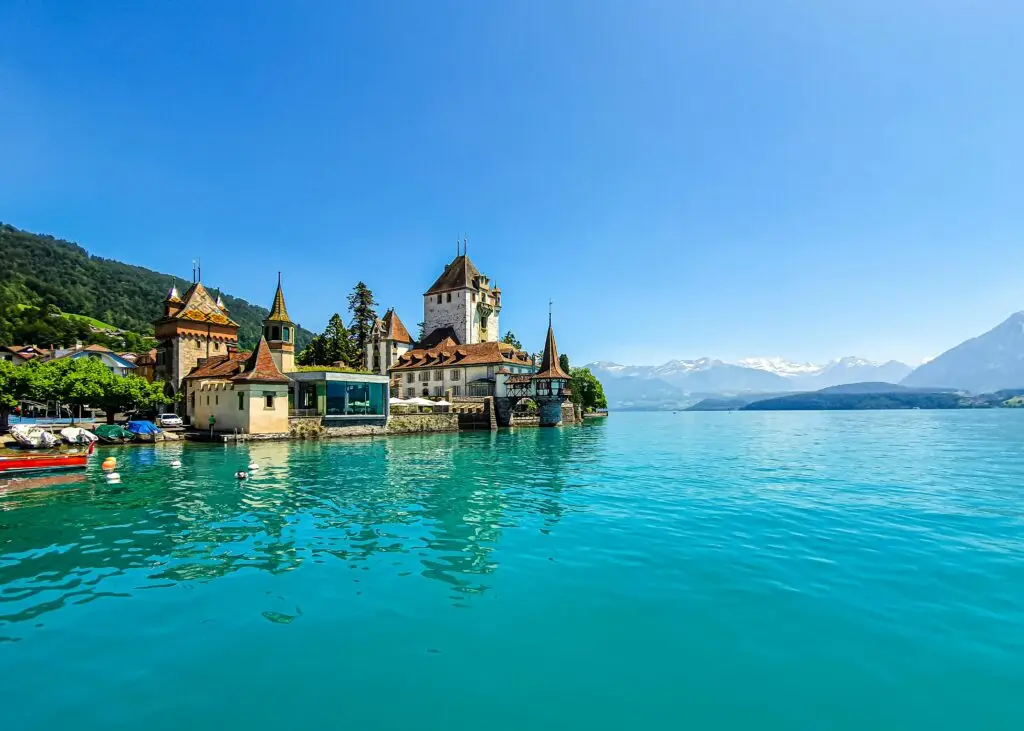
Switzerland’s lakes are another story of perfection. Lake Geneva mirrors the Alps and French Riviera atmosphere, Lake Lucerne curves gracefully among mountains, Lake Zurich sparkles beside its modern city, and the turquoise waters of Lake Brienz and Lake Thun could make you believe you are looking at a painting.
Seasons in Switzerland
Switzerland changes its soul with the seasons, each offering a different kind of beauty. In spring, meadows explode in wildflowers and the snowline retreats, leaving rivers full and fast. Summer brings green valleys, clear skies, and long days that seem made for hiking and swimming in mountain lakes. Autumn paints the vineyards gold and red, the air turns crisp, and mountain peaks start to gleam with early snow. Winter, though, is pure magic — when the Alps become a playground of skiing, snowboarding, and cozy evenings by firelight.
The Swiss live according to these rhythms. Their celebrations, foods, and traditions follow the calendar of nature. In winter, fondue and raclette warm the evenings, while summer means outdoor markets, festivals, and open-air concerts where alphorns echo through valleys.
Zurich – Where Elegance Meets Energy
Switzerland’s largest city, Zurich, stands at the meeting point of culture, innovation, and history. Built along a serene lake and crossed by the River Limmat, Zurich is often seen as the financial capital of the country, but it’s far more than banks and business. Behind the glass façades and efficient trams, you find an artistic soul — galleries, old guild houses, hidden courtyards, and cafés buzzing with conversation.
Stroll through the Altstadt, Zurich’s old town, where medieval streets lead to churches like Grossmünster and Fraumünster with their stained-glass windows by Chagall. In summer, locals swim in the lake during lunch breaks or gather at riverside bars as the sun sets behind distant hills. The city blends luxury and simplicity effortlessly: elegant boutiques stand beside family bakeries, and high-end restaurants coexist with lakeside kiosks selling sausages and ice cream.
Zurich is also a gateway to the Alps. Within an hour, trains take you to Lucerne, Zug, or the first mountain peaks. The combination of city sophistication and proximity to nature makes it one of Europe’s most livable places.
Lucerne – The Gateway to the Alps
Few cities capture the essence of Switzerland as perfectly as Lucerne. It lies beside its namesake lake, surrounded by mountains that rise like guardians — Pilatus, Rigi, and Titlis. The Chapel Bridge, with its flower boxes and painted panels, stretches gracefully across the Reuss River and has become an icon of the country. The old town is a maze of frescoed buildings, cobbled lanes, and the smell of chocolate drifting from cafés.
Lucerne’s charm lies in its balance between natural beauty and cultural depth. You can take a boat cruise across the lake, then ride a cogwheel train up Mount Pilatus for sweeping views of peaks and valleys. On cloudy days, visit the Swiss Museum of Transport or attend the Lucerne Festival, one of the world’s finest classical music events.
In the evenings, as the lights reflect off the water and the mountains turn purple with dusk, Lucerne feels like a dream suspended between sky and lake.
Bern – A Timeless Capital
Switzerland’s capital, Bern, is a city built on a curve of the Aare River and filled with quiet charm. Its UNESCO-listed old town is a masterpiece of medieval architecture — arcaded streets, fountains topped with statues, and the Zytglogge clock tower that still chimes as it has for centuries. Bern feels less like a capital and more like a large village, where government buildings stand beside small bookstores and markets selling flowers and cheese.
The people of Bern live slowly and deliberately. They swim in the Aare during summer, floating downstream past the parliament, and gather on terraces overlooking the river. From the Rose Garden, you can see the city’s rooftops glowing golden under the evening sun, framed by the snowy Bernese Alps in the distance.
Bern’s museums, such as the Zentrum Paul Klee and the Einstein House, tell the stories of creativity and discovery that shaped the world. Yet the greatest joy of Bern is simply wandering — under the arcades during rain, past bear pits and bridges, feeling time slow down around you.
Geneva – The Meeting Point of the World
In the far west, Geneva sits at the tip of Lake Geneva, surrounded by vineyards and framed by Mont Blanc. It is a city of diplomacy and diversity, home to the United Nations, the Red Cross, and countless international organizations. People from every corner of the world live here, giving the city a cosmopolitan air.
Geneva’s lakefront is one of the most beautiful in Europe, dominated by the Jet d’Eau fountain that shoots water 140 meters into the sky. Behind it, elegant hotels and promenades lead to the old town, where cobblestone streets climb toward St. Pierre Cathedral. From the tower, you can see rooftops, lake, and mountains blending into one panorama.
Despite its global role, Geneva retains a human scale. Locals picnic by the water, sail small boats, or enjoy fondue in tiny bistros hidden behind grand façades. The rhythm of life is calm, the air clear, and the feeling of peace — fitting for a city dedicated to it.
The Bernese Oberland – Switzerland’s Dreamland
If one region could represent the soul of Switzerland, it would be the Bernese Oberland. Here, nature takes center stage: snow-capped peaks, deep valleys, waterfalls, and alpine meadows filled with wildflowers. Interlaken, set between Lake Thun and Lake Brienz, serves as the gateway to this wonderland. From here, mountain trains climb toward Lauterbrunnen, Wengen, Grindelwald, and Mürren — names that sound like music to travelers’ ears.
Lauterbrunnen Valley, often called “the valley of 72 waterfalls,” is one of the most breathtaking places on Earth. Water cascades from cliffs hundreds of meters high, and wooden chalets sit beneath them as if painted into the landscape. Above it rises the Jungfrau region — the Eiger, Mönch, and Jungfrau peaks forming a trio of majestic giants. The Jungfraujoch railway, a masterpiece of engineering, tunnels through mountains to the “Top of Europe,” where you can stand on snow and ice even in midsummer.
Hiking here feels like walking through a postcard. Trails lead through alpine meadows where cowbells echo softly, past huts serving fresh milk and cheese. On clear days, you see peaks reflected in blue lakes so pure they seem unreal.
Zermatt and the Matterhorn
In the south, near the Italian border, lies Zermatt — a village so perfectly Swiss that it feels like a symbol of the nation. No cars are allowed here; instead, electric taxis and horse-drawn carriages glide through streets lined with wooden chalets. Above it rises the Matterhorn, perhaps the most famous mountain in the world, its pyramid-shaped peak cutting into the sky like a blade of ice.
Seeing the Matterhorn for the first time is unforgettable. It doesn’t seem real — too perfect, too symmetrical — yet it commands respect. The air feels different, sharper, cleaner. Hike or take the Gornergrat Railway for panoramic views that stretch across glaciers and peaks as far as the eye can see. In winter, Zermatt becomes one of the best ski resorts in the world, connected even to Italian slopes in Cervinia.
But beyond skiing and hiking, Zermatt holds something spiritual. As evening falls and the last light touches the summit, the mountain turns gold, then pink, then violet, and finally disappears into night. It’s a moment that reminds you how small you are, and how beautiful the world can be.
The Lakes and the Riviera of Switzerland
Not all of Switzerland is snow and mountains. The southern regions, especially Ticino, bring a taste of Italy. Palm trees line the promenades of Lugano and Locarno, while narrow streets climb through old towns filled with piazzas and fountains. Lake Maggiore and Lake Lugano shimmer under Mediterranean light, and the food here — risotto, espresso, gelato — speaks of the south.
To the west, Lake Geneva offers elegance and culture. Montreux, known for its jazz festival, has a lakeside promenade that seems made for slow walks at sunset. Nearby, the Château de Chillon stands on its rock above the water, immortalized by poets for centuries. Vevey and Lausanne combine vineyards, art museums, and a relaxed rhythm of life.
Switzerland’s lakes are more than scenery; they are a way of life. Locals swim, sail, and picnic by their shores, and every reflection tells a story of tranquility.
The Swiss Alps – Nature’s Masterpiece
The Alps define Switzerland’s identity. They are not just mountains but a living culture. Small villages cling to slopes, farmers move cattle up and down with the seasons, and hikers follow ancient trails that connect valleys and peaks. The Alps are where the Swiss learn endurance, precision, and respect for nature.
Hiking here is a revelation. The air smells of pine and snow, the paths wind past glaciers and streams, and the silence is profound. The Via Alpina, a long-distance trail crossing the country, passes through some of the most spectacular scenery imaginable. Cable cars take you high above valleys, yet even modern technology feels humble against the scale of the mountains.
Winter turns the Alps into a wonderland — not just for skiing but for walking, sledding, and simply admiring the beauty of snow under sunlight. Resorts like St. Moritz, Davos, Verbier, and Gstaad blend luxury with authenticity, each offering its own charm. But even the smallest village feels special when you wake up to fresh snow and hear nothing but the sound of church bells echoing through the cold.
Swiss Culture and Simplicity
Switzerland’s culture is one of quiet excellence. The people value precision, quality, and reliability — whether in watchmaking, chocolate, or hospitality. But they also value discretion. Everything works, but nothing boasts. There is pride in doing things well and living modestly.
Each language region adds its own flavor. The German-speaking areas bring order and structure, the French regions add elegance and art, the Italian regions warmth and spontaneity. Together, they create a cultural mosaic that feels both varied and harmonious.
The Swiss are deeply connected to nature. Weekends mean hiking, skiing, or simply sitting by a lake. Family and community life are strong, and traditions — from alphorn music to yodeling — are cherished, not as performances but as living culture.
Architecture, Art, and Innovation
Switzerland’s cities are clean, compact, and full of beauty. Architecture ranges from medieval towers to futuristic glass structures. Basel, in particular, is a hub of art and design, home to the Art Basel fair and some of the most impressive modern buildings in Europe. Museums across the country — from the Fondation Beyeler to the Kunsthaus Zürich — showcase art that reflects both Swiss precision and international influence.
Swiss engineering and design are world-famous. From trains that climb impossible slopes to bridges that seem to float, everything is crafted with care. Even the mountain huts — small wooden shelters high above the tree line — reflect a sense of order and beauty.
A Journey of Stillness
To travel in Switzerland is to rediscover stillness. Whether you stand on a mountain ridge watching clouds drift below, walk beside a glacier listening to its slow heartbeat, or sip hot chocolate while snow falls outside, time feels suspended. The country teaches you to appreciate details: the way sunlight touches a peak, the sound of a distant cowbell, the taste of pure mountain water.
You realize that luxury here is not gold or glamour but peace — the rare, quiet luxury of feeling safe, inspired, and connected to the world around you.
A Route Through the Country
Imagine beginning in Zurich, following the lake to Lucerne, then taking the GoldenPass train to Interlaken, where mountains close in like walls of wonder. From there, ascend to Jungfraujoch or hike through Grindelwald, then continue south to Zermatt and gaze at the Matterhorn. From the snowfields, descend into Ticino, where palm trees line the lakes and Italian warmth fills the air. End in Geneva, watching the sunset over the lake as Mont Blanc glows in the distance.
That single route — from the German-speaking north to the French and Italian south — reveals Switzerland’s entire soul: precision, beauty, diversity, and peace.
Why Switzerland Stays in the Heart
Switzerland is more than a destination. It is a feeling — of order without rigidity, of beauty without arrogance, of peace without emptiness. It shows that a country can be small yet infinite in experience. Whether you came to ski, to hike, to rest, or simply to breathe, Switzerland changes something in you.
It is the clarity of the air, the perfection of its reflections, and the kindness of its people that linger. It is the moment you hear an echo in the mountains and realize the world is listening too.
Switzerland doesn’t need to impress; it simply exists in perfect balance. And for travelers who seek that balance — between nature and comfort, between motion and stillness — there may be no greater journey on Earth.
 Related Articles
- Kakslauttanen Arctic Resort
- Top 10 Most Unique Places to Stay in Europe
- 10 Incredible Castles Around the World
Grid
Top 15 Winter BucketList Experiences You Must Try Before You Die