
🇼🇸 THE ULTIMATE TRAVEL GUIDE
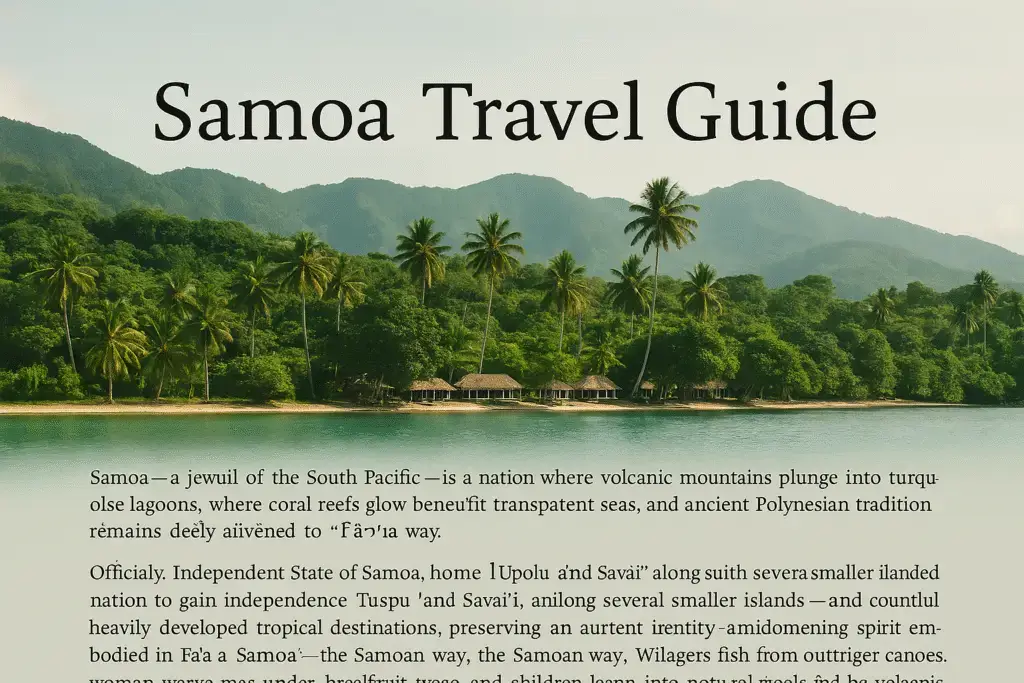
a jewel of the South Pacific — is a nation where volcanic mountains plunge into turquoise lagoons, where waterfalls thunder down rainforest cliffs, where coral reefs glow beneath transparent seas, and where ancient Polynesian tradition remains deeply alive.
Officially the Independent State of Samoa, the country consists of two main islands — Upolu and Savai’i — along with several smaller islands. Samoa offers a distinctive blend of untouched natural beauty, cultural depth, and a welcoming spirit embodied in Fa’a Samoa — “the Samoan way.”
Unlike heavily developed tropical destinations, Samoa maintains an authentic, grounded identity. Life follows rhythms shaped by family, tradition, and nature. Villagers fish from outrigger canoes, women weave mats under breadfruit trees, and children leap into natural pools fed by volcanic springs.
This guide explores all of Samoa: its culture, islands, cities, nature, history, transport, food, and countless experiences.
✅ QUICK FACTS
| Category | Details |
|---|---|
| Official Name | Independent State of Samoa |
| Capital | Apia |
| Major Islands | Upolu & Savai’i |
| Population | ~205,000 |
| Location | Polynesia, South Pacific |
| Languages | Samoan, English |
| Currency | Samoan Tala (WST) |
| Government | Parliamentary republic |
| Time Zone | GMT +13 |
| Religion | Mostly Christian |
| Independence | 1962 (first Pacific island nation to gain independence) |
🌺 OVERVIEW
one of the world’s oldest Polynesian societies, preserving traditions that date back 3,000 years. Although modern life is present — cars, mobile phones, supermarkets — tradition remains foundational. Families gather at open-walled fale homes, chiefs oversee community decisions, and customary etiquette shapes social life.
Visitors experience a rare combination:
- Ancient culture
- Untouched natural beauty
- Warm hospitality
- Outdoor adventure
Waterfalls, volcanic craters, blowholes, fruit plantations, soft-sand beaches, coral gardens, lava fields, and rugged rainforest combine to make Samoa remarkably diverse despite its compact size.
feels wild and serene — peaceful yet powerful.
🌏 GEOGRAPHY
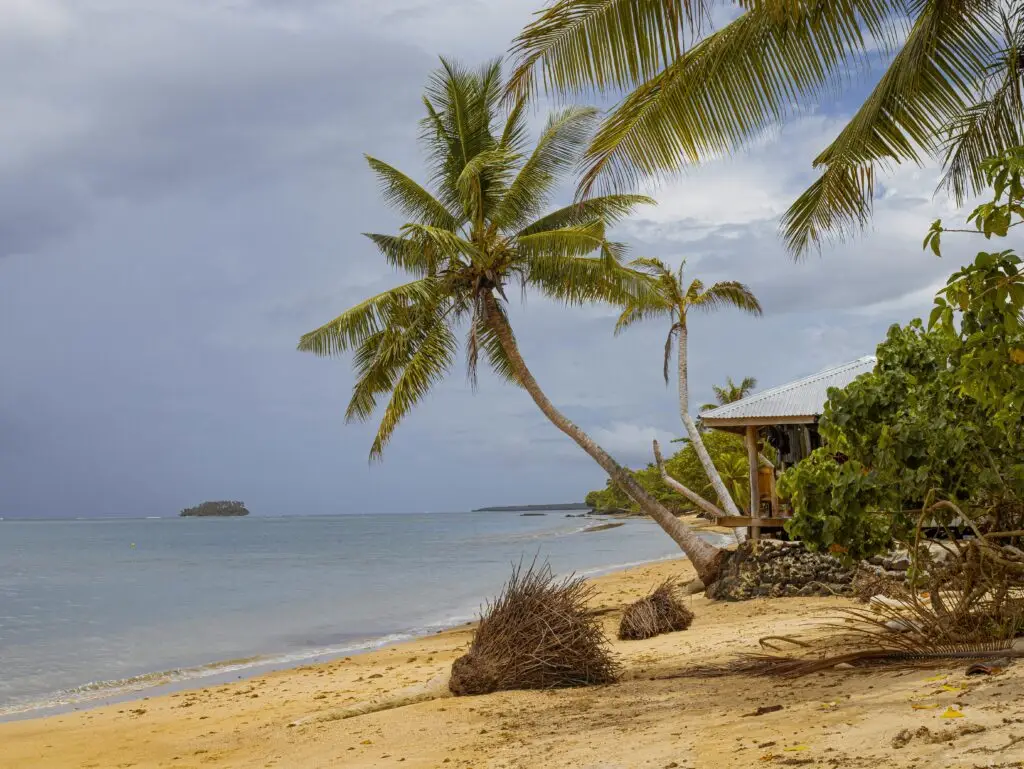
located roughly halfway between New Zealand and Hawai’i, part of the wider Polynesian triangle.
Two main islands:
- Upolu
- Savai’i
Smaller islands:
- Manono
- Apolima
- Nu‘utele
- Nu‘ulopa
(and several tiny uninhabited islets)
Both Upolu and Savai’i are of volcanic origin, with fertile interior valleys, upland forests, waterfalls, and lava fields.
🗺 ISLANDS OF SAMOA
✅ Upolu
The more populated island, home to:
- Capital city Apia
- Main airport (Faleolo)
- Many villages
- Popular beaches & lagoons
- Major waterfalls
Upolu is lush and mountainous; its southern coast shelters many sandy beaches and fales.
✅ Savai’i
Savai’i is one of the largest islands in Polynesia and far more rural and untouched than Upolu.
Savai’i is defined by:
- Volcanoes
- Lava fields
- Ancient rainforest
- Sliding rock pools
- Traditional villages
Life on Savai’i feels slower and more traditional.
✅ Smaller Islands
Manono & Apolima
Between Upolu and Savai’i — very traditional, quiet, and beautiful.
Nu‘utele & Nu‘ulopa
Tiny islets near Upolu’s south coast; sea bird sanctuaries.
🏛 BRIEF HISTORY
Early Settlement
Samoa has been inhabited for over 3,000 years, among the earliest Polynesian societies. Oral histories recount long lineages of chiefs and navigators whose voyages connected islands across the Pacific.
became a cultural center influencing Tonga, Fiji, and beyond.
Contact with Europeans
In the 18th and 19th centuries, European traders, explorers, and missionaries arrived. Complex rivalries among foreign powers led to conflict, culminating in colonial control.
Colonial Period
Germany dominated Western Samoa until World War I, when New Zealand took control.
In 1962, Samoa became the first independent Pacific nation, later changing its name from Western Samoa to Samoa (1997).
👥 CULTURE — FA’A SAMOA
Fa’a Samoa — “the Samoan way” — defines nearly every aspect of life. It encompasses:
- Respect for elders
- Community obligations
- Traditional etiquette
- Extended family living
- Ceremonial exchange
- Village structure
Family is central. Villages follow strong social structures led by matai (chiefs).
Fa’a Samoa keeps tradition alive even today.
Social Structure
Every village is built around:
- Family groups (aiga)
- Chiefs (matai)
- Churches
- Open fale meeting houses
Matai make decisions and represent families locally and nationally.
The Fale
Traditional houses called fale are open-walled, supported by pillars with circular or rectangular shapes.
They are designed for airflow, community, and transparency.
Religion
Christianity is deeply rooted; Sundays are restful, family-oriented days.
Tattoo (Tatau)
Samoa is one of the heartlands of traditional Polynesian tattoo.
Important patterns:
- Pe‘a — Male tattoo, waist to knee
- Malu — Female tattoo, thighs to knees
The tatau is ceremonial, sacred, and earned — a symbol of endurance and responsibility.
🎭 ARTS & CEREMONY
Samoan culture honors:
- dance
- poetry
- storytelling
- song
- wood carving
- tattoo
- weaving
Performances include siva, danced with grace and expressive gesture.
🌴 NATURE & LANDSCAPES
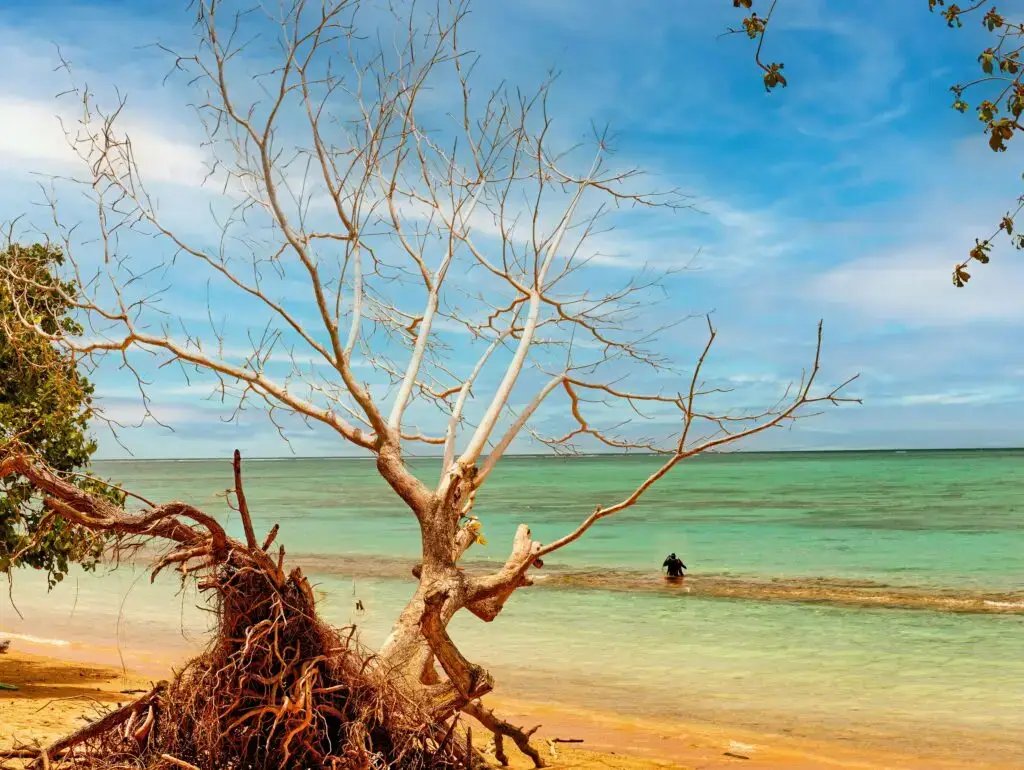
landscape is lush and varied — rainforest, plantations, waterfalls, rivers, lagoons, mountains, lava formations, and beaches. Much island interior remains wild.
🏞 HIGHLIGHTS OF UPOLU
✅ To Sua Ocean Trench
A dramatic natural sinkhole filled with bright turquoise seawater. A wooden ladder leads down for swimming. One of most photographed sites.
✅ Lalomanu Beach
A gorgeous white-sand beach on the southeast coast. Palm trees, coral reef offshore, gentle waves.
✅ Papase‘ea Sliding Rocks
Smooth volcanic rock formations create natural water slides into pools.
✅ Piula Cave Pools
Freshwater pools fed by underground springs beneath a stone Methodist college.
✅ Sopoaga Waterfall
Tucked into rainforest, offering jungle scenery and calm energy.
✅ O Le Pupu-Pu‘e National Park
Samoa’s oldest national park, protecting rainforest, volcanic areas, and coastline.
🏞 HIGHLIGHTS OF SAVAI‘I
✅ Alofaaga Blowholes
Powerful ocean pressure shoots water high through ancient lava tubes.
✅ Saleaula Lava Fields
Hardened black lava plains from Mt. Matavanu’s eruptions (1905–1911).
The lava engulfed churches; stone walls remain preserved in lava.
✅ Afu Aau Waterfall
A serene jungle pool beneath a beautiful cascade.
✅ Falealupo Rainforest
Suspension bridge and canopy walkway with sweeping views.
✅ Lava Coastlines
Many portions of Savai’i are fringed with volcanic rock and black sand.
🌊 OCEAN & MARINE LIFE
waters are warm, clear, and full of coral.
Marine species:
- Reef fish
- Turtles
- Rays
- Reef sharks (harmless)
- Dolphins
- Seasonal whales
Snorkelling is excellent in southern Upolu and many areas of Savai’i.
🐾 WILDLIFE
Samoa has limited mammals but rich bird life.
Native wildlife:
- Flying foxes (fruit bats)
- Herons
- Kingfishers
- Pacific pigeon
- Sea turtles
- Tropical reef fish
Birdwatchers will find many forest species, particularly in upland rainforest.
🏙 CITIES & TOWNS
✅ Apia
The capital is a compact coastal city on Upolu.
Known for:
- Waterfront markets
- Churches
- Robert Louis Stevenson Museum
- Local restaurants
- Palolo Deep Marine Reserve
Apia balances modern life with village rhythms.
✅ Salelologa (Savai’i)
Ferry port and main town on Savai’i.
Markets, basic services, and transport connections.
🏝 BEACHES
Samoa has some of the Pacific’s most beautiful beaches. Many remain undeveloped.
Top coastal areas:
- Lalomanu (Upolu)
- Manase (Savai’i)
- Aganoa (Savai’i)
- Tafatafa (Upolu)
Traditional beach fale stays allow travelers to sleep in open-air huts.
🌋 VOLCANOES & GEOLOGY
islands were created by volcanic hotspot activity.
- Mt. Matavanu (Savai’i) erupted in the 20th century
- Numerous extinct and dormant cones dot Upolu and Savai’i
- Lava fields and black-rock coastlines show recent volcanic history
🧭 OUTDOOR ADVENTURE
Samoa offers many nature-based activities.
✅ Hiking
- Mt. Vaea (tomb of writer Robert Louis Stevenson)
- Savai’i rainforest trails
- Lava fields
✅ Swimming
- To Sua Ocean Trench
- Piula Cave Pool
- Afu Aau waterfall
✅ Snorkelling
- Palolo Deep
- Lalomanu
- Manase
✅ Canoeing // Outrigger paddling
Traditional canoes remain part of island heritage.
🍽 FOOD & CUISINE
Samoan cuisine is based on:
- Taro
- Breadfruit
- Coconut
- Fresh fish
- Pork
- Bananas
- Tropical fruit
Cooking styles:
- Umu — earth oven using hot stones
- Coconut cream in curries & stews
- Grilled fish
Food is communal, often prepared for Sunday feasts.
🌤 CLIMATE
Samoa has a warm tropical climate.
| Season | Months | Notes |
|---|---|---|
| Dry | May–October | Best weather |
| Wet | November–April | Humid, rain, storms |
Cyclone season appears during the wet season.
🚗 TRANSPORT
Getting Between Islands
Ferry connects:
- Upolu ↔ Savai’i
On Land
Travel by:
- Bus
- Taxi
- Rental car
Village roads are scenic.
🛡 SAFETY & CULTURE TIPS
is a safe and welcoming destination.
Etiquette tips:
- Dress modestly in villages
- Sundays are quiet (church + family time)
- Ask before photographing locals
- Remove shoes before entering a fale
Village protocol is important; respect is key.
🧳 SAMPLE ITINERARIES
✅ 1 WEEK
- Upolu + Apia + Lalomanu
✅ 2 WEEKS
- Upolu + Savai’i round trip
✅ 3 WEEKS
- Add Manono + outer villages
WHY SAMOA IS SPECIAL
Samoa offers a rare blend of:
✅ Wild tropical beauty
✅ Deep cultural continuity
✅ Slow, peaceful village life
✅ Stunning coasts, waterfalls, forests
What makes Samoa unforgettable is its spirit —
the proud, beautiful simplicity of Fa’a Samoa.
Here, nature remains pure. Culture remains sacred. People remain connected.
Most of all, Samoa is a place where visitors feel embraced —
not as tourists, but as honored guests.
You leave with memories of waterfalls and coral seas…
but even more, with memories of people, smiles, stories, and song.
Samoa is not only a destination —
it is a way of life.
Related Amazing Bucketlist Articles
- 5 Once-in-a-Lifetime Floating Stays
- Hurawalhi Island Resort
- Top 10 Most Romantic Countries in the World for Couples