
Complete Travel Guide
Portugal is a country that invites you to slow down, breathe deeply, and savor life. Sunlight falls softly over terracotta rooftops; the Atlantic stretches into endless blue; fishing villages cling quietly to the coastline; and cities unfold like living storybooks filled with tiled façades, fado melodies, and winding cobblestone streets. Despite its modest size, Portugal feels remarkably expansive. Each region carries its own atmosphere — Lisbon’s poetic charm, Porto’s riverside elegance, the golden coastline of the Algarve, the rolling vineyards of the Douro Valley, the quiet plains of the Alentejo, and the volcanic drama of Madeira and the Azores.
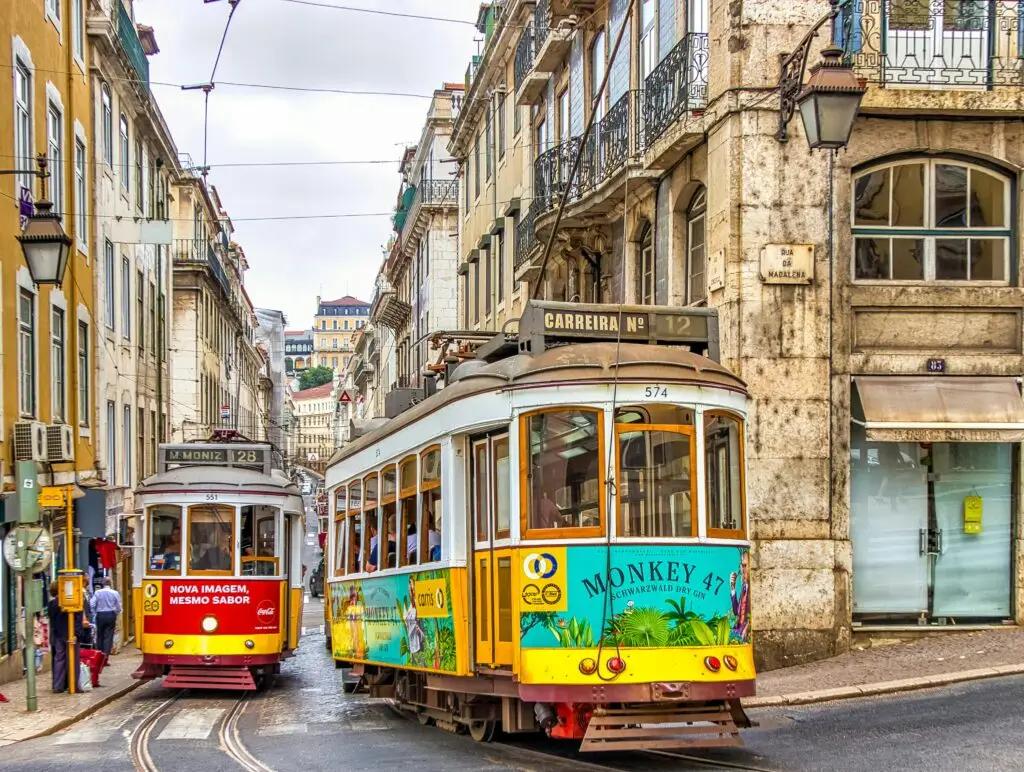
Traveling here means embracing moments rather than rushing through them. It might be sipping coffee at a quiet square while watching trams rattle by; sharing grilled seafood at a seaside taverna; or standing before the Atlantic as the wind sweeps across the cliffs. Portugal’s rhythm is gentle but deeply emotional. Music and poetry run through its veins, and an understated sense of nostalgia — saudade — colors its spirit. Yet this melancholy is not sadness; it is a warm longing, a reminder that beauty is fragile and life must be felt deeply.
The landscapes are equally expressive. In the north, mountains rise above terraced vineyards and rivers that have flowed for millennia. Central Portugal reveals medieval towns, monasteries, and forests. To the south, limestone cliffs plunge into turquoise seas, and sandy beaches stretch into infinity. Offshore, the islands stir with volcanic peaks, lagoons, and misty green pastures. Portugal holds both the intimacy of small places and the grandeur of nature, offering a journey that feels both personal and vast.
A Brief History
Portugal’s story begins more than a thousand years ago, when the kingdom emerged on the Iberian Peninsula and slowly carved its identity along the Atlantic. By the 12th century, Lisbon was under Christian rule, and the nation’s borders began to resemble the shape they hold today — remarkably stable compared to much of Europe.
The centuries that followed brought global transformation. During the Age of Exploration, Portuguese sailors set off into the unknown, navigating around Africa and across the world’s oceans. From these voyages grew a far-reaching maritime empire and a legacy of exchange, discovery, and cultural fusion. Spices, ideas, and languages flowed between continents; Lisbon became one of the wealthiest and most cosmopolitan capitals in Europe.
But history also brought challenges. Colonial power waned; the 18th-century earthquake devastated Lisbon; and political turmoil marked the 20th century until the peaceful Carnation Revolution restored democracy. Today, Portugal looks outward with calm confidence — protective of its traditions but open to the world. Its people carry a strong sense of cultural continuity, blending memory and modernity with elegance.
This history lingers in architecture, in azulejo tiles that tell stories of sea voyages and saints; in monasteries that glow with golden carvings; and in music, where the ache of longing floats through ancient neighborhoods. Everywhere you go, history is not a distant tale — it lives in the present, shaping the way Portugal speaks, sings, and celebrates.
Geography & Landscapes
Portugal stretches along the western edge of Europe, defined by its long Atlantic coastline and a diversity of landscapes that unfold gently from north to south.
The coastal air carries salt and warmth; inland hills give way to mountains and plains; and the islands rise from the ocean like emerald fragments of another world.
The Atlantic Ocean is a constant companion. It shapes the climate, flavors the food, and influences the culture. Fishing villages dot the shoreline, while surfers chase powerful waves that arrive from storms thousands of kilometers away. On calm days, the sea rests in shades of silver and turquoise; on stormy days, it crashes against cliffs with ancient force.
In the north, the land is greener and more mountainous. Rivers such as the Douro carve deep valleys, and terraced vineyards climb impossibly steep slopes. Winters are cooler and wetter here, lending a sense of mystery to stone villages and forests.
Central Portugal opens into gentler terrain: pine forests, river valleys, and medieval towns built of golden sandstone. The air feels calm, the landscapes broad and welcoming.
Farther south lies the Alentejo, a region of rolling plains, cork oak forests, and quiet villages painted white and blue. The landscape here is spacious and meditative, filled with warm light and long horizons.
At the southern edge sits the Algarve, where limestone cliffs fold into secret coves and beaches glow beneath warm sun. Inland, orange groves surround traditional towns; along the coast, fishing boats rest on golden sands.
Beyond the mainland rise two island groups — Madeira and the Azores — each with volcanic mountains, lush forests, crater lakes, and dramatic ocean cliffs. They feel deeply connected to nature: ancient, wild, and breathtakingly beautiful.
Lisbon – A City of Light & Memory
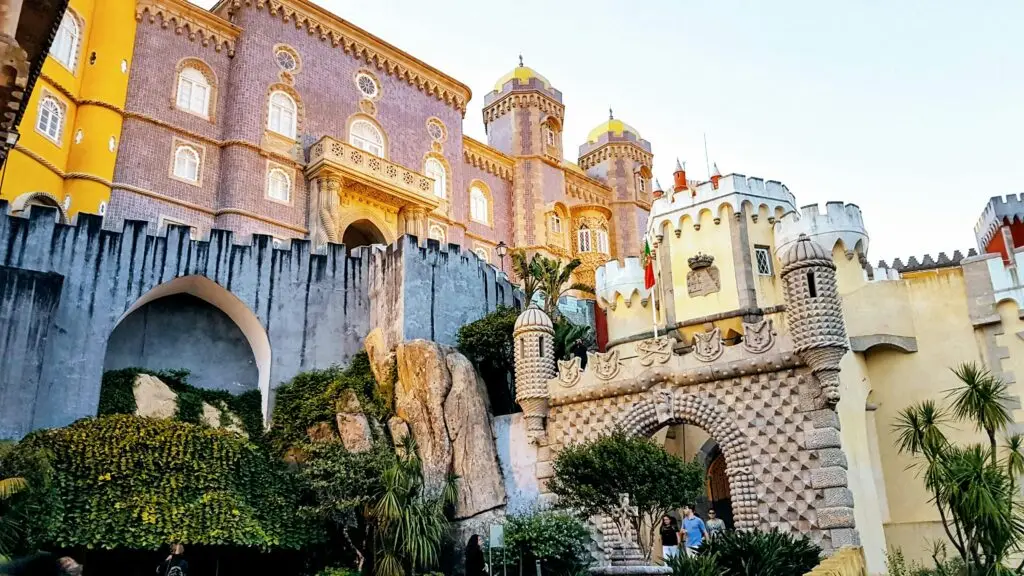
Lisbon enchants almost immediately. The city rises over seven hills, their slopes dotted with pastel houses and tiled façades that catch the sunlight like mirrors. From the top of each hill, you see the Tagus River widen into shimmering gold before it meets the Atlantic. The light here seems softer, warmer, as though filtered through memory itself.
Life in Lisbon unfolds at an unhurried pace. Trams rattle along narrow streets; laundry hangs from balconies; elderly men chat outside cafés; and music drifts through alleyways. The city feels layered — Moorish courtyards, medieval lanes, elegant 18th-century plazas, and modern riverfront promenades. Each neighborhood carries its own personality, yet they blend naturally, like chapters in a story that never quite ends.
The oldest quarters — Alfama, Mouraria, and Graça — cling to the hillside beneath the castle. Their streets curve like rivers, forming a maze of stairs, viewpoints, and small taverns where the smell of grilled sardines fills the air. At night, fado echoes in intimate rooms: a singer, a guitar, and voices that rise with longing. Watching it unfold feels like sharing a secret — raw, emotional, and deeply Portuguese.
Lower down, Baixa opens into grand boulevards rebuilt after the 1755 earthquake. Here the city feels wide and ordered, with tile mosaics underfoot and cafés spilling into plazas. Nearby, the riverfront district of Belém holds the spirit of Portugal’s seafaring age. Monuments and monasteries pay tribute to the explorers who once set sail from this shoreline in fragile wooden ships, navigating into the unknown.
Yet Lisbon is not frozen in nostalgia. Young artists, designers, and chefs are re-shaping the city, turning old warehouses into creative studios and markets into culinary playgrounds. The atmosphere remains relaxed, but there is a pulse beneath the calm — a sense that Lisbon is quietly evolving without ever losing its soul.
Porto – Tradition Along the Douro
Porto is Lisbon’s northern counterpart — quieter, moodier, yet filled with warmth. The city hugs the steep banks of the Douro River, its red-roofed houses cascading toward the water like a painting in motion. Bridges arc gracefully between riverbanks, while boats drift slowly along the current. Porto feels intimate. Its beauty is not polished; it is textured, authentic, worn by salt and time.
The heart of Porto lies in Ribeira, a waterfront quarter where medieval streets twist toward the river. Here, cafés spill onto cobblestones, children play near the dock, and the colors of the buildings shimmer in the water. Across the river, in Vila Nova de Gaia, centuries-old wine cellars store the region’s most famous treasure — port wine. Visiting them feels like stepping into a world of shadowed stone, oak barrels, and stories whispered through generations.
Porto’s architecture carries grandeur. The cathedral towers above the city; tiled churches gleam in patterned blues; and railway stations unfold like museums. But the most memorable part is the atmosphere — a mix of melancholy and generosity. Locals speak softly; markets bustle without hurry; and the scent of coffee and pastries lingers in the air.
The Douro Valley stretches eastward — terraced vineyards carved into mountainsides, twisting roads that follow the river, and villages that seem untouched by time. Even a short journey beyond Porto feels like traveling deeper into the essence of Portugal: peaceful, rural, simple, and breathtaking.
Coimbra – A City of Knowledge, Youth & Quiet Elegance
Coimbra rests gently on the hills that rise above the Mondego River, carrying with it centuries of scholarship and the soft energy of university life. The city feels layered, built from stone streets that twist uphill toward one of Europe’s oldest universities. As you climb through the old town, the walls seem to whisper the stories of generations who have studied, debated, loved, and dreamed here. Coimbra does not shout its beauty; rather, it reveals itself slowly, asking you to notice small details — a carved doorway, a balcony draped with flowers, the sound of a guitar floating from a courtyard.
The University of Coimbra is the soul of the city. Founded in the 13th century, it occupies a hilltop complex that feels both solemn and inspiring. The courtyard sits high above the river, surrounded by libraries, chapels, and ceremonial halls. The Joanina Library is perhaps the most magical room in Portugal — a Baroque treasure filled with gilded shelves and ancient volumes whose pages seem to contain the memory of the nation. Even the scent of the wood and paper carries a certain enchantment, a reminder of how knowledge has been guarded and celebrated here.
Student culture shapes the daily rhythm of Coimbra. Young people fill cafés, study on terraces, and gather in parks along the river. Traditional student cloaks — long, black garments — appear during ceremonies and celebrations, creating scenes that feel timeless. Music is another essential part of the city’s identity. Fado de Coimbra, distinct from the Lisbon style, is performed by men and often linked to poetic serenades. Hearing it live is a deeply emotional experience, especially in quiet, candle-lit spaces where voices echo against stone walls.
Away from the university, the town unfolds into peaceful neighborhoods where families live behind old gates and small squares hold fountains draped in moss. Gardens open suddenly between buildings, offering shade and stillness. Along the riverbanks, long paths invite slow walks or bike rides. At sunset, the water turns gold, and Coimbra becomes reflective — a city of memory and youth, constantly looking both backward and forward.
Coimbra feels like a place meant not only to be visited but lived in, at least for a little while. It moves at a gentle pace, inviting you to linger, read, listen, and observe. Time here feels deeper, layered with imagination.
Évora – Whispering Stones of the Alentejo
Évora rises from the plains of the Alentejo like a preserved fragment of another era — a quiet city of pale white houses, terracotta rooftops, narrow lanes, and medieval walls. The sunlight here is warmer, slower; it settles upon the stones and seems to remain until evening. Walking through Évora feels like stepping into a dream where time moves differently, where Roman columns and Gothic spires coexist with tiled façades and simple bakeries.
At the center stands the Roman Temple of Évora, its Corinthian columns glowing in the afternoon light. Built nearly two thousand years ago, it remains remarkably intact, a silent witness to centuries of change. The nearby cathedral — a fortress-like structure of granite — holds a quiet gravity. From its rooftop, the Alentejo stretches outward in gentle waves, dotted with cork oak trees and small whitewashed villages that shimmer beneath the sun.
Évora’s streets meander without hurry. Arches span overhead, vines curl along walls, and doorways reveal inner courtyards where light falls softly on stone benches and tiled fountains. The town feels both grand and intimate, its history never overwhelming but always present. Churches, cloisters, and palaces appear suddenly after narrow turns, inviting reflection.
Yet Évora’s most haunting place lies quietly behind church walls — the Chapel of Bones. Built in the 16th century, it is lined with thousands of human bones arranged to remind visitors of life’s brevity. The atmosphere is not frightening but contemplative, a solemn gesture from another age that encourages stillness.
Beyond the city, the plains of the Alentejo open wide. Vineyards, olive groves, and cork forests roll toward the horizon. The light seems endless; the silence feels ancient. Hidden among the hills are prehistoric stone circles older than Stonehenge, linking Évora to a past far deeper than its magnificent Roman remains. Time here is layered like the land itself — slow, rich, and quietly enduring.
Évora is not a destination to rush. Its beauty lies in calm observation — a long lunch shaded by olive trees, an evening stroll beneath violet skies, a glass of red wine shared while cicadas sing from distant fields. Its rhythm invites you to match your steps to the pulse of the countryside: slow, steady, deeply human.
The Algarve – Sunlit Cliffs, Gentle Towns & Endless Sea
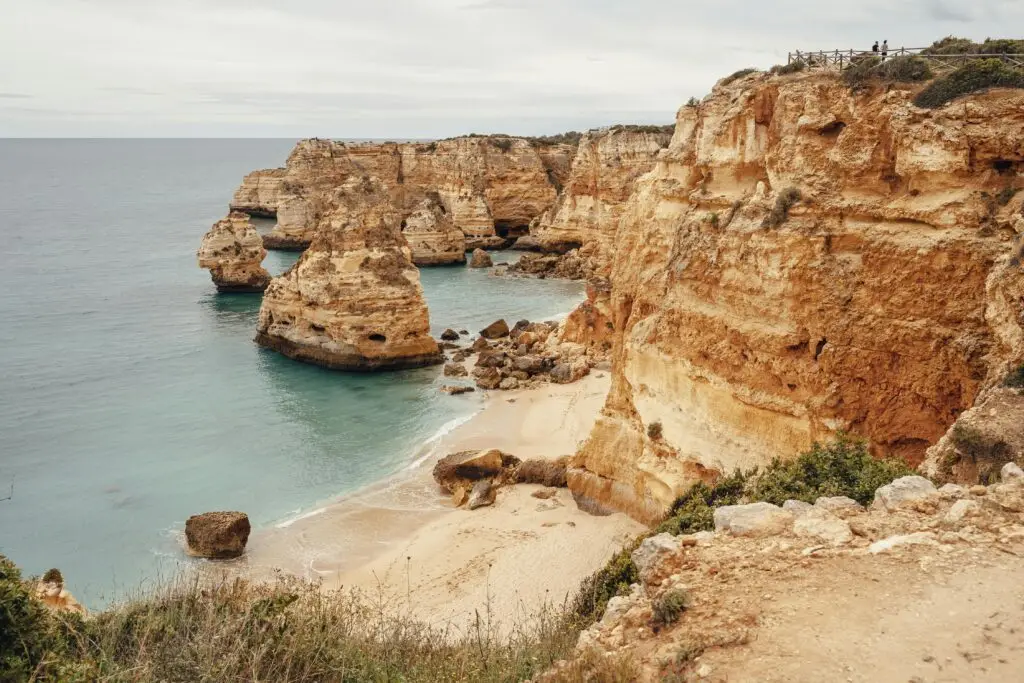
At the southern edge of Portugal, the Algarve unfolds in golden light. It is a place where dramatic cliffs plunge into turquoise waters, where long beaches stretch into soft mist, and where fishing villages rest beneath bright skies. Though the region is well-known, it still holds pockets of profound quiet — places where the only sound is the sea pressing against the rocks.
The coastline changes constantly. In some areas, cliffs rise into cathedral-like formations, eroded into arches and hidden coves where sunlight filters softly into green water. Trails follow the edges of these cliffs, offering views of sea and earth intertwining in endless motion. Standing at one of these viewpoints, you sense the immensity of the Atlantic — a horizon that seems to draw the mind outward.
Towns and villages along the coast each carry their own character. Some feel peaceful and timeless, their harbors lined with wooden boats painted in faded blues and reds. Others are livelier, with open squares filled with cafés, music, and evening warmth. Whatever their style, they share the same nearness to the sea. Life seems to move to the rhythm of tides; mornings begin with fishing boats returning to shore, and evenings settle with gentle breezes drifting through whitewashed streets.
The Algarve is also shaped by its inland life. Just a short distance from the coast, hills rise into orchards and small farms. The scent of orange blossoms fills the air each spring, and markets overflow with fresh fruit and honey. Villages sit quietly beneath the sun, their white walls glowing, their streets lined with cork trees and agave. The pace slows; time stretches.
In summer, beaches come alive. Families play in soft sand; surfers wait for waves; and the ocean glitters beneath wide skies. Yet even in the busiest months, one can find solitude — a quiet cove reached only by a narrow staircase, or a cliffside path where wind and sea meet in quiet conversation.
Winter in the Algarve is gentle. The days are bright and mild, inviting long walks, lazy afternoons, and evenings spent tasting local dishes — grilled fish, warm bread drizzled with olive oil, sweet pastries filled with almond cream. The region remains peaceful, beautifully still, reminding visitors that its true charm is not in tourism, but in the simple union of land, sun, and sea.
Madeira – The Floating Garden of the Atlantic
Far out in the Atlantic lies Madeira, a place so lush and dramatic that it feels like a world unto itself. Steep mountains plunge into deep blue water; clouds drift across emerald peaks; and terraces layered with banana trees and vineyards cling to slopes that seem impossibly steep. The island was born of volcanoes, and its landscapes still carry the energy of their creation — sharp ridges, craters softened by time, and high plateaus that stretch toward the sky.
Funchal, the capital, spreads across a sunlit amphitheater facing the sea. Its streets are lined with jacaranda trees, whose purple blossoms fall over white pavements. Markets overflow with tropical fruits and flowers, filling the air with sweetness. Old churches and elegant squares reveal the island’s long history, while modern cafés and galleries give it a lively cultural pulse.
From the coast, the land rises quickly. Roads twist into mountains that hold hidden valleys, waterfalls, and ancient laurel forests. These forests, shrouded in mist, feel enchanted — branches curve into mossy arches, and sunlight flickers like whispers through leaves. Walking through them grants a sense of quiet wonder, as though the island itself is speaking softly.
Madeira’s levadas — narrow irrigation channels — form a network of trails that lead deep into the island’s interior. They follow cliffs, cross streams, and pass beneath waterfalls. Walking along them feels meditative; the water murmurs constantly, and the landscape changes with every step. At higher elevations, peaks rise like towers. Standing above the clouds, you see the island spread beneath you like a map of mountains, valleys, and ocean.
Along the coastline, small villages rest between cliffs and sea. Their houses cluster around small harbors, where fishermen mend nets and boats rock gently in quiet water. Life here feels simple and complete, shaped by nature’s rhythm. At sunset, the sky turns deep orange, and the ocean reflects it like a vast mirror.
Madeira’s beauty is not loud. It is gentle, intimate, full of contrast — wild peaks and soft forests, dramatic cliffs and peaceful gardens. Perhaps that is why travelers return again and again: the island has a way of becoming part of you.
The Azores – Wild Isles of the Atlantic
Far west of mainland Portugal, scattered across the Atlantic like emerald jewels, lie the Azores — nine volcanic islands that feel raw, quiet, and profoundly alive. Their isolation has preserved a landscape unlike anywhere else in Europe: steaming calderas, crater lakes in impossible shades of green and blue, fields where hydrangeas bloom like ribbons through the countryside, and cliffs that plunge sharply into oceans filled with whales and dolphins. The climate here is soft and humid, mist weaving through hills and suddenly revealing views that feel like visions.
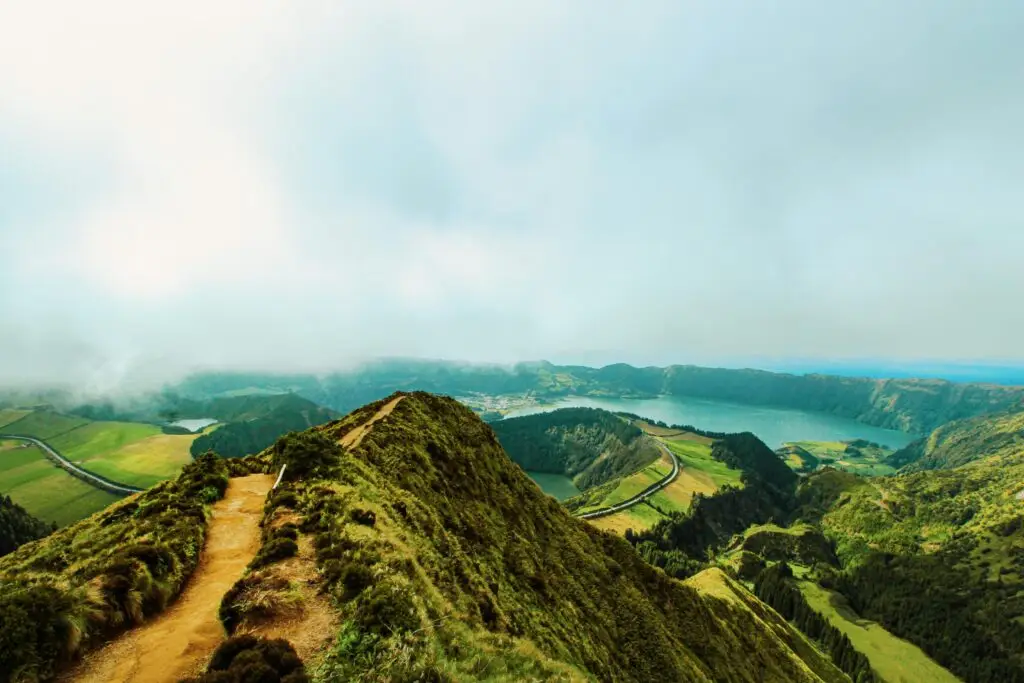
São Miguel, the largest island, offers a first glimpse into the Azores’ unique spirit. The landscape seems to shift constantly — from rolling farmland to dense forests, from coastal lava pools to massive craters holding villages and lakes. The town of Furnas sits beside steaming hot springs and fumaroles that breathe quietly from the earth; cooking pots are lowered into volcanic soil to prepare cozido, a traditional stew slow-cooked by geothermal heat. At Sete Cidades, twin lakes rest within a vast caldera — one blue, one green — a sight so gentle and haunting that it leaves most visitors silent for a moment.
On Pico Island, a perfect volcanic cone rises sharply toward the sky — Portugal’s highest peak, often wrapped in clouds. Lava fields stretch across its flanks, covered in vineyards that grow in small stone enclosures protected from the wind. The wine produced here carries the taste of earth and sea, a reminder of how deeply nature shapes life on these islands. Offshore, whales and dolphins migrate in large numbers, and the surrounding waters have become one of the world’s quietest sanctuaries for marine life. Sitting on a small boat, listening to nothing but wind and surf, you begin to feel the scale of the Atlantic around you.
Faial, known as the “blue island,” bursts with flowers, while its harbor in Horta has been a meeting point for sailors for centuries. Walls here are painted with the signatures and emblems of passing crews — a living mural of ocean travelers who left marks of their journeys. On Terceira, the city of Angra do Heroísmo holds pastel houses, stately squares, and churches that reflect its former importance as a maritime port. Many travelers linger here, feeling the gentle rhythm of island life.
What binds all nine islands together is not uniformity, but a mood — one of quiet wonder. Clouds drift along mountainsides, light flickers on ocean waves, and pastures appear suddenly between black volcanic walls. The Azores remind visitors that the earth is alive, that nature moves beneath the surface, and that sometimes the most powerful experiences are found in silence.
Culture & Identity
Portuguese culture is woven from threads of sea, song, memory, and gentle resilience. For centuries, Portugal looked outward — toward Africa, Asia, and the Americas — and this connection to the wider world has shaped everything from language to cuisine. Yet the country remains deeply rooted in local tradition. Family ties run strong; religious ceremonies continue in small villages; and ancient crafts hold quiet dignity. At the same time, new voices have risen in art, literature, and design, giving Portugal a sense of constant, soft renewal.
Saudade, often called untranslatable, forms the emotional core of Portuguese identity. It is a longing for something that may never return — a memory, a dream, a person, or a feeling. This gentle melancholy colors music, poetry, and storytelling, creating a cultural mood that is introspective yet hopeful. You feel saudade in the quiet corners of Lisbon, in the voices of fado singers, in the way the Atlantic seems to call from far away.
Regional identities add richness. In the north, the spirit is rugged and traditional, shaped by mountains and vineyards; in the Alentejo, life moves slowly beneath wide skies; coastal communities carry pride in their seafaring past; and the islands foster a profound connection with nature. Yet across all regions, generosity and humility remain central. You are never rushed. Time stretches. People greet strangers with warmth, offering stories, pastries, or simple kindness.
The arts flourish in Portugal. Ceramic tiles — azulejos — cover churches, houses, and stations with scenes of myth, history, and daily life. Literature has given the world great poets and thinkers; cinema tells stories that are at once intimate and universal; and music explores traditions rooted in both land and sea. What stands out most is the modesty with which these cultural treasures are shared. Portugal does not boast; it simply invites.
Food & Culinary Life
To eat in Portugal is to taste the meeting of land and ocean. Simple dishes carry deep character — not because they are elaborate, but because they are honest. Recipes reflect a long relationship with the sea, with fishing communities shaping the national palate. Cod — bacalhau — holds legendary status, prepared in countless forms: baked with olives, simmered with potatoes, layered with cream. Grilled sardines, fresh and smoky, fill the air with their scent during summer festivals, eaten with bread, wine, and laughter.
Along the coast, seafood reigns — octopus roasted until tender; clams cooked in garlic and cilantro; prawns grilled beneath lemon and salt. Inland, flavors soften into rustic comfort — stews of lamb and pork, hearty soups, and loaves of bread baked in village ovens. The Alentejo is famous for dishes made with coriander, olive oil, and local pork, while the Douro and Minho regions offer cured meats and cheeses served beside wine that tastes like river and sun.
Portugal’s desserts may be its sweetest legacy. The pastel de nata, with its flaky crust and caramelized custard, has become a symbol of national pride. Eating one fresh from the oven, sprinkled with cinnamon, feels almost sacred. Many pastries trace their origins to convents, where monks and nuns once created sweets from egg yolks and sugar. Every town seems to have its own specialty — almond cakes, fig pastries, honeyed breads — each telling a quiet story.
Drinks follow regional logic. The Douro Valley produces strong, full wines; the Minho offers crisp vinho verde; Madeira’s fortified wines carry island character; and port wine, aged in dark cellars, stands as one of Portugal’s great gifts to the world. More humble but deeply loved is ginjinha, a cherry liqueur served in small cups — strong, sweet, and often shared on street corners.
Dining in Portugal is rarely rushed. Meals unfold slowly, with conversation pausing between courses so that flavors and fellowship can settle. There is a quiet belief that food is not merely nourishment, but a way to celebrate life’s simplest joys.
Nature & Outdoor Life
Portugal’s natural world offers endless invitations — to explore, to breathe, to feel. The landscapes shift constantly; even a short journey can take you from mountain to sea, from vineyards to stone canyons, from wildflower meadows to quiet islands surrounded by deep blue.
Hiking trails crisscross the country. In the north, pathways climb through vineyards that cling to steep hillsides, rewarding effort with wide river views. In central Portugal, forests carpet the foothills, rich with pines and chestnut trees. The south offers rugged coastal routes where cliffs drop into coves and birds circle silently overhead, while the islands hold trails unlike anywhere else — levadas through cloud forest, ridgelines above the sea, volcanic craters that glow green after rain.
The Atlantic shapes much of this outdoor life. Surfers gather along the coast, drawn by powerful swells and golden light. Fishermen rise early, moving quietly through the dawn as the ocean shifts beneath their boats. Beaches offer moments of stillness — morning walks when only footprints mark the sand, winter days when wind crashes over rocks and the sea turns silver-gray.
Wildlife thrives, especially in the Azores, where whales and dolphins trace ancient routes. Birds nest on cliffs along the Algarve; foxes and boar roam forests inland; and in protected areas, fragile ecosystems survive unchanged for centuries. Portugal understands the need to preserve these landscapes, not as attractions but as lifelines.
Practical Travel Information
Traveling in Portugal is easy and relaxed. Distances are short, and the transportation network is efficient. Trains connect major cities with comfort and scenic views; buses reach towns and villages; ferries link islands; and roads are well-maintained for drivers. Even without a plan, you can arrive and simply wander — the country welcomes spontaneity.
English is widely spoken, especially in cities and tourist areas, though learning a few Portuguese phrases is always appreciated. The currency is the euro, and prices remain moderate compared to many Western European destinations. Accommodation ranges from simple guesthouses to boutique hotels, often housed within historic buildings that carry stories in their walls.
Safety is one of Portugal’s quiet strengths. Cities feel comfortable to walk at night; small towns seem timeless and peaceful; and the atmosphere is generally calm and respectful. Portuguese hospitality is subtle but sincere — warm smiles, helpful gestures, and conversations that flow easily once begun.
Best Time to Visit
Portugal’s climate is gentle, and each season brings its own charm. Spring paints the landscapes with wildflowers; cities bloom with outdoor cafés; and temperatures feel soft and welcoming. Summer is bright and energetic, especially along the coast, where sea breezes cool warm days. Autumn holds quiet beauty — vineyards burn gold and ruby, and markets fill with seasonal harvests. Winter offers quieter travel, especially in the south, where days remain mild and coastal paths feel almost private.
Suggested Itineraries
A journey through Portugal might begin in Lisbon, where old neighborhoods climb hills above the river, and where days slip easily into nights filled with music. From there, one can travel north to Coimbra and Porto, following the Douro Valley into vineyards that shine in sunlight. Another path leads south — to Évora and the Alentejo, where plains stretch under vast skies, then to the Algarve, where cliffs and beaches form the country’s bright edge. With more time, islands call: Madeira’s mountains and levadas, the Azores’ craters and ocean life. Portugal rewards both slow wandering and ambitious exploration — neither is wrong, and both are beautiful.
Conclusion
Portugal is a land of sunlight and memory, of quiet emotion and open horizons. Its people, gentle and warm, carry traditions that feel ancient yet welcoming. Its landscapes change constantly — mountains, plains, islands, and sea — each inviting pause and reflection. And its culture, filled with poetry, music, and flavors both humble and rich, leaves a lasting impression. Traveling here means connecting with simplicity — a cup of coffee in the morning light, a seaside conversation, a walk through cobbled streets where history feels alive. Portugal is not a place that tries to impress; it is a place that stays with you.
 Related Articles
- Kakslauttanen Arctic Resort
- Top 10 Most Unique Places to Stay in Europe
- 10 Incredible Castles Around the World