
The World’s Most Unreal Natural Wonders
Are These Places Even Real?
There are moments when reality feels… off.
There are countless Top 10 Places around the globe, waiting to be discovered by adventurous souls.
Top 10 Places to see a photo online — glowing oceans, floating mountains, perfectly shaped rock formations — and your first instinct is simple: this has to be fake. Top 10 Places are often the most breathtaking spots on Earth. 🌍 Top 10 Places That Don’t Feel Real 😳
But what if it’s not?
These Top 10 Places redefine the boundaries of nature’s beauty.
Each of these Top 10 Places offers a unique experience that lingers in your memory long after you’ve left.
What if some of the most surreal, dreamlike places on Earth are not created by CGI, Photoshop, or artificial intelligence — but by nature itself?
In this series, we’re exploring 10 of the most unreal places on Earth. These are destinations that blur the line between fantasy and reality. Locations that look like they belong in a sci-fi movie, a fantasy novel, or a different planet entirely. 🌍 Top 10 Places That Don’t Feel Real 😳
Discovering these Top 10 Places can be life-changing.
Planning your trip to these Top 10 Places will surely be rewarding.
When you visit these Top 10 Places, you witness nature at its finest.
#10 – Giant’s Causeway (Ireland)
A Natural Formation That Looks Engineered
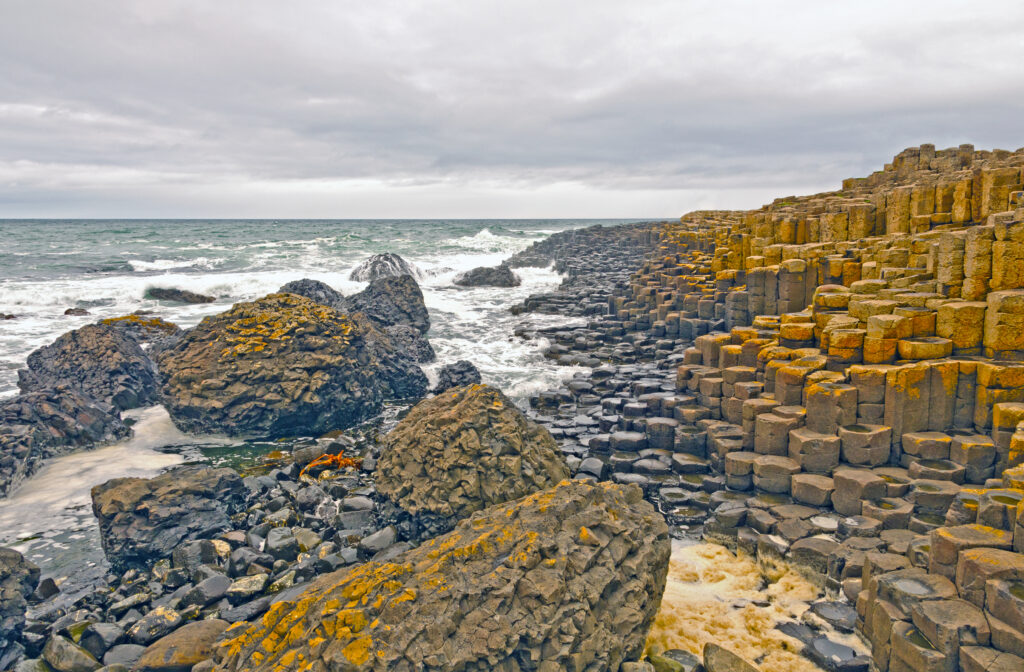
At first glance, the Giant’s Causeway doesn’t look natural at all.
The stories behind these Top 10 Places are as captivating as their appearances.
Visiting the Top 10 Places often feels like stepping into a dream.
These Top 10 Places remind us of nature’s power and artistry.
It looks constructed.
Thousands of stone columns rise from the ground, tightly packed together like a carefully designed architectural project. The shapes are almost perfectly geometric — mostly hexagonal — as if carved by human hands with mathematical precision. 🌍 Top 10 Places That Don’t Feel Real 😳
But no human built this.
What Makes Giant’s Causeway So Unique?
Located on the rugged coast of Northern Ireland, the Giant’s Causeway consists of over 40,000 interlocking basalt columns. These columns form stepping-stone-like structures that stretch from the cliffs into the sea.
People travel from afar to experience these Top 10 Places firsthand.
What makes them so mesmerizing is their uniformity:
- Most columns have six sides (hexagons)
- Some have four, five, seven, or eight sides
- They fit together like a natural mosaic
- Many are nearly identical in size and shape
This level of consistency feels impossible — almost artificial.
The Myth Behind the Name
Before science explained it, people created stories.
According to Irish legend, the causeway was built by a giant named Finn McCool (Fionn mac Cumhaill). He supposedly constructed the pathway to cross the sea and fight a rival giant in Scotland.
And honestly? When you see it in person, that explanation feels just as believable as the scientific one.
The Real Science (And Why It’s Still Mind-Blowing)
Around 60 million years ago, this area experienced intense volcanic activity.
Here’s what happened:
- Lava erupted and spread across the landscape
- As the lava cooled, it began to contract
- This contraction caused cracks to form
- The cracks spread in patterns that minimized energy — often forming hexagons
This process is known as columnar jointing.
The result? Perfectly shaped rock columns that look engineered — but are purely natural.
Why It Feels Unreal
The Giant’s Causeway sits at the intersection of order and chaos.
Nature is usually messy, unpredictable, and irregular.
But here, it behaves like a mathematician.
That contradiction — natural perfection — is what makes it feel unreal. 🌍 Top 10 Places That Don’t Feel Real 😳
Every one of these Top 10 Places has a story to tell.
These Top 10 Places challenge our understanding of beauty.
#9 – Pink Lake (Australia)
A Body of Water That Breaks All Expectations
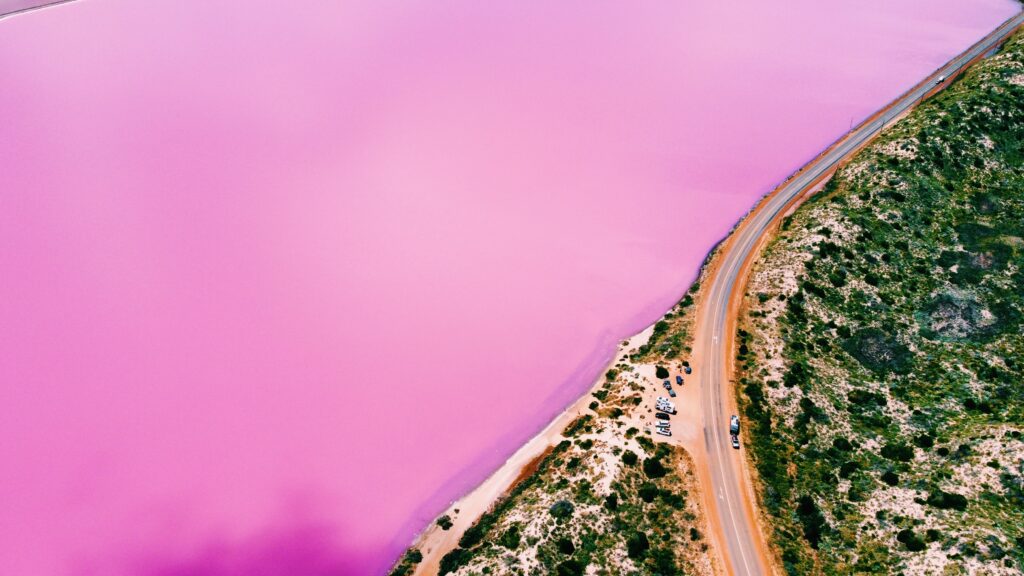
Water is supposed to be blue.
Sometimes green. Occasionally brown.
But pink?
Exploring these Top 10 Places is a journey into the extraordinary.
Every visit to these Top 10 Places ignites a sense of wonder.
Bright, bubblegum, almost neon pink?
That sounds like something out of a fantasy world — not real geography.
And yet, in Western Australia, it exists.
What Is Pink Lake?
Often referred to as Lake Hillier, this lake sits on Middle Island, part of the Recherche Archipelago.
From above, the contrast is shocking:
- Deep blue ocean
- Narrow strip of white sand
- And then… a vivid pink lake
The color is so intense that it looks digitally enhanced — even in real life.
What Causes the Pink Color?
Unlike many natural wonders, this one doesn’t rely on optical illusions or lighting tricks.
The color is real.
And it’s caused by microscopic life.
The lake contains:
- Dunaliella salina (a type of algae)
- Halophilic bacteria (salt-loving microbes)
These organisms produce pigments — including carotenoids — which give the water its pink hue.
The Strangest Part: It Stays Pink
Here’s where it gets even more surreal.
If you take water from the lake and put it into a container… it remains pink.
This isn’t a reflection.
It’s not a trick of the eye.
The water itself is genuinely colored.
Why It Feels Unreal
We associate lakes with calm, natural, predictable colors.
Pink water breaks that expectation instantly.
It creates a cognitive dissonance — your brain says:
“This is wrong. This shouldn’t exist.”
And that’s exactly what makes it so fascinating.
#8 – Salar de Uyuni (Bolivia)
The World’s Largest Natural Mirror
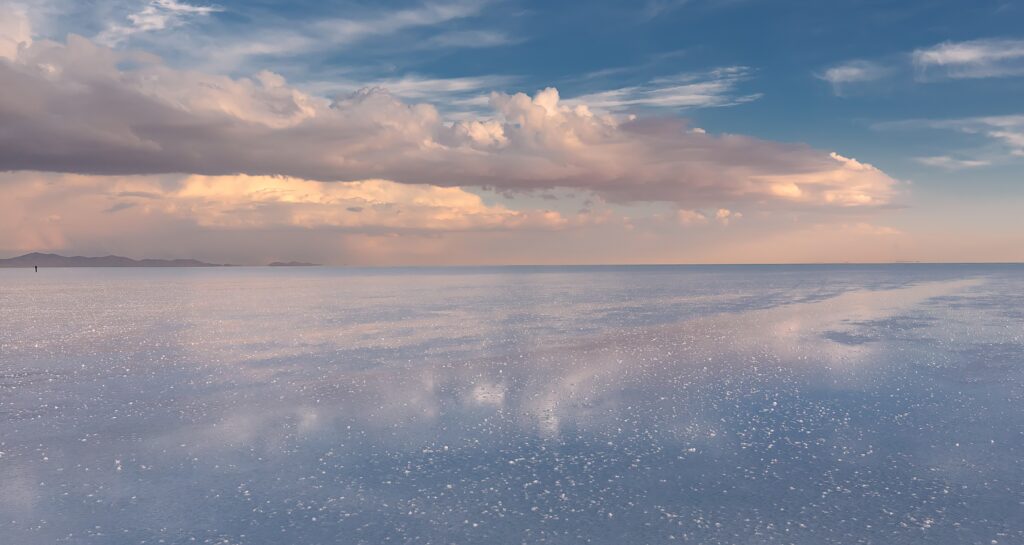
Imagine standing in a place where the ground disappears.
Where the sky is below you.
Where the horizon fades, and you can’t tell where Earth ends and heaven begins.
That’s Salar de Uyuni.
What Is Salar de Uyuni?
Located in southwest Bolivia, Salar de Uyuni is the largest salt flat in the world, covering over 10,000 square kilometers.
During the dry season, it looks like:
- An endless white desert
- Covered in salt patterns
- Stretching as far as the eye can see
But during the rainy season…
It transforms completely.
The Mirror Effect
When a thin layer of water covers the salt flat, something extraordinary happens.
The surface becomes perfectly reflective.
Not slightly reflective.
Not partially reflective.
Perfectly reflective.
The result:
- The sky is mirrored on the ground
- Clouds appear below your feet
- People look like they’re walking on air
It becomes one of the largest mirrors on Earth.
Why Is It So Flat?
The effect works because Salar de Uyuni is incredibly level.
Its elevation varies by less than a meter across its entire surface.
This extreme flatness allows water to spread evenly — creating a flawless reflective layer.
A Photographer’s Dream
Because of its surreal visuals, Salar de Uyuni is one of the most photographed places in the world.
It allows for:
- Perspective illusions
- Floating effects
- Infinite reflections
- Dreamlike landscapes
It’s a place where reality becomes abstract.
Why It Feels Unreal
Most landscapes have depth, texture, and boundaries.
Salar de Uyuni removes all of that.
It erases:
- Horizon lines
- Visual anchors
- Spatial awareness
You’re left in a space that feels infinite.
Almost like stepping into another dimension.
Book a tour here:
#7 – Zhangjiajie Mountains (China)
The Real-Life “Floating Mountains” of Avatar
If you’ve seen the movie Avatar, you probably remember the floating mountains of Pandora — massive rock formations suspended in mist, defying gravity. 🌍 Top 10 Places That Don’t Feel Real 😳
What many people don’t realize is this:
They were inspired by a real place.
What Are the Zhangjiajie Mountains?
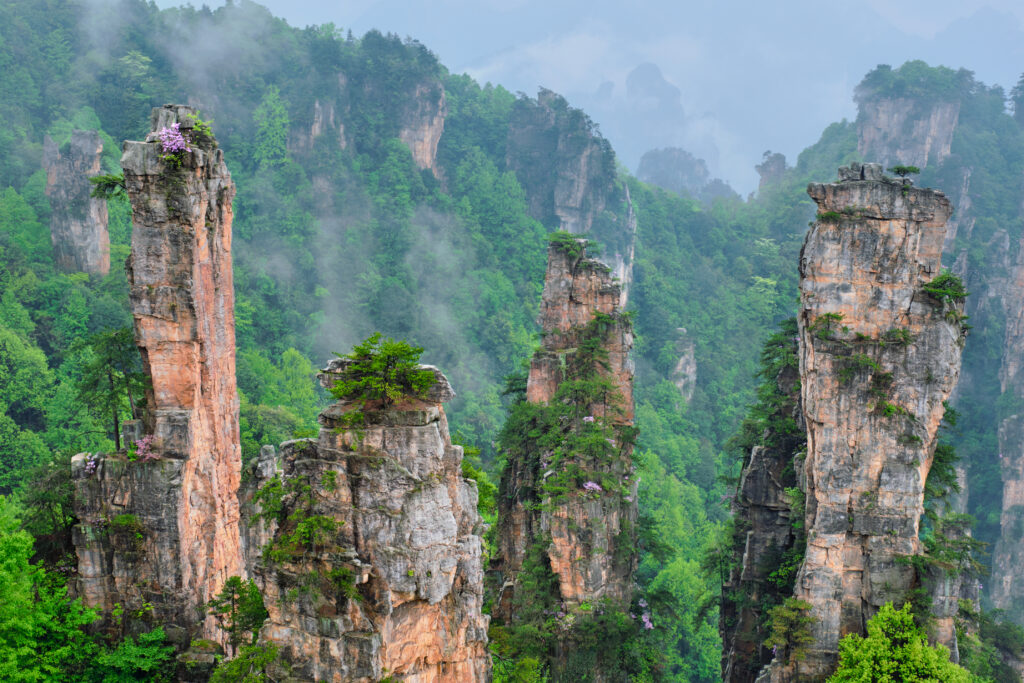
Located in China’s Hunan Province, Zhangjiajie National Forest Park is home to thousands of towering sandstone pillars that rise dramatically from the ground.
These formations are:
- Tall and narrow
- Covered in lush vegetation
- Often surrounded by thick mist
- Seemingly disconnected from the earth below
From certain angles, they look like they’re floating.
How Were They Formed?
The pillars were shaped over millions of years through:
- Erosion from wind and water
- Weathering of sandstone
- Geological uplift
As softer rock eroded away, harder sections remained — forming vertical columns.
Why It Feels Unreal
The magic comes from the atmosphere.
Fog and mist frequently wrap around the peaks, hiding their bases and making them appear suspended in air.
This creates a powerful illusion:
Your brain sees floating mountains — even though they’re grounded.
The Avatar Connection
The filmmakers of Avatar used these mountains as inspiration for the fictional world of Pandora.
In fact, one of the pillars was officially renamed the “Avatar Hallelujah Mountain.”
A Landscape That Defies Gravity (Visually)
Even though physics isn’t actually broken here, it feels like it is.
That’s what makes Zhangjiajie unforgettable. 🌍 Top 10 Places That Don’t Feel Real 😳
#6 – Maldives Water Villas
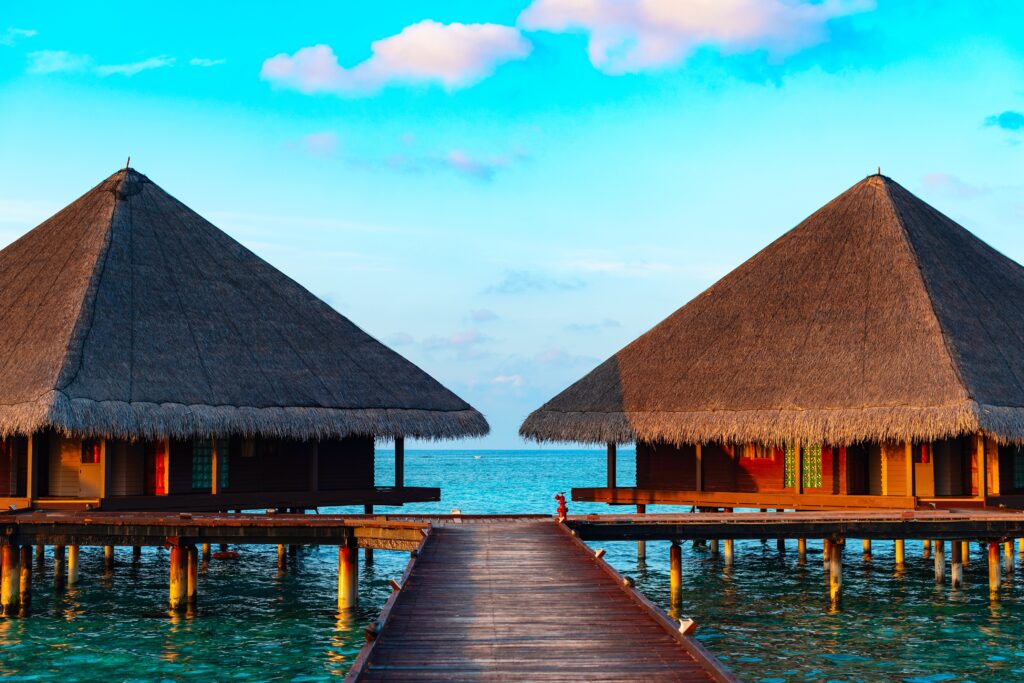
A Place Where Luxury Meets Unreal Clarity
There are beautiful beaches… and then there are the Maldives.
This island nation in the Indian Ocean is famous for something that almost looks fake:
Water so clear, it feels invisible.
What Are Maldives Water Villas?
Across the Maldives, luxury resorts feature overwater villas — houses built directly above the ocean.
These villas include:
- Glass floors
- Private decks
- Direct access to the sea
- Uninterrupted views of turquoise water
From above, they look like they’re floating.
Why Is the Water So Clear?
The clarity of Maldivian water comes from several factors:
- White sandy seabeds that reflect sunlight
- Low levels of pollution
- Minimal river runoff (which usually clouds water elsewhere)
- Calm ocean conditions
The result is water that appears almost surreal.
The Color Palette That Feels Unreal
The ocean here isn’t just blue.
It’s layered:
- Light turquoise in shallow areas
- Deep blue in the distance
- Crystal-clear transitions between shades
It creates a gradient that looks digitally enhanced — but it’s completely natural.
Why It Feels Unreal
In most places, water hides what’s beneath it.
In the Maldives, it reveals everything.
Fish, coral, shadows — all visible from above.
It creates the illusion that the villas are suspended in mid-air rather than resting over water.
A Glimpse Into Another Reality
For many people, this isn’t just a destination — it’s a different version of life.
One where the boundary between land and sea disappears.
#5 – Antelope Canyon (USA)
A Canyon That Looks Like Flowing Fabric
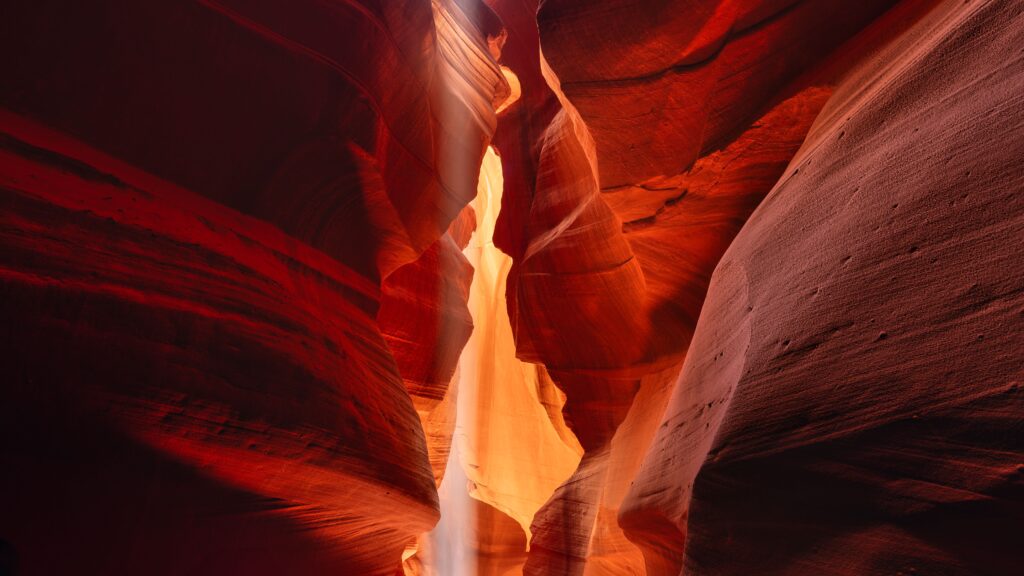
At first glance, Antelope Canyon doesn’t look like rock.
It looks like something soft.
Like silk. Like waves. Like liquid frozen in time.
What Is Antelope Canyon?
Located in Arizona, USA, Antelope Canyon is a slot canyon — a narrow passage carved into sandstone.
It’s famous for:
- Smooth, flowing walls
- Curved, wave-like shapes
- Rich orange and red tones
- Light beams that shine through narrow openings above
How Was It Formed?
Over thousands of years, flash floods carved the canyon.
Water rushed through tight spaces, gradually shaping the rock into fluid, organic forms.
Unlike typical canyons, which feel rugged and sharp, Antelope Canyon feels:
- Polished
- Sculpted
- Almost alive
The Light Phenomenon
One of the most iconic features is the light beams.
At certain times of day, sunlight enters through narrow openings at the top, creating visible shafts of light that illuminate the canyon.
These beams:
- Highlight the curves
- Enhance the colors
- Create a dreamlike atmosphere
Why It Feels Unreal
Rock is supposed to feel solid and rigid.
But here, it looks like it’s moving.
The curves resemble flowing water — even though they’re completely still.
This creates a visual paradox:
Something hard appears soft.
Something permanent appears fluid.
A Natural Work of Art
Antelope Canyon is often described as one of the most photogenic places on Earth.
But photos don’t fully capture it.
Because what makes it truly surreal isn’t just how it looks…
It’s how it feels to walk through it. 🌍 Top 10 Places That Don’t Feel Real 😳
Book here a tour:
#4 – Socotra Island (Yemen)
The Most Alien-Looking Place on Earth
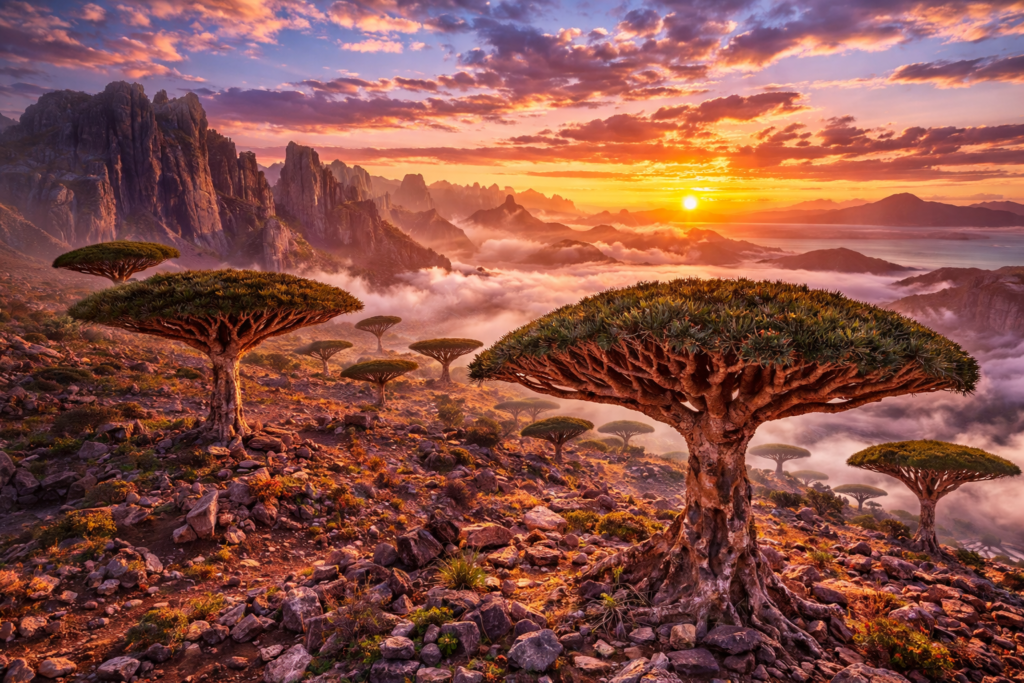
If there is one place on Earth that truly feels like another planet, it’s Socotra.
Often called the “Galápagos of the Indian Ocean,” this remote island is unlike anywhere else on Earth.
What Makes Socotra So Unique?
Socotra is located in the Arabian Sea, isolated for millions of years.
Because of this isolation, life evolved in completely different ways.
The result?
A landscape filled with plants and trees that look biologically impossible.
The Famous Dragon Blood Tree
The most iconic feature is the Dragon Blood Tree.
It has:
- A thick trunk
- A wide, umbrella-shaped canopy
- A structure that looks like it’s upside down
From a distance, it resembles something designed for a sci-fi movie.
When cut, the tree produces a red resin — known as “dragon’s blood.”
Extreme Biodiversity
Socotra is home to:
- Over 700 species found nowhere else on Earth
- Plants that evolved independently from mainland ecosystems
- Unique reptiles, birds, and insects
More than 30% of its plant life is endemic.
Why It Feels Unreal
Most places on Earth share similarities — trees look like trees, landscapes follow familiar patterns.
Socotra breaks all of that.
It feels like Earth… rewritten.
Different rules. Different designs. Different outcomes.
A Glimpse Into Evolution’s Creativity
Socotra shows what happens when nature is left alone for millions of years.
No interference. No mixing.
Just pure, isolated evolution.
The result is something that feels completely foreign.
#3 – Pamukkale (Turkey)
The “Cotton Castle” That Looks Frozen in Time
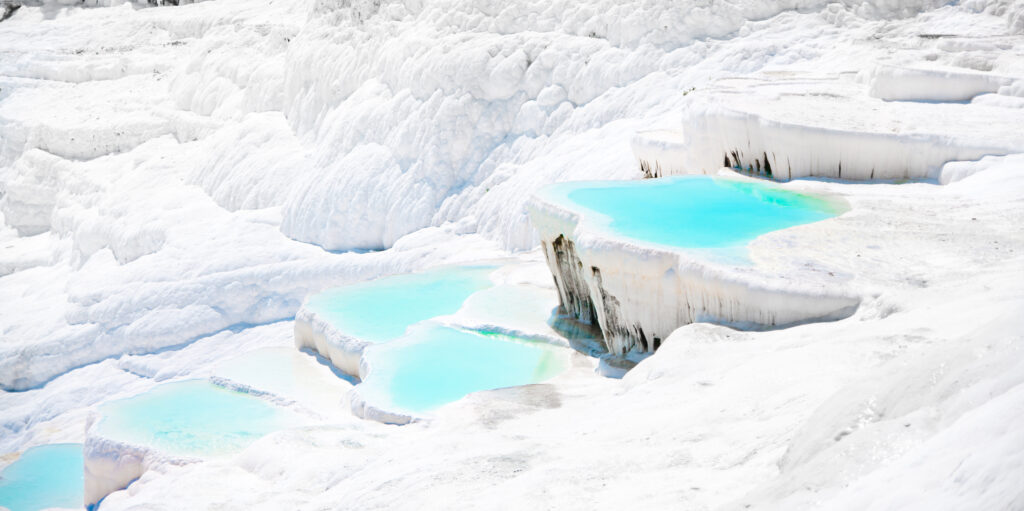
At first glance, Pamukkale doesn’t look like a natural formation.
It looks like snow.
Or ice.
Or a frozen waterfall cascading down a mountainside.
But it’s none of those things.
What Is Pamukkale?
Pamukkale, which means “Cotton Castle” in Turkish, is a series of white terraces formed by mineral-rich thermal waters.
These terraces:
- Cascade down a hillside
- Contain shallow pools of warm water
- Have a bright white appearance
- Contrast beautifully with blue skies
How Was It Formed?
The process is slow but powerful.
Here’s how it works:
- Hot springs rise from underground
- The water contains high levels of calcium carbonate
- As the water flows and cools, it deposits minerals
- Over time, these deposits form solid white terraces (travertine)
This process has been happening for thousands of years.
Why It Looks Like a Frozen Waterfall
The mineral deposits create layers that resemble flowing water — but solidified.
It’s as if a waterfall suddenly stopped mid-motion and turned to stone.
The Thermal Pools
The terraces are filled with warm, mineral-rich water.
Visitors can walk through them, experiencing:
- Soft, smooth surfaces
- Warm temperatures
- Stunning views
Why It Feels Unreal
Our brains associate white landscapes with:
- Snow
- Ice
- Cold environments
But Pamukkale is warm.
That contradiction creates a surreal experience.
It looks frozen — but feels alive.
Book Here:
#2 – Mount Roraima (South America)
The Flat Mountain Above the Clouds
Imagine a mountain with a perfectly flat top.
Now imagine it rising above clouds, isolated from the world below.
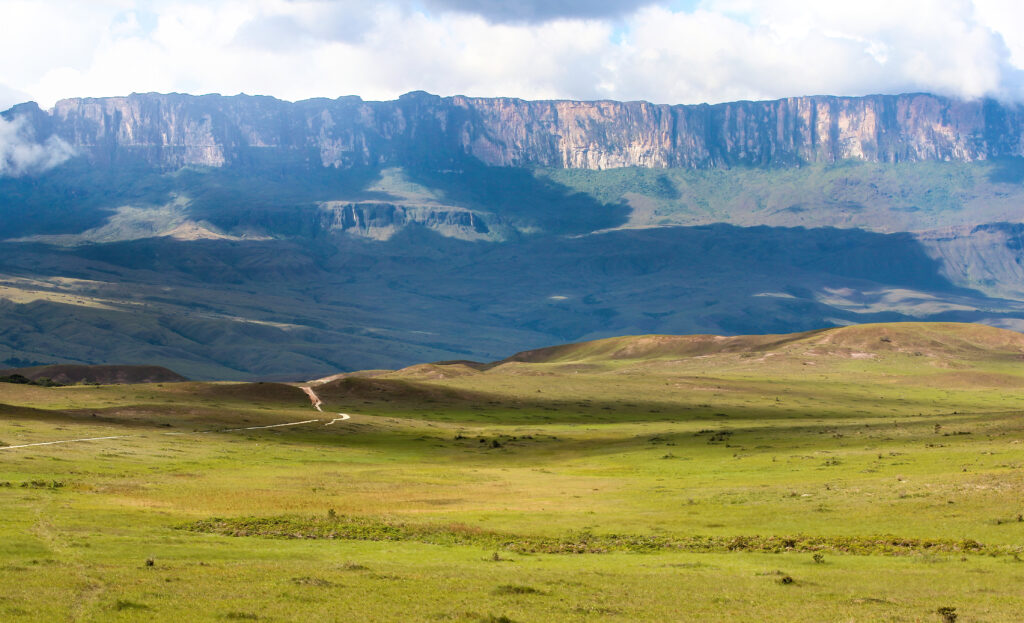
That’s Mount Roraima.
What Is Mount Roraima?
Mount Roraima is a tepui — a type of table-top mountain found in South America.
It sits at the border of:
- Venezuela
- Brazil
- Guyana
And it’s one of the oldest geological formations on Earth.
A Lost World
The top of Mount Roraima is completely different from the surrounding land.
It features:
- Unique ecosystems
- Strange rock formations
- Constant mist and clouds
- Rare plants and animals
Because of its isolation, many species evolved independently.
The Sheer Cliffs
What makes Roraima so dramatic is how it rises:
- Vertical cliffs on all sides
- Thousands of feet high
- Almost impossible to climb without specific routes
It looks like a giant stone island floating in the sky.
Inspiration for Fiction
Mount Roraima inspired:
- Sir Arthur Conan Doyle’s novel The Lost World
- Countless adventure and fantasy stories
Because it truly feels like a place untouched by time.
Why It Feels Unreal
Mountains usually have peaks.
Roraima has a plateau.
Mountains usually blend into landscapes.
Roraima stands alone.
It breaks the visual rules we expect — and that’s what makes it unforgettable.
🥇 #1 – Maadhoo Island (Maldives)
The Beach Where the Ocean Lights Up at Night
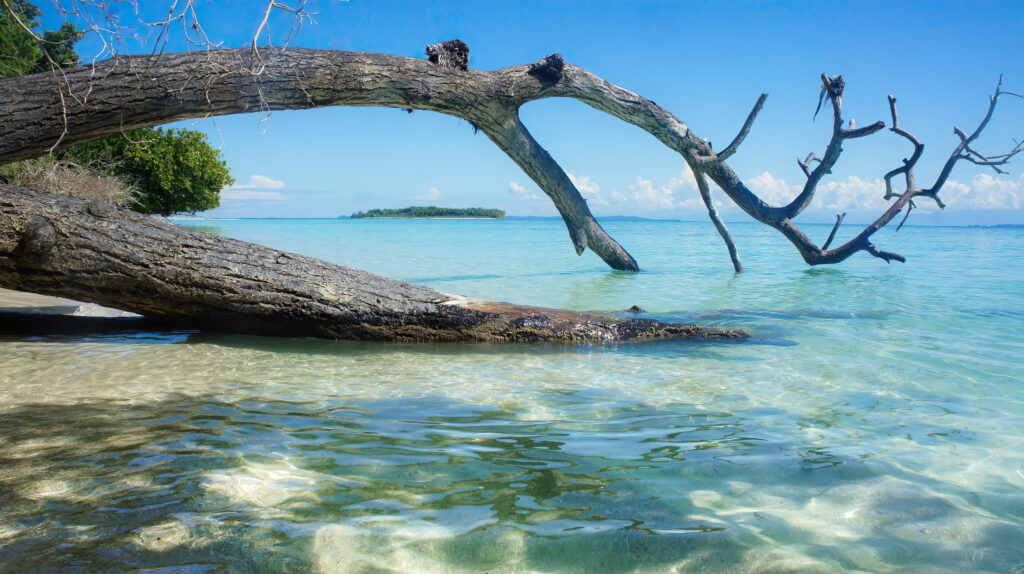
Imagine walking along a quiet beach at night.
The sky is dark. The stars are faint.
And then…
With every step you take, the shoreline begins to glow.
Waves crash softly — and each one lights up in electric blue.
It looks like the ocean is filled with stars.
Welcome to Maadhoo Island. 🌍 Top 10 Places That Don’t Feel Real 😳
What Makes Maadhoo Island So Special?
Maadhoo Island, located in the Maldives, is famous for a phenomenon often called:
“The Sea of Stars”
At night, the water along the shore emits a glowing blue light, creating one of the most magical natural displays on Earth.
It looks like:
- Neon waves rolling onto the sand
- Sparkling lights following your footsteps
- A galaxy reflected in the ocean
And the most incredible part?
This is not artificial.
It’s completely natural.
The Science Behind the Glow
As magical as it looks, there is a scientific explanation.
The glow is caused by bioluminescent plankton, specifically microscopic organisms known as dinoflagellates.
How Does It Work?
These organisms produce light through a chemical reaction.
When the water is disturbed — by:
- Waves
- Movement
- Footsteps
They emit a flash of blue light.
This process is known as bioluminescence.
Why Do They Glow?
The light is believed to be a defense mechanism.
When disturbed, the glow can:
- Startle predators
- Attract larger predators that eat their attackers
- Serve as a warning signal
So what looks like magic…
Is actually survival. Places That Don’t Feel Real
Why It Feels Unreal
We associate glowing light with:
- Technology
- Electricity
- Artificial sources
Not with nature.
Seeing the ocean glow challenges everything we expect.
It creates a moment where your brain struggles to process what’s happening.
Is it real?
Is it an illusion?
Is it safe to touch?
And then you step into the water…
And it lights up around you. 🌍 Top 10 Places That Don’t Feel Real 😳
The Experience: Walking Through a Sea of Stars
Visitors often describe the experience as unforgettable.
Imagine this:
- You walk along the shoreline
- Each step leaves a glowing footprint
- Waves shimmer as they break
- The water sparkles with every movement
It feels like interacting with light itself.
Like walking through a dream.
When Can You See It?
The glowing effect is not constant.
It depends on:
- The presence of plankton
- Water conditions
- Time of year
- Level of disturbance
Typically, the best time is:
- Warm nights
- Calm conditions
- Minimal light pollution
🌍 Top 10 Places That Don’t Feel Real 😳Places That Don’t Feel Real
A Reminder of Nature’s Power
Vaadhoo Island represents something deeper than just beauty.
It shows that nature can:
- Create light without electricity
- Produce effects that rival technology
- Surprise us in ways we don’t expect
It’s a reminder that the most extraordinary experiences on Earth are often the ones we can’t control. 🌍 Top 10 Places That Don’t Feel Real 😳
Final Thoughts: A World More Unreal Than Fiction
We started this journey with a simple idea: 🌍 Top 10 Places That Don’t Feel Real 😳
Some places on Earth don’t feel real.
Now we’ve seen why. 🌍 Top 10 Places That Don’t Feel Real 😳
From #10 to #1, these locations have shown us that reality can be:
- Stranger than fiction
- More beautiful than imagination
- More creative than anything humans design
The Full List Recap
- #10 – Giant’s Causeway (Ireland)
- #9 – Pink Lake (Australia)
- #8 – Salar de Uyuni (Bolivia)
- #7 – Zhangjiajie Mountains (China)
- #6 – Maldives Water Villas
- #5 – Antelope Canyon (USA)
- #4 – Socotra Island (Yemen)
- #3 – Pamukkale (Turkey)
- #2 – Mount Roraima (South America)
- 🥇 #1 – Maadhoo Island (Maldives)
 Related Articles
These Top 10 Places will inspire you to appreciate the wonders of the world.
From the vast landscapes to intricate details, the Top 10 Places are a feast for the eyes.
The beauty of these Top 10 Places is unparalleled.
Each of the Top 10 Places offers a unique perspective on our planet.
Visiting the Top 10 Places is a chance to reconnect with nature.